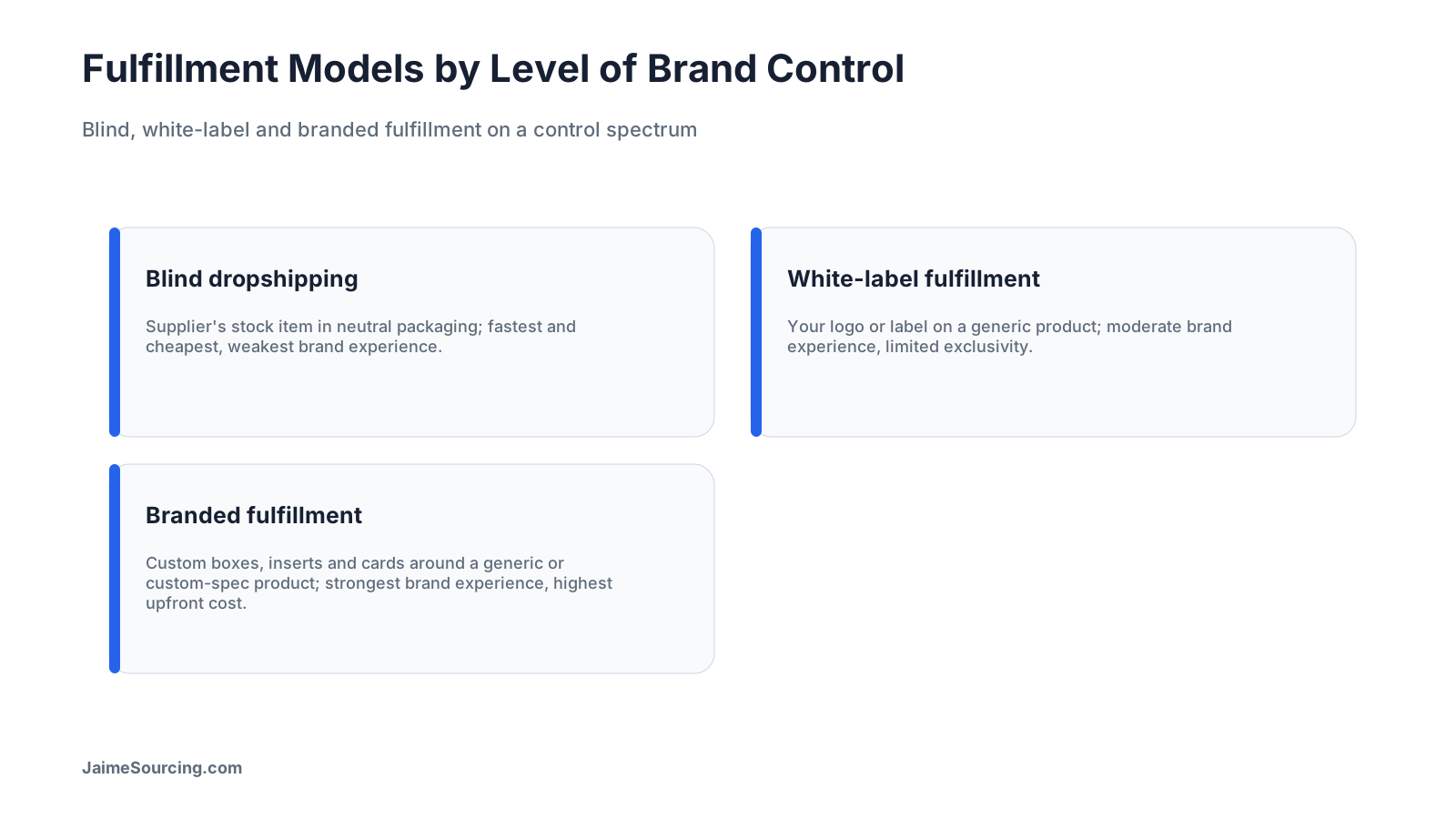
Blind dropshipping ships a generic product in neutral packaging with no seller branding; white-label fulfillment puts your logo on a supplier’s existing generic product; branded fulfillment goes further, adding branded packaging, inserts and sometimes custom specs. For a Shopify reseller, the choice is a trade-off between speed and cost on one side, and brand control, quality risk and per-unit cost on the other. The three models sit on a spectrum of control, and most sellers move from one to the next as volume and margin pressure grow.
Shopify’s own guidance frames the same ladder: standard dropshipping sells the supplier’s product as-is, white-label applies your brand to a generic product that other merchants can also sell under their own names, and private label produces a product to your specifications that others cannot sell. Branded dropshipping is the packaging layer on top—custom boxes, labels, thank-you cards and inserts that make an unbranded shipment feel like your store. Knowing where each model sits prevents the most common mistake: paying for “branding” that never touches the product or the parcel.
The Three Models Side by Side
| Dimension | Blind dropshipping | White-label fulfillment | Branded fulfillment |
|---|---|---|---|
| Product | Supplier’s stock item, unchanged | Generic product with your logo/label | Generic or custom-spec product |
| Packaging | Neutral, often poly bag | Usually neutral; branding optional | Custom box, tissue, inserts, cards |
| Who else sells it | Many resellers | Many resellers (same base product) | Fewer, if specs or MOQ create exclusivity |
| Upfront cost | Lowest | Low to moderate | Highest (tooling, MOQ, packaging runs) |
| Quality control | Minimal; you see what the customer sees | You can request pre-shipment checks | Built into production and inspection stages |
| Brand experience | Weak | Moderate | Strong |
| Best for | Testing demand fast | Building a recognisable store brand | Defending margin and repeat purchase |
The table hides the operational detail, so treat each column as a workflow rather than a label.
Blind Dropshipping: Speed With Almost No Control
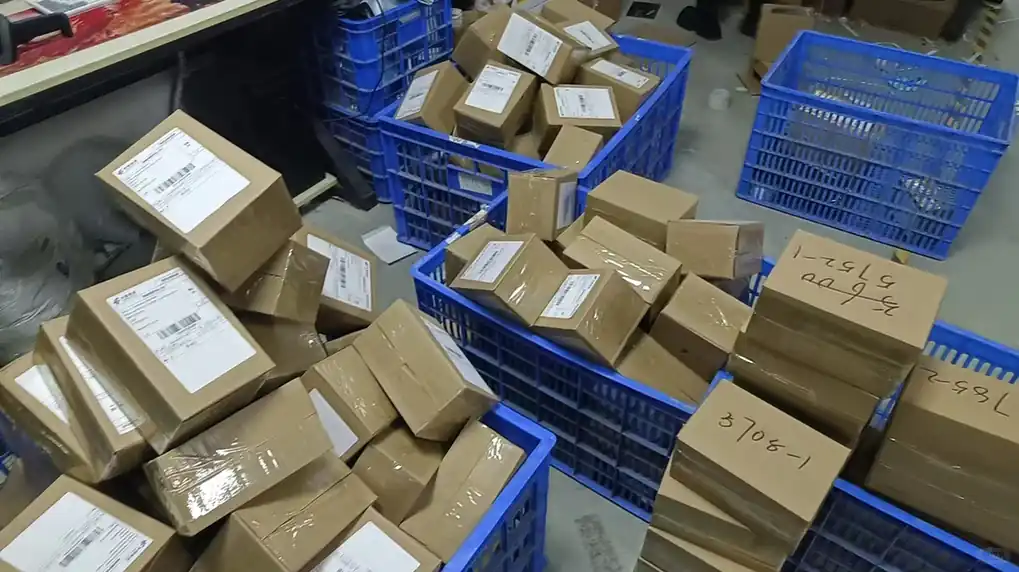
Blind dropshipping means the supplier fulfils your customer’s order directly, in packaging that carries no trace of your store. It is the lowest-friction entry point: no inventory, no upfront production spend, and product development, warehousing and fulfillment costs sit with the third-party supplier. That is useful for validating a product before you commit capital.
The costs are less visible. You cannot inspect what you have not handled, so defect rates surface as customer complaints and refund requests rather than as a pre-shipment decision. Packaging is generic, which weakens unboxing and repeat-purchase signals. And because the same item is available to every other reseller, price competition is structural—there is no product-level reason for a customer to choose you.
If you use this model, the practical controls are supplier-side: request the exact packaging and insert spec in writing, ask for a sample sent to your own address (not a stock photo), and confirm who is responsible for lost or damaged parcels. Shopify’s supplier directories and apps are a reasonable starting point for finding fulfillment partners, but directory listings are not quality evidence.
White-Label Fulfillment: Your Brand on Someone Else’s Product
White-label fulfillment applies your brand and logo to a generic product before it ships. The base product remains available to other merchants under their own brands, so exclusivity is limited—but the customer-facing experience improves, and the cost step-up is usually modest.
Two things are often conflated here. A printed logo on the product is not the same as branded packaging, and neither is the same as a custom formulation or specification. Shopify’s comparison is explicit that white-label products are generic items carrying your brand, while private-label products are manufactured to your specifications or design and are unique to you. If a supplier quotes you “white label” and you expect exclusivity, clarify which of the three you are actually buying.
White-label also changes your QC exposure. Once your logo is on the item, defects become your brand defects. That argues for a defined inspection step before goods leave the factory or warehouse, and for agreeing in writing what happens to rejected units.
Branded Fulfillment: Packaging, Inserts and the Unboxing Layer
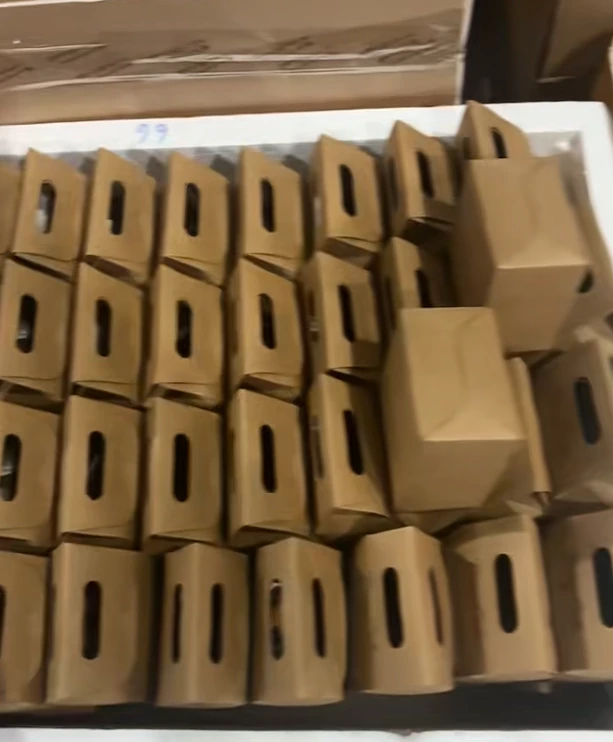
Branded fulfillment customises the parcel—boxes, labels, cards, inserts—so an otherwise generic product arrives as a branded experience. It is the cheapest meaningful differentiator available to a small seller, because packaging cost scales with volume rather than with tooling.
The trade-offs are operational. Custom packaging usually carries a minimum order quantity, so packaging becomes inventory you must store and reorder. Print colours drift between runs, so you need an approved physical proof, not a PDF. And packaging adds dimensional weight, which changes shipping cost—model this before you commit.
Branded fulfillment pairs naturally with consolidation: if you are buying from more than one factory, having goods packed and branded at a consolidation point avoids shipping packaging materials separately. This coordination work is hard to run from another time zone.
Where Quality Control Fits
None of the three models removes the need for inspection; they only change when you can act on it. For blind dropshipping, inspection is largely retrospective. For white-label and branded fulfillment, you can inspect before your brand goes on the goods.
A practical inspection plan uses AQL sampling under ISO 2859-1, the international counterpart of ANSI/ASQ Z1.4. General Inspection Level II is the common default for consumer goods. Defects are classified as Critical (safety or legal issues, typically 0 accepted), Major (functional or visible failures that would trigger a return) and Minor (cosmetic deviations). Critical 0 / Major 2.5 / Minor 4.0 is a widely used starting point, not a universal rule—tighten it for regulated categories and agree the classification with your supplier before production, not after.
Two verification habits matter more than the sampling plan itself. First, confirm the supplier’s legal identity: the Chinese National Enterprise Credit Information Publicity System shows the Unified Social Credit Code, establishment date, registered capital and whether subscribed capital is actually paid in—registered capital is a promise, paid-in capital is money in the bank. Tianyancha and Qichacha surface the same registry data plus shareholder and litigation signals. Second, check that the entity on the contract, the entity on the bank account and the entity on the export documents match.
Landed Cost, Incoterms and Payment Mechanics
Model choice changes your cost base, so price the whole chain. Under EXW, you take on origin handling and export clearance; under FOB, the supplier covers origin charges and export clearance while freight and import duty remain yours; under DDP, the seller quotes a delivered, duty-paid price. DDP is convenient but carries real risk: a “tax-inclusive” quote that under-declares value or uses a non-compliant clearance route can leave you exposed to customs penalties in your own jurisdiction. Ask for the declared value and the importer of record in writing, and check current customs rules for your destination country—US, UK, EU, Canada and Australia each differ.
For payments to Chinese suppliers, T/T is standard. Expect to cover bank charges on both ends unless agreed otherwise, and note that FX exposure sits with whoever holds the currency. Trade Assurance-style platform protection charges a fee and covers only what the order terms document. Pay a company account matching the contracted entity, not a personal account, and agree explicitly whether sample and courier fees are deducted from the bulk order or absorbed.
What to Verify Before You Proceed
- Entity check: Unified Social Credit Code, establishment date, registered vs. paid-in capital on the National Enterprise Credit Information Publicity System; cross-check on Tianyancha or Qichacha.
- Model clarity: written confirmation of whether you are buying generic, white-label or custom-spec goods, and who else can buy the same base product.
- Packaging spec: physical proof approved, MOQ and reorder lead time stated, dimensional weight impact modelled.
- Inspection terms: AQL level, defect classifications and reject handling agreed before production.
- Incoterm and importer of record: named in the contract, with declared value stated for DDP quotes.
- Payment details: beneficiary name matches the contract entity; fees and FX responsibility allocated.
FAQ
Is blind dropshipping the same as white-label dropshipping?
No. Blind dropshipping ships the supplier’s generic product in neutral packaging, while white-label applies your brand or logo to that same generic product before it ships. White-label costs more but gives you a customer-facing brand; blind dropshipping is faster and cheaper but leaves you competing on price alone.
Can I get branded packaging with dropshipping?
Yes, but it is a separate layer from the product itself. Branded dropshipping adds custom boxes, labels and inserts to an otherwise generic item, and typically requires a packaging minimum order quantity. Confirm the physical proof and the added shipping weight before committing.
Does white-label mean the product is exclusive to me?
Usually not. White-label products are generic items carrying your brand, and other merchants can sell the same base product under their own names. True exclusivity generally requires private-label production to your specifications, which brings minimum order quantities and longer lead times.
How do I check a Chinese supplier before paying?
Verify the legal entity on the National Enterprise Credit Information Publicity System, checking the Unified Social Credit Code, establishment date and paid-in capital, then cross-check on Tianyancha or Qichacha. Confirm the contract, bank account and export documents name the same entity before sending any deposit.
Managing the Gap Between You and the Factory
Whichever model you choose, the recurring risks are the same: quality drifts between the approved sample and the production run, follow-ups stall when nobody is physically at the factory, and a twelve-hour time difference turns a two-minute question into a two-day delay. These are distance problems, not contract problems, and they get worse as you move from blind dropshipping toward branded fulfillment.
That is where having a ground team in China changes the economics. Jaime Sourcing supports overseas buyers with supplier research and verification, inspection and quality control, consolidation, packing and shipment coordination—the hands-on steps between placing an order and receiving goods that match what you approved. If you are weighing a move from blind dropshipping to white-label or branded fulfillment, start with a supplier check or a workflow review before you commit capital.
Turn your product and order requirements into a controlled sourcing brief.
Share the product, supplier link, quantity, destination and current order stage. We will identify the practical verification, quality-control, packing and shipping steps.