Cargo insurance pays you for loss, damage or theft of goods in transit, up to the insured value — but only for events the policy covers, and only if you can prove what was shipped, what arrived, and when you reported it. For a Shopify reseller importing from China, the practical answer is this: buy all-risks cover where the value justifies it, treat carrier liability as a rounding error rather than protection, and build an evidence file before the container leaves the factory. Most claim disputes are lost on documentation and timing, not on the merits of the loss.
This guide explains what international freight insurance covers, where the gaps sit, and which documents and photos you need when something goes wrong.
What Cargo Insurance Covers — and What It Doesn’t
Cargo insurance protects goods against loss, damage and theft during transport, and pays out at the declared value of the goods rather than the carrier’s limited liability. Premiums are typically a small fraction of the insured value; one freight forwarder quotes all-risks cover at roughly 0.3–0.5% of insured value for general cargo, while noting that actual rates depend on the goods, route and policy terms. Treat that figure as an indicative benchmark to test against your own quotes, not a rate you can assume.
Coverage varies widely between policies, but commonly cited insured events include natural disasters, transport accidents, abandonment of cargo, customs rejection, war and piracy. All-risks policies — the broadest common form — extend to physical damage in handling, partial or total loss, theft in transit or storage, and marine perils such as sinking, collision or grounding, subject to the policy’s exclusions.
The exclusions matter just as much. Problems within the shipper’s control — inadequate packaging, product defects, dangerous goods — are commonly excluded. Wear and tear, and late or weak documentation, are frequently cited causes of rejected claims. If you sell fragile ceramics or lithium-battery products, ask the insurer in writing how those specific goods are treated before you book.
Carrier Liability Is Not Insurance — Know the Gap
A common and expensive misconception is that the freight forwarder or carrier already protects you. In practice, national and international law and convention limit carrier liability, entitling you to a relatively small compensation. One forwarder puts carrier liability at roughly US$2–22 per kilogram regardless of actual value, meaning a US$10,000 shipment might recover only US$200–2,000. That range is a useful sanity check, not a contractual figure — confirm the actual limit in your carrier’s terms.
The second gap is the trade term. Under FOB and CIF, risk transfers to you at defined points, so you should not assume the supplier’s insurance protects your interest. If you buy on EXW, you carry risk from the factory door; on FOB, from the point goods are loaded on board; on DDP, the seller nominally carries risk to your door but the insurance behind it may be minimal or unverifiable. Always check which Incoterm you signed and where risk actually passes.
| Trade term | Who arranges main carriage | Where risk typically passes to buyer | Who should insure |
|---|---|---|---|
| EXW | Buyer | At seller’s premises | Buyer, from collection |
| FOB | Buyer | When goods are on board at origin port | Buyer, from loading |
| CIF | Seller | When goods are on board at origin port | Buyer should confirm seller’s cover and consider own policy |
| DDP | Seller | At named destination | Buyer should verify the seller’s policy actually exists and covers full value |
This table reflects general Incoterms logic; confirm the exact risk point in your contract, because DDP arrangements in particular are sometimes described loosely and the underlying insurance may not match the promise.
The Claim Evidence File: What Insurers Actually Ask For
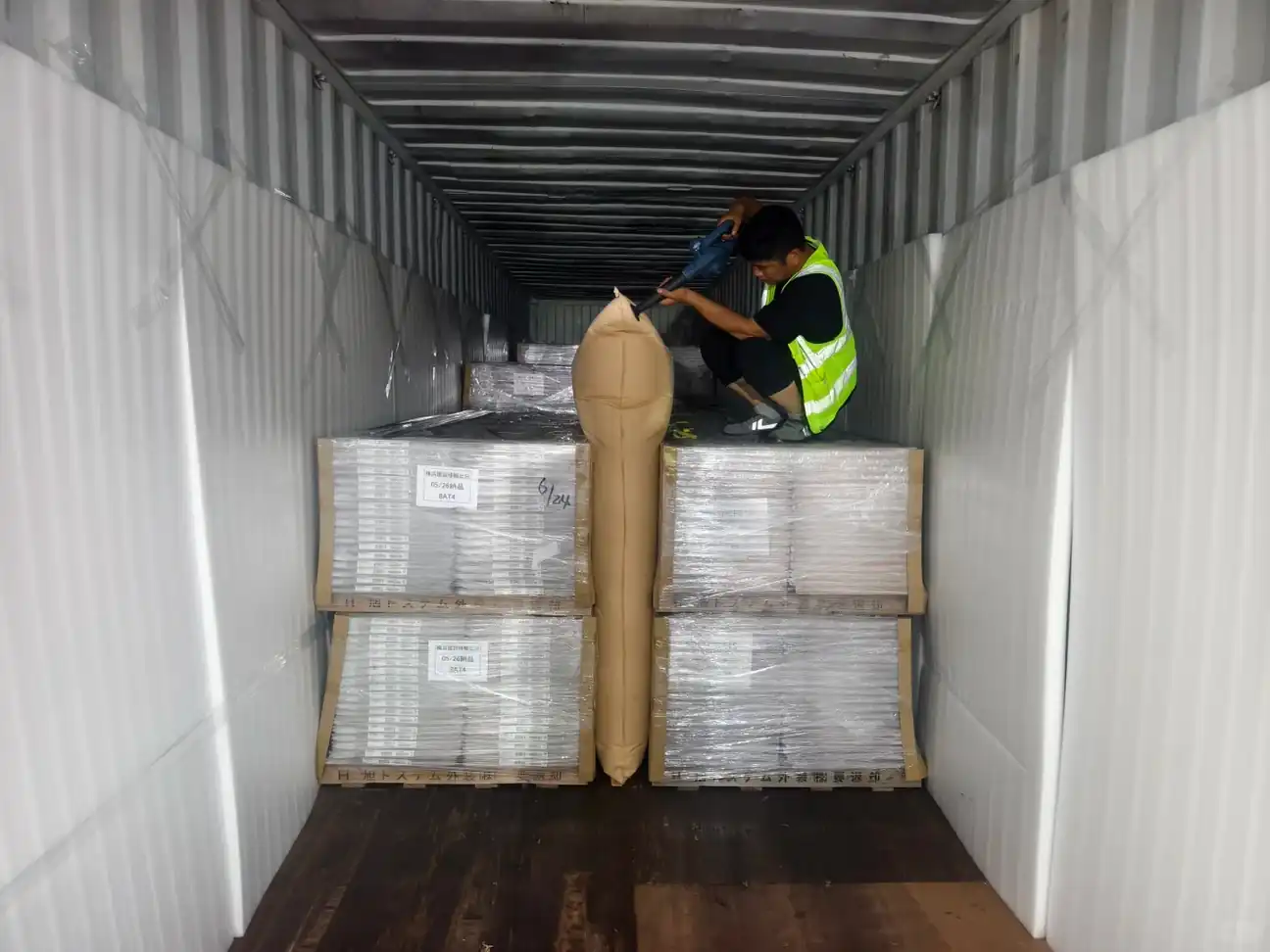
Successful claims are won on a complete, timestamped evidence file. Insurers and forwarders consistently ask for the same core set: bill of lading, commercial invoice, packing list, photographs and an inspection or survey report. Build these before the shipment moves, not after damage is discovered.
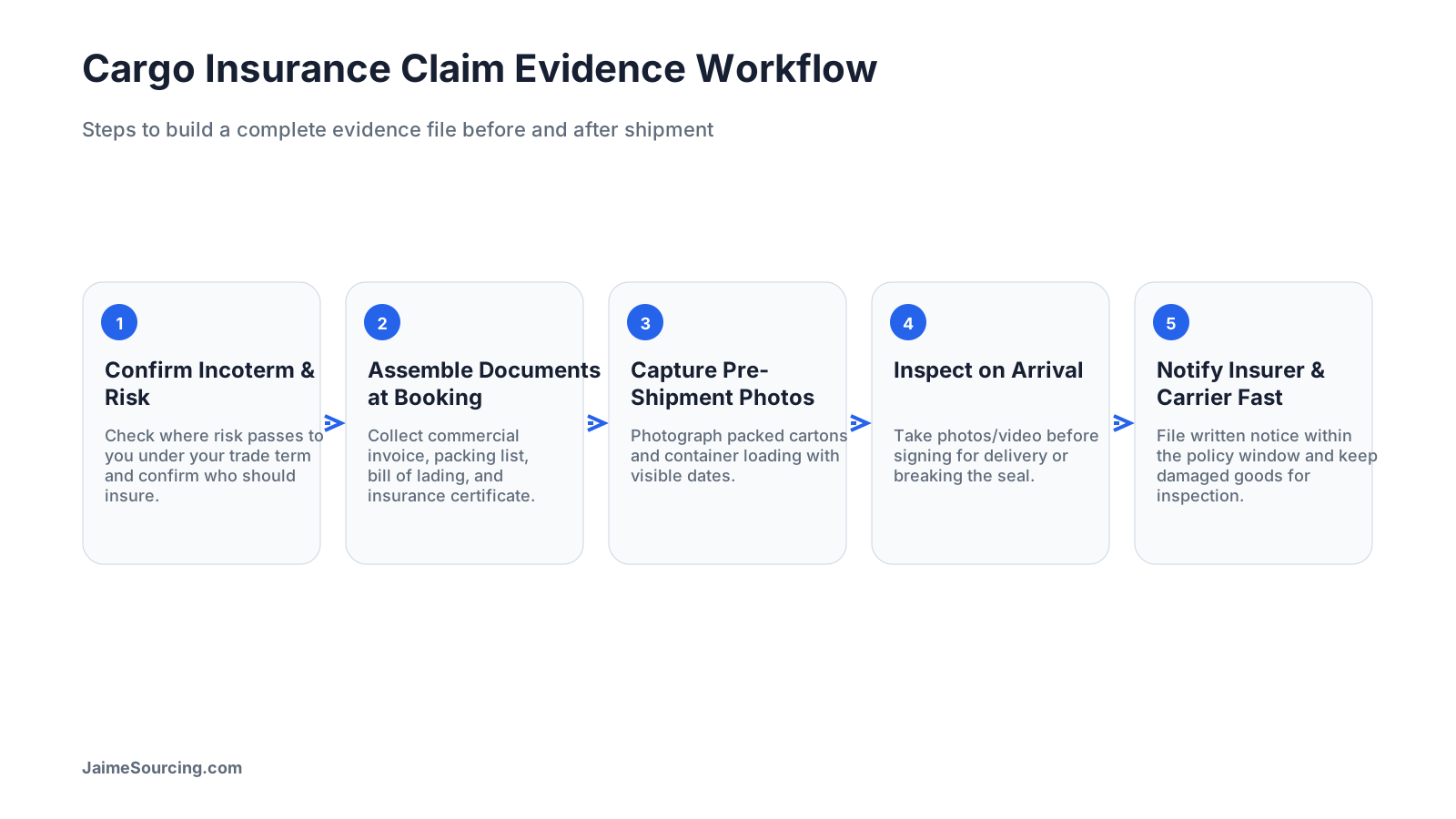
Documents to assemble at booking and shipping:
- Commercial invoice showing unit values and total declared value — this anchors the claim valuation, which is typically invoice value plus freight and insurance cost.
- Packing list with carton counts, dimensions and weights, matching what the factory actually loaded.
- Bill of lading or air waybill, clean and consistent with the invoice.
- The insurance certificate or policy schedule, showing insured value, coverage type and deductible.
- Pre-shipment photos of packed cartons and container loading, ideally with dates visible.
Evidence to capture at arrival:
- Photos and video of the pallet, carton and product condition before you sign for the delivery or break the seal, where possible.
- A written notice of loss to the carrier and insurer within the policy’s notification window — one source advises formal notice within 24–72 hours and notes that policy deadlines commonly run 3–30 days. Check your own policy wording; these windows are contractual, not universal.
- A third-party survey or inspection report for material losses.
- Repair or replacement quotes, or a salvage/disposal record if goods are unsalvageable.
Keep the damaged goods available for inspection until the insurer releases them. Discarding them early is one of the fastest ways to weaken a claim.
Timing, Valuation and the Mistakes That Sink Claims
Three failure modes account for most rejected or reduced claims.
Late notification. Insurers impose notice deadlines, and delay is repeatedly cited as a leading cause of rejection. Put a calendar reminder for the day your shipment is due to arrive, and inspect within 24 hours of delivery.
Weak or inconsistent paperwork. If the invoice value, packing list and bill of lading disagree, the insurer will question the declared value. One source notes that incomplete documentation underpins a large share of rejections — treat document consistency as a QC step in its own right.
Misunderstanding what “all risks” means. All-risks is broad but not unlimited; exclusions for packaging, inherent vice and delay still apply. Read the exclusions schedule before you ship, and ask the insurer to confirm in writing that your specific product category is covered.
Valuation is also worth planning. Claims are generally assessed on invoice value plus freight and insurance cost, and some all-risks policies cover goods plus freight plus a margin of expected profit. If you sell at a high markup, ask whether your policy includes a profit margin — otherwise a total loss reimburses your cost, not your lost revenue.
Practical Steps for Shopify Resellers and Small Importers
You do not need a logistics department to get this right. A repeatable workflow is enough.
- Decide per shipment, not per year. Low-value, high-frequency parcels may sit within a courier’s declared-value protection; high-value or fragile consignments justify a standalone policy. Ask yourself: if this shipment vanished, could I absorb it? If not, insure it.
- Confirm the Incoterm in writing before the PO is placed, and note where risk passes.
- Request the insurance certificate from your forwarder or broker and check insured value, coverage type and deductible against your invoice.
- Standardise pre-shipment photo evidence. Ask your supplier or inspection partner to photograph packed cartons, labels and container loading with a date reference.
- Inspect on arrival and notify fast. Photograph before unpacking, notify the carrier and insurer within the policy window, and keep the goods.
- Keep a claim file template with the document checklist above so nothing is missing under pressure.
If you are consolidating multiple suppliers into one shipment, confirm that the policy covers the consolidated consignment and that each supplier’s cartons are itemised on the packing list — a consolidated shipment with a vague packing list is harder to claim against.
What to Verify Before You Proceed
Before you rely on any insurance arrangement, verify these points directly:
- The policy, not the promise. Ask for the certificate or schedule and read the exclusions and deductible.
- The insured party. Confirm the policy names your company or assigns benefits to you; a supplier’s policy may not pay you.
- The declared value basis. Confirm whether it is invoice value, invoice plus freight, or includes a profit margin.
- The notification window. Note the exact deadline in days and diarise it.
- The carrier’s liability limit in your booking terms, so you understand the gap.
- The supplier’s identity and standing, if you are also assessing whether the factory is real. For mainland Chinese suppliers, cross-check the company name against the Chinese National Enterprise Credit Information Publicity System, and use Tianyancha or Qichacha for a second view. Read registered capital alongside subscribed versus paid-in capital — a high registered figure with little paid-in capital tells you less than it appears to. Check the establishment date and the Unified Social Credit Code against the name on your invoice and contract; a mismatch is a red flag worth resolving before you pay a deposit.
- Product compliance for your destination. Insurance does not cure a customs problem. For the US, UK, EU, Canada and Australia, check the current official rule for your product category, labelling and import documentation with the relevant customs authority — rules change and this article does not substitute for them.
FAQ
Does cargo insurance cover theft during transit?
Yes, theft in transit or storage is commonly covered under all-risks policies, provided you report it within the policy’s notification window and document the loss. Photograph seals, packaging and any evidence of tampering immediately, and file notice to the carrier and insurer the same day. Keep the packaging, since it is often the only physical evidence of how entry was made.
What documents do I need to file a freight claim?
The core set is bill of lading, commercial invoice, packing list, photographs and an inspection or survey report. Add the insurance certificate, notice of loss and any repair or replacement quotes. Insurers may request more, so keep originals and a dated copy of everything you send.
Is carrier liability enough instead of buying insurance?
Usually not. Carrier liability is limited by law and convention to a relatively small amount per kilogram, often far below the goods’ actual value. For high-value, fragile or time-critical shipments, standalone cargo insurance is the only way to recover close to full value. Confirm the exact limit in your booking terms rather than assuming a figure.
When should I notify the insurer after damage is found?
Notify as soon as damage is discovered — one source advises formal notice within 24–72 hours, with policy deadlines commonly running 3–30 days. These windows are contractual, so read your own policy. Late notice is one of the most common reasons claims are rejected or reduced.
Does my supplier’s insurance protect my shipment?
Not necessarily. Under FOB and CIF, risk transfers to you at defined points, so the supplier’s cover may not pay your loss. Even under DDP, verify that a real policy exists and covers full value. Ask for the certificate and confirm you are the beneficiary or assignee.
A note on distance and drift. Insurance protects the value of your goods, but it does not stop quality drifting between the approved sample and the shipped batch, and it does not chase a factory for a corrected packing list at 2am your time. Those problems are solved on the ground in China, in person and in the right time zone. Jaime Sourcing supports overseas buyers with supplier research, verification, inspection, quality control, consolidation, packing and shipment coordination — the ground team that keeps your evidence file complete and your factory accountable. If you would like a supplier check or a review of your sourcing and shipping workflow, talk to Jaime Sourcing.
Turn your product and order requirements into a controlled sourcing brief.
Share the product, supplier link, quantity, destination and current order stage. We will identify the practical verification, quality-control, packing and shipping steps.