Before you pay a deposit to a new Chinese supplier, confirm that the company you are talking to is the same legal entity that will sign the contract, stamp the invoice and receive your money. A Chinese business license (business license, yíngyè zhízhào) is the starting point, but the document itself is only a claim until you match it against the official registry. Take the Chinese company name and the 18-character Unified Social Credit Code (Unified Social Credit Code, USCC) from the license, look them up on the National Enterprise Credit Information Publicity System (GSXT, gsxt.gov.cn), and compare status, scope, address and legal representative against every commercial document in the deal.
This guide was reviewed on November 8, 2026. Regulations, tariff treatment and platform rules can change. Confirm the current requirements with the destination-country authority, customs broker or qualified compliance adviser before placing an order.
What a Chinese Business License Actually Tells You
A business license is a registration record, not a quality certificate, credit rating or guarantee of manufacturing capability. It tells you who the registered entity is, where it is registered, what it is permitted to do, and whether it is still active. For an overseas buyer, the most useful fields are:
- Unified Social Credit Code (USCC): an 18-character identifier printed at the top of modern licenses. Under GB 32100-2015 it encodes the registration authority, entity type, region, former organisation code and a check digit; the letters I, O, Z, S and V are never used.
- Chinese registered name: the legal name, which may differ completely from the English trade name, website brand or Alibaba storefront name.
- Registration status: should show as operating normally (active/operating). Suspended, revoked or deregistered status is a stop signal.
- Business scope (business scope): the activities the entity may legally carry out. If you are buying electronics, toys or chemicals, check that the scope covers them.
- Registered address and legal representative: useful for matching against contracts, invoices and factory addresses.
- Establishment date and registered capital: context, not proof of strength. Registered capital is the amount shareholders have committed to contribute, not cash in the bank; under the 2023 Company Law, limited liability shareholders may have up to five years to pay it in, and paid-in amounts can be checked on GSXT.
Registered capital is not a proxy for reliability. A company with high registered capital but little paid-in capital and a short operating history may be less substantial than the number suggests. Treat it as one data point alongside status, scope, history and physical verification.
Step-by-Step: Check a Chinese Business License as a Foreign Buyer
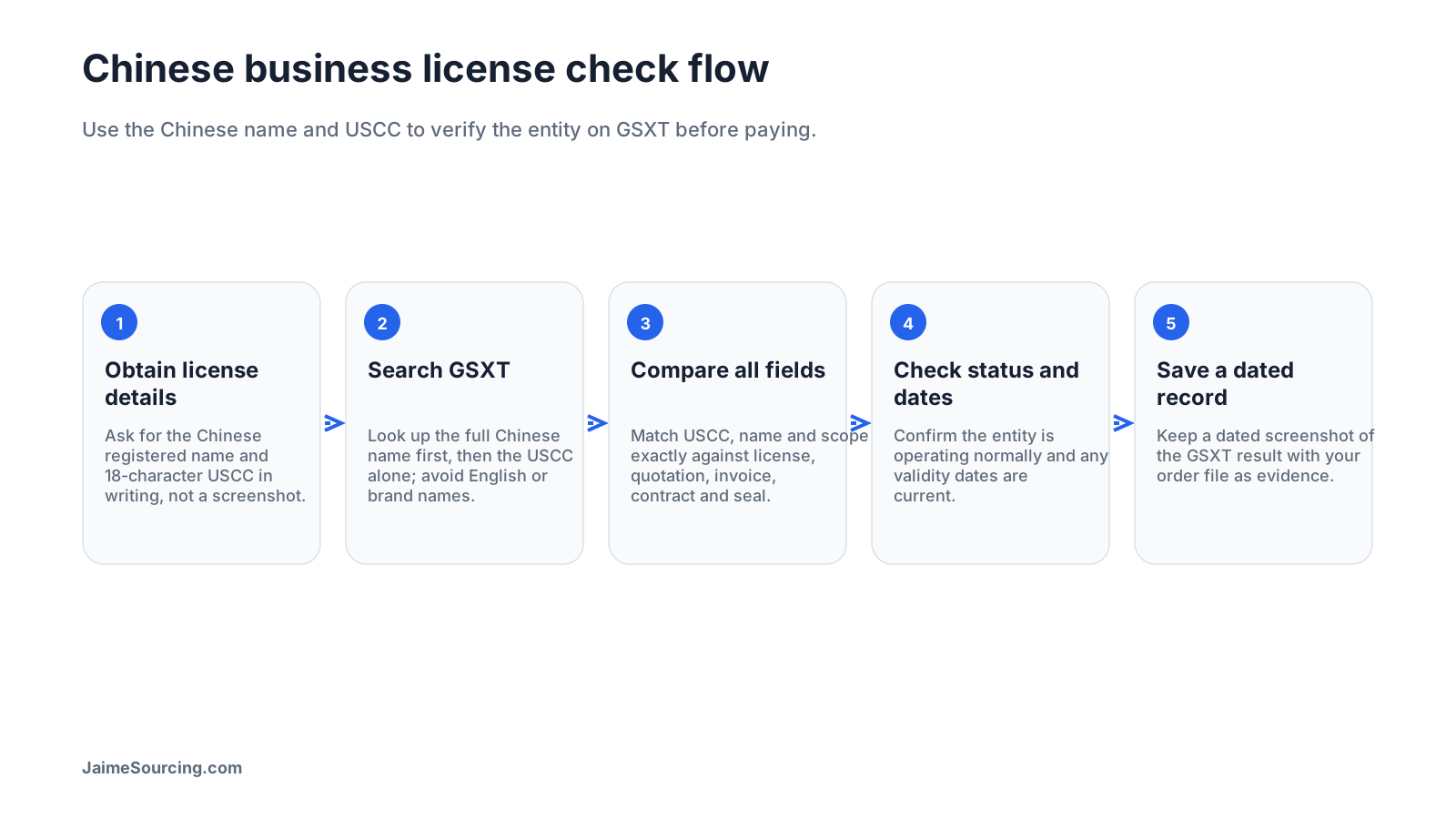
The official free route is GSXT, operated by the State Administration for Market Regulation. Repeat this workflow for every new supplier and every material change in the deal.
- Ask for the license itself. Request a clear colour image or PDF showing the full document, not a cropped screenshot. Ask for the Chinese name and USCC in writing in the same email.
- Search by the exact Chinese name first, then by USCC. Do not start with the English trade name, a brand name or a Chinese abbreviation; these often return no result even when the company is legitimate. If the name search fails, search the 18-character code on its own.
- Compare field by field. Check that the Chinese name, USCC, legal representative, registered address and status on GSXT match the license image exactly. A single differing character in the USCC is a red flag, not a typo to wave through.
- Read the business scope against your product. If the scope does not cover the goods you are importing, ask the supplier to explain and, where relevant, involve a compliance adviser before ordering.
- Check change records and abnormal listings. Look for recent changes of legal representative, address or name, and for any “abnormal operations” (abnormal operations) entries. Frequent changes are not proof of fraud, but they deserve a written explanation.
- Cross-check the commercial documents. Put the license next to the quotation, proforma invoice, contract, company chop (company chop) and bank account details. The contracting entity, the chop and the receiving account should point to the same legal person.
- Escalate to physical verification for high-value or first orders. A registry check confirms the entity exists; it does not confirm that the factory, warehouse or production line exists. An on-site visit or third-party verification closes that gap.
Commercial databases such as Qichacha, Tianyancha and Aiqicha aggregate registration, shareholder, change and risk information and can speed up research. They are secondary tools; the official GSXT record is the reference point when the two disagree. GSXT and some government portals require JavaScript and may be slow or partially inaccessible from outside mainland China. If a page will not load, try again later or ask your China-based representative to capture the record with a timestamp.
Reading the Unified Social Credit Code and Common Mismatches
The USCC is the single most useful identifier because it ties the license, the registry record, the contract and the bank account together. Many disputes do not begin with quality problems; they begin with entity confusion — an English name on the contract, a different Chinese company on the chop, and a third-party account receiving payment.
Watch for these patterns:
| Red flag | What it can indicate | Practical response |
|---|---|---|
| USCC missing, incomplete or one character different from GSXT | Altered or fabricated license image | Do not pay; request a fresh license image and re-check GSXT |
| English trade name used as the contracting party | Brand or trading name is not the legal entity | Ask for the Chinese registered name and USCC in writing |
| Contract signed by a Hong Kong company, production by a mainland factory, payment to a third party | Unclear trading structure | Request a written explanation, authorisation or joint liability arrangement |
| Payment requested to a personal account | Weak link between payment and contracting entity | Insist on the registered corporate account or documented authorisation |
| Business scope excludes your product category | Possible customs or compliance problem | Clarify scope, or reconsider the supplier |
| Status shows revoked, suspended or abnormal | Entity may not be able to trade normally | Stop and verify before any deposit |
A Hong Kong trading company is not inherently a problem. The issue is whether the structure is documented: who signs, who receives payment, who manufactures, who delivers and who carries quality responsibility. If the answer is “different companies for each step”, get it in writing before you pay.
Registered Capital, Status and Scope: What Matters and What Doesn’t
Three fields cause the most confusion among overseas buyers.
Registered capital versus paid-in capital. Registered capital is a subscription commitment by shareholders, not proof that funds are available. Paid-in capital is what has actually been contributed, and it can be checked on GSXT. A high subscription figure with low paid-in capital and a recent establishment date tells you less than a modest figure with a long operating history and consistent filings.
Registration status. “Operating” or “in existence” is what you want to see. Statuses indicating revocation, cancellation or abnormal operations mean the entity may not be able to perform the contract normally. Status can change between your check and your shipment, so re-check before final payment and before shipment.
Business scope. The scope defines permitted activities. It is not a capability audit, but a mismatch between scope and product can create problems at customs or with your own compliance obligations. For regulated categories, confirm the specific licensing requirements in the destination market as well as in China.
None of these fields replaces a factory audit, a sample evaluation or a production inspection. They answer “who is this entity and is it active?”, not “can it make my product to specification?”
Where the License Check Fits in Your Quality and Payment Workflow
A license check is one control in a sequence. For a Shopify reseller or small brand, a workable sequence is:
- Supplier research and license check before any deposit.
- Sample order with written specifications, and a clear agreement on who pays sample and courier costs.
- Payment controls: pay the registered corporate account by T/T, confirm bank charges are split as agreed, and note that FX exposure sits with whichever party bears conversion. If a platform escrow or Trade Assurance service is used, read the fee terms rather than assuming protection is free.
- Incoterm clarity: under EXW the buyer carries origin charges and export responsibility; under FOB the supplier handles export clearance and origin charges up to the vessel; under DDP the seller arranges delivery and duty. Be cautious with unusually cheap “tax-inclusive DDP” offers, because non-compliant customs declarations can create problems for the importer of record.
- Pre-shipment inspection using a defined sampling plan. AQL inspection commonly follows ISO 2859-1 / ANSI/ASQ Z1.4 at General Inspection Level II, with Critical, Major and Minor defect classes. Critical 0 / Major 2.5 / Minor 4.0 is a common starting example, not a universal rule; the right limits depend on your product and risk tolerance.
- Consolidation and shipping coordination once goods pass inspection.
The license check protects the payment and legal side. Inspection protects the product side. Buyers who skip the first often discover the problem only when a claim needs to be filed against an entity they cannot clearly identify.
What to Verify Before You Proceed
- The Chinese registered name and 18-character USCC match exactly across the license image, GSXT record, contract, proforma invoice and company chop.
- GSXT shows the entity as operating normally, with no unexplained abnormal-operation entries or recent changes of legal representative or address.
- The business scope covers your product category, or the supplier has explained any gap in writing.
- The bank account receiving your deposit belongs to the contracting entity, or a written authorisation explains the third-party or Hong Kong structure.
- Registered capital, paid-in capital and establishment date have been read as context, not as a guarantee.
- A physical verification, audit or inspection plan is in place for first orders or high-value shipments.
- Destination-country import requirements, including any product-specific licensing, have been confirmed with a customs broker or compliance adviser.
FAQ
Can a foreign buyer check a Chinese business license for free?
Yes. The National Enterprise Credit Information Publicity System at gsxt.gov.cn is the official free registry, searchable by Chinese company name or USCC. Commercial databases can add convenience, but the official record should be your reference when results differ.
Why does my supplier’s English company name not appear in the Chinese registry?
English names are usually trade names or brand names, not the registered legal name. Search using the exact Chinese name on the license, then the 18-character USCC, rather than the English name or a Chinese abbreviation.
Is a Hong Kong company with a mainland factory a red flag?
Not by itself. The real question is whether the structure is documented: who signs the contract, who receives payment, who manufactures and who is responsible for quality. Ask for written clarification and, where appropriate, authorisation or joint liability arrangements.
Does a valid business license prove the factory is reliable?
No. A license confirms registration, status and permitted scope, not production capability, quality systems or financial strength. Pair the registry check with sample evaluation, factory verification and pre-shipment inspection.
How often should I re-check a supplier’s license?
Re-check before each significant payment and before shipment, and whenever the supplier’s name, bank details, address or legal representative changes. Registry status and scope can change after your initial check.
Managing Distance, Quality Drift and Follow-Ups
A license check answers the identity question, but it does not close the distance between your desk and a production line in China. Quality drift between the approved sample and mass production, missed follow-ups across time zones, and the difficulty of visiting a factory in person are the day-to-day risks that erode margin for small ecommerce brands.
Jaime Sourcing works as a buyer’s ground team in China, supporting supplier research, verification, inspection, quality control, consolidation, packing and shipment coordination. If you are evaluating a new supplier or reviewing an existing sourcing workflow, bring us the license details and the commercial documents and ask for a supplier check or workflow review before you place the next order.
Turn your product and order requirements into a controlled sourcing brief.
Share the product, supplier link, quantity, destination and current order stage. We will identify the practical verification, quality-control, packing and shipping steps.