A supplier quote of “about 30 days by sea” is a starting point, not a delivery date. For a Shopify reseller restocking from China, the number you need is door-to-door transit time — from your supplier’s loading dock to your 3PL or garage — built from a port-to-port sailing time plus several separate legs that each carry their own delay risk. Published averages put China-to-US West Coast port-to-port sailing at roughly 15–20 days, while full door-to-door delivery typically runs 25–40 days once port handling, customs and inland transport are added. Know which number you are being quoted, then plan the buffer yourself.
Why the Two Numbers Are Not Interchangeable
Port-to-port (P2P) covers only the ocean leg: the container is loaded at the origin port and discharged at the destination port. Everything before and after — trucking to port, export clearance, import clearance, drayage, rail — sits outside that figure. Door-to-door (D2D) wraps the whole chain into one responsibility, which is why it is longer but more controllable.
The gap is not trivial. One logistics breakdown estimates door-to-door adds roughly 5–9 days over pure port-to-port on comparable lanes, once origin pickup, destination clearance and final delivery are counted. Another source frames the same idea as a 25–40 day door-to-door range against a 15–20 day West Coast sailing. The exact delta depends on your inland distance and how clean your paperwork is.
A practical rule: never compare a P2P quote from one forwarder against a D2D quote from another. They measure different things, and the “cheaper” one usually just excludes more work.
Building the Door-to-Door Timeline, Leg by Leg
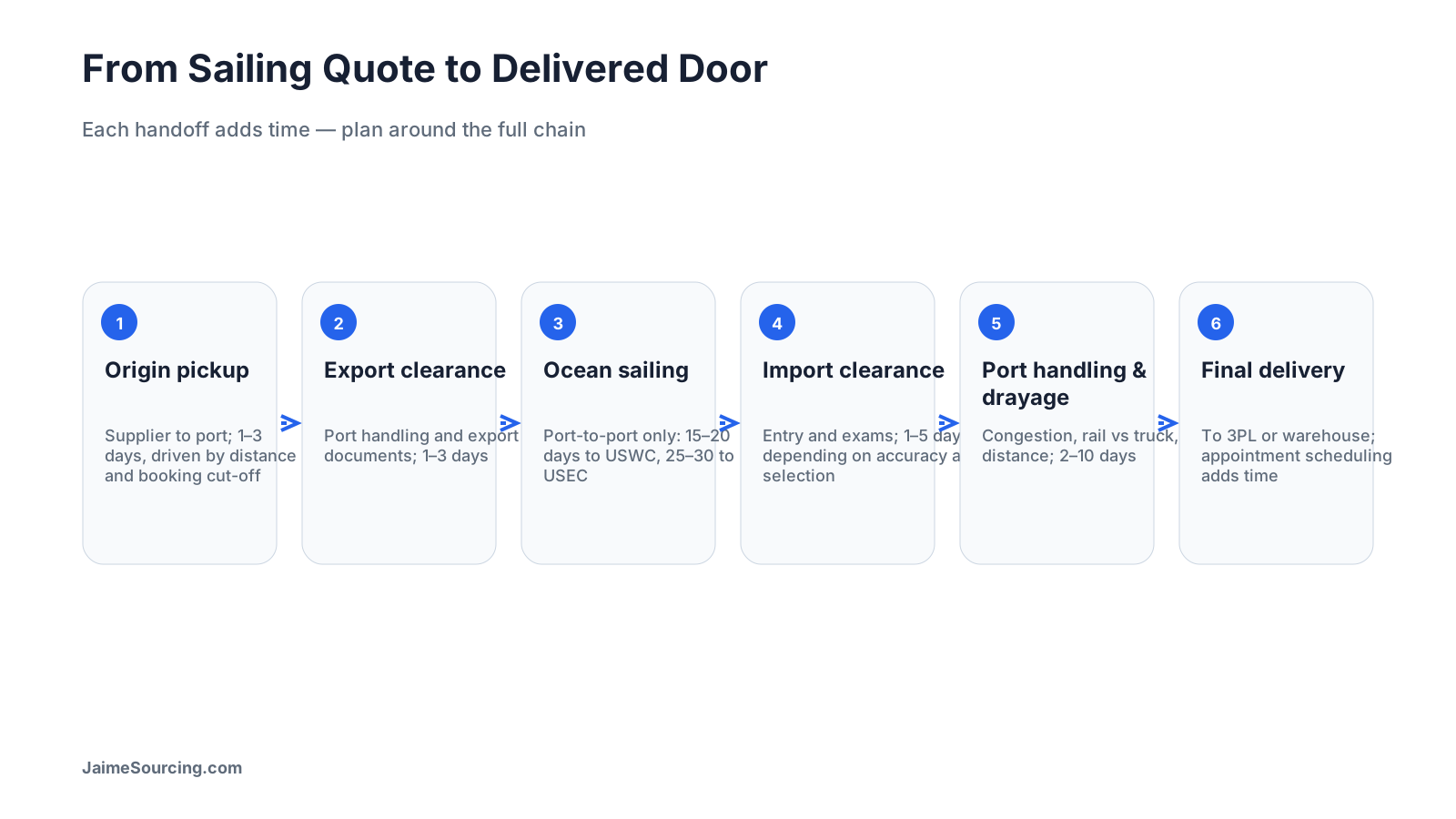
A shipment is a relay, not a single race. Each handoff has its own clock, and most first-shipment delays happen at the handoffs, not mid-ocean.
| Leg | Typical added time | What drives it |
|---|---|---|
| Origin pickup / supplier to port | 1–3 days | Distance, booking cut-off, container availability |
| Export clearance & port handling | 1–3 days | Document accuracy, cut-off timing |
| Ocean sailing (port-to-port) | 15–20 days USWC; 25–30 days USEC | Route, canal transit, service speed |
| Import clearance | 1–5 days | Entry accuracy, exam selection |
| Destination port handling & drayage | 2–10 days | Congestion, rail vs truck, distance |
| Final delivery to warehouse | Included above | Appointment scheduling, 3PL receiving |
The sailing figures above reflect common published ranges: Shanghai/Ningbo/Shenzhen to Los Angeles/Long Beach at 15–20 days, and to East Coast ports such as New York or Savannah at 25–30 days. Other sources quote slightly wider bands — for example 12–15 days to Los Angeles and 25–30 days to New York, with express versus standard services differing by 3–5 days. These are different service definitions rather than contradictions; treat any single number as a range midpoint, not a promise.
For Europe, the ocean leg is longer. One source cites Shanghai–Rotterdam port-to-port at 30–40 days, and another puts Europe door-to-door at 35–45 days including clearance and inland transport. If you sell into the EU or UK, budget accordingly.
What Actually Stretches the Timeline
Transit time is a distribution, not a fixed value. The main variables:
- Port congestion. Congestion at major gateways can add 3–10 days; at peak, vessels have waited up to a week to berth at Los Angeles/Long Beach, pushing total transit past 25 days.
- Peak season. Chinese New Year (January–February) and the US retail build (August–October) can lengthen transit by 20–35%, or roughly 3–7 days, and bookings should be made 3–4 weeks ahead.
- Customs exams. A clean release at New York can take about 2 days; a full exam can stretch to 5, adding 1–5 days to door-to-door.
- Routing and transshipment. Not every sailing is direct; some services relay through hub ports, adding time. Feeder networks move cargo from smaller Chinese ports to major hubs before the ocean leg begins.
- Coast choice. West Coast ports are generally 7–10 days faster than East Coast for the ocean leg, but for a buyer whose warehouse is in the eastern US, an East Coast port can still win on total door-to-door once inland rail/truck is counted.
Build your reorder point around the upper end of the door-to-door range, not the sailing average.
Reading Your Quote: Incoterms, Charges and the DDP Trap
The transit number is only half the story; the commercial terms decide who owns each leg and each cost.
- EXW (Ex Works): your supplier’s obligation ends at their door. You arrange and pay origin pickup, export clearance, freight and everything after. Maximum control, maximum admin.
- FOB (Free On Board): the supplier delivers to the origin port and clears export; you own the ocean freight, destination charges, import clearance and inland delivery. This is the most common structure for small importers and keeps the freight relationship in your hands.
- DDP (Delivered Duty Paid): the seller or forwarder handles everything to your door, including duties. Convenient, but the risk is non-compliant “tax-inclusive” DDP — arrangements where duties are under-declared or the importer of record is obscured. As the buyer, you remain legally responsible for accurate customs declarations in your jurisdiction, so insist on seeing how duty and VAT/GST are calculated and who is named as importer of record. Check the current official rule with your local customs authority (CBP in the US, HMRC in the UK, the relevant EU member state customs body, CBSA in Canada, ABF in Australia).
On payment, overseas buyers paying Chinese suppliers should agree T/T terms in writing, confirm who absorbs bank charges at each end, and note that FX exposure sits with whoever holds the currency. Where a platform such as Trade Assurance is used, its fee structure should be confirmed before assuming it is free. Pay the company account named on the contract, not a personal account, and agree in advance who pays sample and courier fees.
A Practical Planning Workflow
- Get two quotes per lane — one P2P, one D2D — and ask each forwarder to itemize origin charges, ocean freight, destination charges and inland delivery separately.
- Confirm the routing (direct vs transshipment) and the specific port pair, since Shanghai–LA and Shanghai–New York differ by roughly 10 days.
- Map your true final destination. A Portland, Oregon buyer, for example, may see cargo discharged at LA/Long Beach and railed north, adding 3–7 days of inland movement to the ocean estimate.
- Set your reorder point using the door-to-door upper bound plus a peak-season buffer.
- Lock documentation early — bill of lading, commercial invoice and packing list are where most first-shipment delays originate.
- Track the container, not just the booking, and reconcile actual versus quoted transit after each shipment so your next plan is evidence-based.
What to Verify Before You Proceed
- Which number you were quoted. Ask directly: “Is this port-to-port sailing time or door-to-door?” Get it in writing.
- The named ports and routing. Confirm POL, POD and whether the service is direct.
- Who is importer of record and how duty/tax is calculated, especially on any DDP offer.
- The forwarder’s destination partners — who clears customs and who arranges drayage.
- Your supplier’s identity and standing. Before committing volume, verify the factory through the Chinese National Enterprise Credit Information Publicity System, and cross-check on Tianyancha or Qichacha. Read registered capital against subscribed versus paid-in capital (a high subscribed figure with little paid-in can signal thin capitalization), check the establishment date for trading-company shells posing as factories, and confirm the Unified Social Credit Code matches the contract and invoice.
- Product quality plan. If you are inspecting, agree an AQL sampling plan under ISO 2859-1 / ANSI/ASQ Z1.4 at General Inspection Level II, with Critical/Major/Minor definitions — a common starting example is Critical 0, Major 2.5, Minor 4.0, but set levels to your product’s risk rather than copying defaults.
FAQ
How long does China ocean freight take port-to-port versus door-to-door?
Port-to-port sailing from China to the US West Coast is commonly 15–20 days and to the East Coast 25–30 days, while door-to-door typically runs 25–40 days once clearance and inland delivery are added. Treat both as ranges, not fixed schedules. Your actual time depends on routing, season and how clean your documents are.
Why is my door-to-door time so much longer than the sailing quote?
Because the sailing quote covers only the ocean leg. Origin pickup, export clearance, import clearance, port handling and inland transport each add days, and together they can add roughly 5–9 days or more. Congestion and customs exams can stretch that further.
Does shipping to the US East Coast always take longer?
For the ocean leg, yes — East Coast ports run about 7–10 days longer than West Coast because of the longer voyage and Panama Canal transit. But if your warehouse is in the eastern US, an East Coast port can still deliver a faster total door-to-door once inland rail and truck are counted.
How much buffer should I add for peak season?
Plan for transit to lengthen by roughly 20–35%, or 3–7 days, during Chinese New Year and the August–October US retail build, and book 3–4 weeks ahead. Build that buffer into your reorder point rather than assuming your forwarder will absorb it.
Is a DDP quote safer than FOB?
Not automatically. DDP is convenient but carries compliance risk if duties are under-declared or the importer of record is unclear. FOB keeps freight and customs in your hands, which is often safer for a growing brand. Either way, confirm who is the importer of record and how duty is calculated.
Managing the Gap Between Quote and Delivery
Transit time is only one of three things that erode a sourcing plan. The others are quality drift (the tenth production run quietly diverging from the approved sample), factory follow-ups (chasing production dates across a language and time-zone gap), and physical distance that makes every problem slower to see and fix. A realistic door-to-door plan protects your cash flow; a ground team in China protects the goods inside the container.
Jaime Sourcing supports overseas buyers with supplier research and verification, inspection and quality control, consolidation, packing and shipment coordination — acting as your on-the-ground team in China so you are not managing factories and forwarders blind from another time zone. If you want a second pair of eyes on a supplier or a review of your sourcing-to-shipping workflow, talk to Jaime Sourcing before your next order ships.
Turn your product and order requirements into a controlled sourcing brief.
Share the product, supplier link, quantity, destination and current order stage. We will identify the practical verification, quality-control, packing and shipping steps.