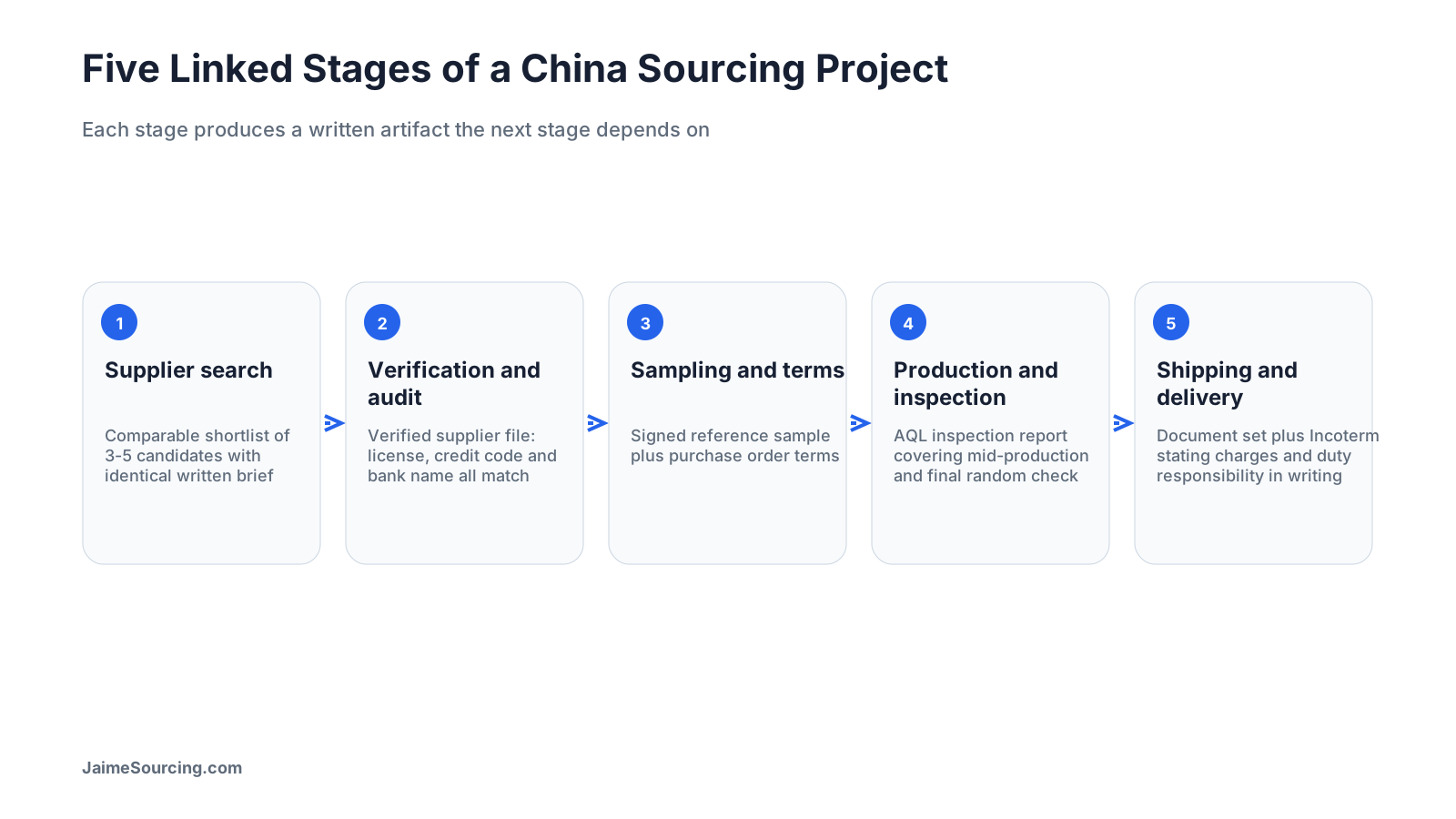
The five stages of a China sourcing project—supplier search, verification and audit, sampling and terms, production and inspection, and shipping and delivery—work as one linked chain, not five separate errands. For a Shopify reseller, each stage must produce a written artifact (a shortlist, a verified supplier file, an approved sample, an inspection report, a shipping document set) that the next stage depends on. When one artifact is missing, the failure usually surfaces later as a quality dispute, a customs delay, or a margin you cannot explain. This article explains how the handoffs work, what to check at each one, and where overseas buyers most often lose money.
Stage 1: Supplier search should end with a shortlist, not a favorite
Most sourcing failures begin with a shortlist of one. A structured process produces three to five candidate suppliers so you can compare capability, not just price. Search channels differ in what they reveal: B2B marketplaces such as Alibaba and 1688 are fast but crowded with trading companies, direct outreach and trade-show contacts give you more context, and industrial clusters matter because capability is geographically concentrated—consumer electronics and light goods in the Pearl River Delta, precision machinery and textiles in the Yangtze River Delta, heavy equipment and building materials around the Bohai Rim.
The output of this stage should be a one-page brief per candidate: what they claim to make, whether they claim to be the manufacturer or a reseller, the production address, and the price band they quoted against an identical specification. Send every candidate the same written requirement—materials, key dimensions, target quantity, destination market, packaging and labeling needs, and required delivery date—so quotes are comparable. A quote that cannot be compared line by line is not a quote; it is a conversation.
Stage 2: Verification and audit turn claims into evidence
Verification has two layers, and buyers routinely do only the first. The desk layer checks the legal entity: request the Chinese business license and confirm the registered company name, Unified Social Credit Code, establishment date, registered address and stated business scope. You can cross-check these details through the Chinese National Enterprise Credit Information Publicity System, and commercial databases such as Tianyancha or Qichacha add shareholder structure, branch records and administrative penalties. Read registered capital carefully: subscribed capital is what shareholders committed to pay, while paid-in capital is what has actually been contributed—a high subscribed figure with little paid-in capital tells you far less about a factory than it appears to. Establishment date helps you judge whether you are dealing with a long-operating plant or a company registered last year.
The second layer is physical. A factory audit assesses actual production equipment, workforce, process flow, incoming-material control and outgoing testing, and it is the only reliable way to distinguish a manufacturer from a trader that subcontracts production. Subcontracting is not automatically disqualifying, but undisclosed subcontracting is, because your specification gets re-interpreted at every handoff. Where a full audit is disproportionate—small trial orders, low-risk commodity items—a live video walkthrough of the production line plus a name-match check across license, contract, invoice and receiving bank account is a reasonable minimum. Any mismatch between the contracting entity and the bank account is a stop signal until explained.
Stage 3: Sampling and commercial terms lock the specification
Sampling is where design confirmation and production approval get confused. A prototype sample proves the idea works; a pre-production sample proves the actual production materials, tooling and process will meet the specification. Ask which one you are approving, keep a signed and labeled reference sample, and write its identity into the purchase order. For machined or custom parts, request first-article measurements against the agreed drawing revision.
Commercial terms belong in the same stage because they determine what “approved” costs. Confirm MOQ and whether it applies per order or per color, size and material; ask whether stock materials, existing tooling or standard packaging allow a smaller trial run, and get setup costs quoted separately. Agree in writing what happens if inspection fails: rework, re-inspection, who pays, and how the balance payment date shifts.
Payment deserves its own checklist. For overseas buyers paying Chinese suppliers by T/T, confirm the invoicing entity, currency, who absorbs bank charges at each end, and whether the receiving account is a corporate account matching the license—personal accounts or unrelated company names warrant verification through a channel you already trust before any transfer. FX exposure sits with whoever bears the currency risk; if you are quoted in RMB but sell in USD or GBP, ask whether the rate is fixed at order or at payment. If you pay through a platform’s trade assurance facility, check the current fee schedule and confirm that the order record and payment path both sit inside the platform, since protection typically depends on that. Sample and courier fees should be allocated explicitly—who pays, and whether the sample fee is credited against the bulk order—rather than left to goodwill.
Stage 4: Production follow-up and inspection are one continuous control
Quality control is not a single event at the end. A three-point structure is common: an initial production check on incoming materials and line setup, a during-production check once roughly 20–50% of output exists, and a final random inspection once production is complete and packing is largely finished. The mid-production check is the one buyers skip and later regret, because systematic deviations are cheapest to correct while the line is still running.
Final inspection is normally sampled using AQL under ISO 2859-1, whose US counterpart is ANSI/ASQ Z1.4, usually at General Inspection Level II. Defects are classified as Critical (safety or legal issues), Major (functional or significant appearance failures likely to cause returns) and Minor (tolerable cosmetic deviations). Critical 0 / Major 2.5 / Minor 4.0 is a common starting point, not a universal rule—tighten it for regulated or high-return categories and agree the levels in writing before booking. The inspection report should record measurements, photographs and defect classifications objectively, not a pass/fail opinion. For high-risk orders or reworked batches, 100% screening and container loading supervision are available as escalation options.
| Stage | Key artifact | Common failure if skipped | Practical check |
|---|---|---|---|
| Supplier search | Comparable shortlist of 3–5 | Single-source dependency, inflated price | Identical written brief sent to all candidates |
| Verification and audit | Verified supplier file | Trader posing as factory; payment fraud | License, credit code and bank name all match |
| Sampling and terms | Signed reference sample + PO terms | Bulk goods differ from approved sample | Pre-production sample, not prototype, approved |
| Production and inspection | AQL inspection report | Batch defects found at your warehouse | Mid-production check plus final random inspection |
| Shipping and delivery | Document set + Incoterm | Customs delay, unexpected landed cost | Incoterm, charges and duty responsibility in writing |
Stage 5: Shipping and delivery decide your real landed cost
The Incoterm you accept determines who owns which risk. Under EXW, the buyer handles everything from the factory gate, including Chinese export clearance—workable but rarely efficient for a small importer. Under FOB, the supplier delivers to the named port and covers origin charges and export clearance, and your freight forwarder takes over from there. Under DDP, the seller quotes a delivered price including duty, which is convenient but carries a specific risk: some “tax-inclusive” DDP arrangements route goods through informal clearance channels that may not withstand scrutiny, leaving the importer of record exposed. Ask who is named as importer of record, which duty and tax figures are included, and whether the arrangement is fully compliant in your destination jurisdiction; customs rules differ by country and change, so verify the current official requirement rather than relying on a forwarder’s summary.
Documentation is the handoff that most often breaks. Commercial invoice, packing list, bill of lading and any certificate of origin or product compliance evidence must agree with each other and with the order. Consolidating multiple suppliers into one shipment reduces freight spend but adds a step where cartons can be mixed up—so packing lists should be checked against physical marks before the container closes. Build your landed-cost model from the FOB price plus freight, insurance, duty, clearance fees and last-mile delivery, and compare it against the DDP quote rather than assuming the DDP number is cheaper.
What to Verify Before You Proceed
- Entity match: registered name, Unified Social Credit Code and bank account name are identical across license, contract, invoice and payment instruction.
- Capital reality: subscribed versus paid-in capital, and establishment date, reviewed on the National Enterprise Credit Information Publicity System or a commercial database.
- Manufacturer status: production address confirmed, and any subcontracting disclosed in writing.
- Sample identity: the approved sample is a pre-production sample, labeled, signed and referenced in the PO.
- Inspection terms: AQL standard, level and Critical/Major/Minor limits agreed in writing before the inspection is booked.
- Incoterm and duty: named port or place, origin charges, importer of record and duty responsibility stated explicitly; DDP arrangements checked for compliance.
- Payment path: corporate account, currency, bank-charge allocation and FX basis confirmed; platform protection terms read for the current period.
FAQ
How long does a China sourcing project usually take from search to delivery?
Timelines vary too widely by product and season to quote a reliable figure, so plan backwards from your required in-warehouse date instead. Work out sampling rounds, production lead time, inspection booking and sea or air transit, then add buffer for rework. The stages overlap more than beginners expect—verification can run while sampling is negotiated.
Do I need a factory audit for a small first order?
Not always a full audit, but always some physical verification proportionate to risk. For low-value trial orders, a live video walkthrough plus a document and bank-account name match is a defensible minimum. For regulated products, custom tooling or high order values, an on-site audit is usually cheaper than one failed batch.
What AQL levels should I set for my first inspection?
Critical 0 / Major 2.5 / Minor 4.0 at General Inspection Level II is a common starting point, not a standard you must accept. Tighten Major for products where a functional failure triggers returns, and define what counts as Critical for your category—typically safety and legal labeling issues. Write the levels into the inspection booking so the result is judged against agreed criteria.
Is DDP always simpler than FOB for a small importer?
Simpler on paper, not always safer. DDP shifts logistics work to the seller but can obscure who is the importer of record and whether duty was properly declared. FOB with your own forwarder gives you visibility of origin charges and clearance. Compare total landed cost and compliance exposure, not just the headline number.
Can I skip the mid-production check if I book a final inspection?
You can, but you lose the cheapest correction window. A final random inspection catches defects after the run is finished, when rework is slowest and most expensive. A mid-production check at roughly 20–50% output catches systematic errors while the line can still be adjusted.
Managing distance, drift and follow-up
The five stages connect through evidence, and evidence decays. A supplier verified last year may have changed ownership, subcontracted a line, or drifted on materials; a sample approved in spring may not match an autumn batch. Physical distance and time-zone friction make every one of these drifts harder to see from a Shopify dashboard in London, Toronto or Sydney. The workable response is rhythm: periodic re-verification of entity and bank details, inspection at more than one production point, and a named person on the ground who can walk the line, photograph the cartons and escalate before the container sails.
Jaime Sourcing supports overseas buyers as their ground team in China, covering supplier research, verification, inspection, quality control, consolidation, packing and shipment coordination. If you are planning a first order or reviewing a workflow that has already produced a surprise, talk to Jaime Sourcing about a supplier check or a workflow review—before the next batch is on the water. </ARTICLE_TO_EDIT>
Turn your product and order requirements into a controlled sourcing brief.
Share the product, supplier link, quantity, destination and current order stage. We will identify the practical verification, quality-control, packing and shipping steps.