An EXW (Ex Works) quote from a Chinese supplier prices only one thing: the goods, packed and made available at the supplier’s premises. It does not include loading, inland trucking to the port, China export clearance, origin terminal handling or the ocean/air freight. Under Incoterms® 2020, the buyer carries almost every cost and risk from the factory door onward, including export clearance in the seller’s own country. That is why an EXW unit price can look 10–20% cheaper than an FOB quote and still produce a higher total bill. For an overseas buyer, the practical fix is to convert every EXW quote into a full origin-cost estimate before comparing suppliers.
What an EXW quote actually includes — and what it leaves out
Under EXW, the seller’s obligation ends when the goods are placed at the buyer’s disposal at the named place, not loaded onto the collecting vehicle. The seller must pack and mark the goods and provide commercial documents, but loading, export declaration, inland transport, insurance and main carriage are the buyer’s responsibility. Even loading is not the seller’s job unless the contract says so — and if the seller does load, that is an Incoterms variant whose damage liability should be written into the sales contract.
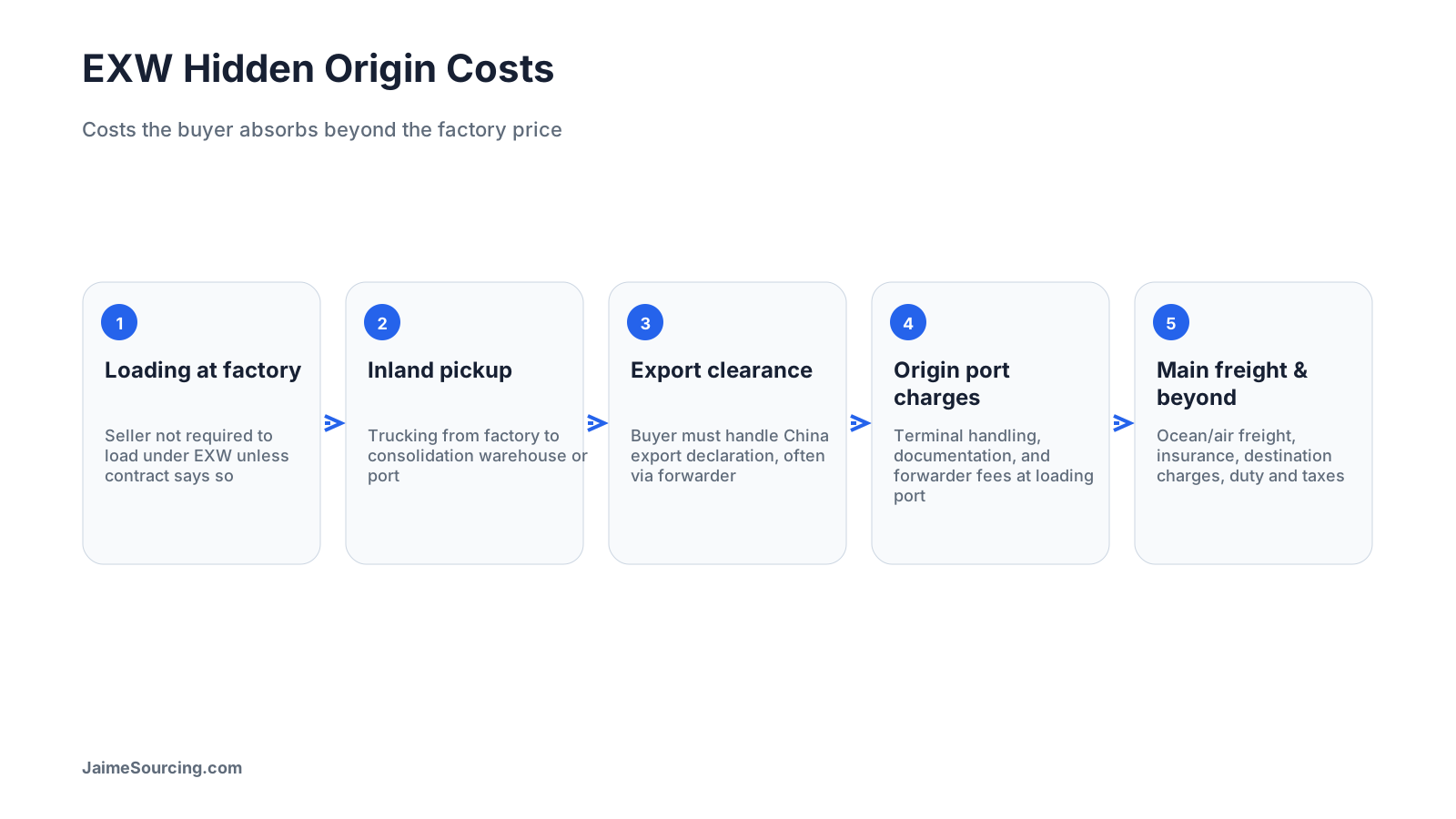
The costs that fall outside a standard EXW price typically include:
- Loading and handling at the factory, especially for cartons or pallets a small supplier cannot forklift safely.
- Inland pickup from the factory to a consolidation warehouse or the origin port.
- China export clearance, including declaration handling and any licensing or inspection steps tied to the product.
- Origin port charges — terminal handling, documentation, and any forwarder fees at the loading port.
- Main freight, insurance, destination charges, duty and VAT/GST, none of which EXW touches.
Because the EXW price excludes the inland freight and insurance up to the point of loading at the export location, Chinese customs rules require those domestic-leg costs to be declared separately on the export declaration when the shipment is filed under EXW. That is a compliance detail, not a cost the supplier absorbs — it confirms the buyer is on the hook for the domestic leg.
The three hidden cost blocks, in the order they hit you
1. Pickup and loading at the factory
Many small Chinese factories sit in industrial parks hours from the nearest container port. A forwarder quoting “pickup included” may still add an operation fee if the driver has to wait, if the site has restricted truck access, or if the goods are not palletized. These charges accumulate fastest on small or LCL shipments and on factories far from major ports. Before you accept an EXW price, ask the supplier for the exact pickup address, whether a container truck can access the loading bay, and who physically loads the cartons.
2. Export clearance in China
This is the block most first-time importers underestimate. Under EXW the buyer must handle export clearance in the seller’s country, which is often impractical for an overseas company with no Chinese customs registration. In practice the buyer appoints a freight forwarder or agent to file the export declaration, and that service is billed to the buyer. Published guidance puts typical China export declaration handling at roughly US$100–$300 per shipment, though the figure varies with product, port and whether inspection is triggered. Treat that range as a planning benchmark, not a quote.
There is also a documentation risk. If the export declaration is filed under the wrong terms, or the seller is incorrectly recorded as the exporter of record, responsibility can become blurred and disputes over damage or delay harder to resolve. The clean approach is to have the forwarder confirm in writing who is the shipper of record and which Incoterm the declaration uses.
3. Origin port and forwarder charges
Once goods reach the port, origin terminal handling, documentation fees and forwarder administration are billed on top. These are separate from the ocean freight line and are easy to miss when a supplier’s “shipping quote” only covers the sea leg. Ask your forwarder for a full origin-charges breakdown — pickup, export declaration, terminal handling, documentation — as one itemized sheet rather than a single lump sum.
EXW vs FOB vs DDP: who pays for what
The table below compares the three terms buyers most often confuse. It reflects standard Incoterms® 2020 allocation; your contract can vary it, but the variation must be written down.
| Cost or responsibility | EXW | FOB | DDP |
|---|---|---|---|
| Packing and marking | Seller | Seller | Seller |
| Loading at factory | Buyer (unless agreed otherwise) | Seller | Seller |
| Inland transport to origin port | Buyer | Seller | Seller |
| China export clearance | Buyer | Seller | Seller |
| Origin port / terminal charges | Buyer | Seller | Seller |
| Main freight and insurance | Buyer | Buyer | Seller |
| Destination port charges | Buyer | Buyer | Seller (usually) |
| Import duty and taxes | Buyer | Buyer | Seller |
| Risk transfers at | Seller’s premises | On board vessel | Destination delivery point |
FOB is the most common choice for China ocean freight because it moves export clearance and origin port handling to the seller while leaving the buyer in control of freight and insurance. DDP looks simplest — the seller handles everything to your door — but it carries its own risk: a seller who misdeclares value or duty, or who lacks knowledge of your country’s customs rules, can create compliance exposure and surprise surcharges. For most small ecommerce brands, FOB or FCA is the more controllable middle ground; EXW only makes sense if you already have a forwarder with a strong China origin operation.
How to turn an EXW quote into a real landed-cost number
Do this before you compare suppliers, not after you have paid a deposit.
- Get the factory address and port of loading. Calculate the inland distance. A factory 300 km from port behaves very differently from one next to the terminal.
- Request an itemized origin quote from your forwarder. Ask specifically for pickup, export declaration, terminal handling and documentation as separate lines.
- Confirm who files the export declaration. If your forwarder files it, get the shipper-of-record arrangement in writing.
- Add freight, insurance, duty and destination charges. Use your own broker’s estimate for duty; do not rely on the supplier’s guess.
- Compare on a per-unit landed basis, not per-unit EXW. A supplier with a higher FOB price but a port-adjacent factory can be cheaper overall.
If you are paying the supplier directly, also budget for the payment layer: T/T bank charges on both ends, FX spread between quote and payment date, and any platform fee if you pay through a trade assurance service. Paying a Chinese company’s corporate account is generally cleaner for documentation than paying a personal account, and sample payments should have their fee allocation agreed up front so it does not become a surprise deduction.
What to Verify Before You Proceed
- Supplier identity. Cross-check the factory’s Chinese legal name on the National Enterprise Credit Information Publicity System, and compare with Tianyancha or Qichacha. Confirm the Unified Social Credit Code matches the name on the invoice and contract. Check establishment date (a very new entity warrants more scrutiny), registered capital, and — importantly — subscribed versus paid-in capital, since a large registered figure with little paid-in capital tells you less about financial substance than it appears to.
- Export eligibility. Confirm the supplier can issue a VAT invoice and has the right to export the specific product category. Some products need additional export licensing or inspection.
- Incoterm and named place. Make sure the contract states “EXW [full factory address], Incoterms® 2020” — not just “EXW China.” The named place determines where your cost and risk begin.
- Loading responsibility. Decide in writing whether the seller loads the vehicle, and who bears damage risk during loading.
- Forwarder origin charges. Get the itemized origin sheet in writing before booking.
- Product compliance for your destination. Duty rates, labeling and safety rules are set by your importing country (US CBP, HMRC, EU customs authorities, CBSA, Australian Border Force). Confirm current official requirements rather than relying on the supplier.
Frequently Asked Questions
Is EXW cheaper than FOB for a small Shopify order?
Usually not once you add pickup, export clearance and origin port charges. The EXW unit price is lower, but the buyer absorbs costs that FOB bundles into the seller’s price, and those add up fastest on small or LCL shipments. Compare total landed cost per unit, not the factory price.
Who is responsible for China export clearance under EXW?
The buyer is responsible under standard EXW terms, which is often impractical for an overseas company without Chinese customs registration. Most buyers appoint a forwarder to file the declaration and pay for it, typically in the US$100–$300 range per shipment as a planning benchmark.
Can I just ask the supplier to quote FOB instead?
Yes, and for most small importers it is the more practical choice. FOB moves export clearance and origin port handling to the seller while leaving you in control of freight and insurance. Ask for both EXW and FOB quotes on the same order so you can see the real gap.
Does an EXW price include loading the truck?
No. Under EXW the seller is not required to load the goods onto the collecting vehicle unless the contract says so. If the seller agrees to load, that is an Incoterms variant and the damage-liability allocation should be written into the sales contract.
Is DDP safer than EXW for a first order?
DDP is more convenient but not automatically safer. A seller who misdeclares value or duty, or who does not understand your country’s customs rules, can create compliance risk and hidden surcharges. For first orders, FOB or FCA with your own forwarder usually gives you more visibility.
Managing the Gap Between a Low EXW Price and a Real Landed Cost
The distance between a Chinese factory and your warehouse is not just physical — it is a chain of handoffs where quality drift, missed follow-ups and time-zone friction quietly raise your true cost. An EXW quote hides the origin half of that chain, and a supplier who is never visited or inspected is a risk you cannot see from a price sheet.
Jaime Sourcing works as your ground team in China, covering supplier research, verification, inspection, quality control, consolidation, packing and shipment coordination. If you are weighing an EXW quote against FOB or DDP, or want a supplier check and workflow review before you commit, talk to Jaime Sourcing and turn the quote into a cost you can actually plan around.
Turn your product and order requirements into a controlled sourcing brief.
Share the product, supplier link, quantity, destination and current order stage. We will identify the practical verification, quality-control, packing and shipping steps.