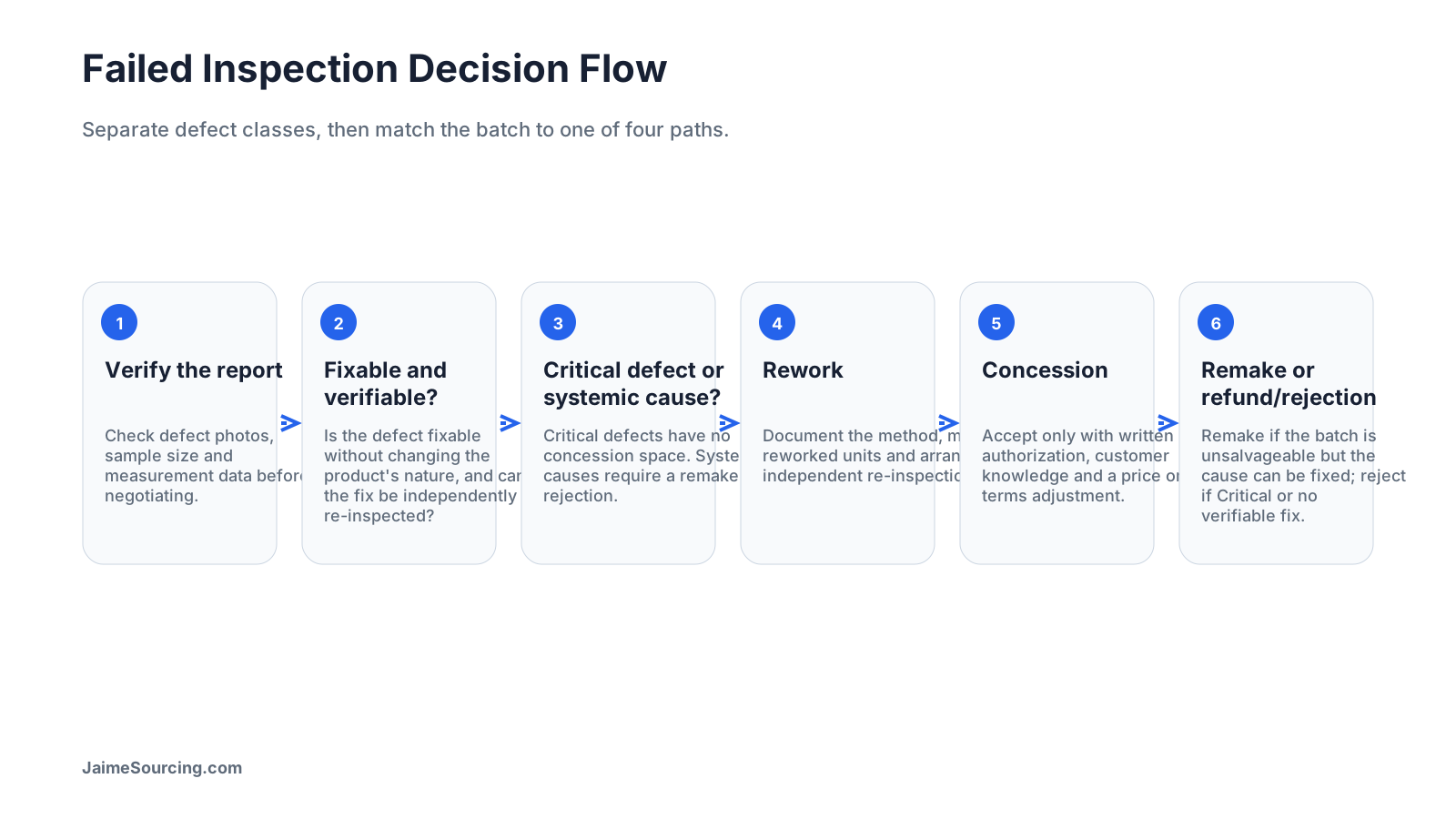
When an inspection fails, do not decide from the report headline alone. Separate Critical, Major and Minor defects first, then match the batch to one of four paths — rework, remake, concession acceptance or refund/rejection — based on whether the defect is fixable, whether the fix is verifiable, and who carries the cost and schedule risk. A failed inspection is a decision point, not automatically a write-off.
This article gives you a decision tree you can apply the same day the report lands, plus the supplier checks and contract terms that make the decision enforceable.
Read the report before you call the factory
A third-party inspection report normally ends in one of four verdicts: pass, accept with deviation, conditional/pending, or fail/reject. Each maps to a different next action. Confusing them is how buyers either lose a sailing date over a cosmetic issue or ship a safety problem.
Before any negotiation, verify three things in the report itself:
- Defect photos. Every listed defect should have a clear photo showing location and severity. If photos are missing or ambiguous, the count is not yet reliable.
- Sample size and sampling plan. Confirm the inspection used the AQL level and lot size you agreed, and that sampling covered different production batches and carton positions.
- Measurement data. Key dimensions, weight and functional test results should be checked against your approved spec sheet, not against the factory’s verbal assurance.
Only after this review should you classify the batch. A report is evidence; the decision is commercial.
Grade the defects: Critical, Major, Minor
Most China inspections use AQL sampling under ISO 2859-1 / ANSI/ASQ Z1.4, commonly General Inspection Level II. A frequent starting point is Critical 0 / Major 2.5 / Minor 4.0 — a common example, not a universal rule. Your category, customer expectations and contract should set the actual levels.
| Defect class | What it means | Typical examples | Decision implication |
|---|---|---|---|
| Critical | Safety, legal or total-loss failure | Electrical leakage, choking hazards, banned substances, sharp objects in packaging | No concession. Rework, remake or reject |
| Major | Function, spec or likely customer rejection | Product does not work, key dimension out of tolerance, wrong voltage label, large scratches | Depends on count vs AQL; often rework or sort |
| Minor | Cosmetic, close inspection only | Light scratches on non-key surfaces, slight color variation, minor carton dents | Usually acceptable with customer sign-off |
Two cautions. First, the same defect can change class by product: a scratch on a phone case may be Major, on industrial hardware Minor. Second, chemical or safety tests (for example formaldehyde or azo dyes in textiles) cannot be judged visually on site and need laboratory testing. If your product touches children, electricals or food contact, confirm the applicable rule in the destination jurisdiction (US, UK, EU, Canada, Australia) with the current official regulator before accepting anything.
The four decision paths and when each applies
Rework
Rework means reprocessing the nonconforming item through the original process so it meets spec. It is the right path when the defect is fixable without changing the product’s nature and the fix can be re-inspected. Examples: re-soldering a joint, re-pressing a seam, re-labeling cartons.
Rework is only credible if it is documented. The factory should define the rework method and standard, the reworked units should be specially marked, and re-inspection should be performed by someone other than the original inspector, using the same or tightened standard. A verbal “we will fix it” with no re-inspection is not rework.
Remake
Remake applies when the batch cannot be economically or reliably repaired, or when the root cause is systemic (wrong material, wrong tooling, wrong spec interpretation). It carries the longest lead time and the highest schedule risk. Before agreeing, ask the factory to state the root cause and the corrective action, because a remake using the same unchecked process will fail again. Where the defect involves a design or engineering change, the rework/remake method should be redefined by the technical function, not improvised on the line.
Concession acceptance (concession acceptance / special approval)
Concession means accepting nonconforming goods under authorized deviation, typically because demand is urgent or the defect does not affect function, safety or the customer’s use. It is legitimate — but only with three controls:
- Written authorization naming the approver, the batch range and the reason.
- Customer knowledge. If you are the buyer, your own customer (or your own risk tolerance) must be informed; defect photos should travel with the report.
- A price or terms adjustment reflecting the reduced value. Concession without compensation is a discount you gave yourself.
Critical defects have no concession space. For Major defects, concession is a judgment call tied to count and end use.
Refund / rejection
Rejection returns the batch to the supplier for handling. It is the correct path when defects are Critical, when the Major count clearly exceeds AQL, or when the factory cannot demonstrate a verifiable fix inside your window. Refund terms — who pays freight, who bears inspection fees, how the deposit is returned — should already exist in your purchase order. If they do not, you are negotiating from weakness.
Compare the real cost of each path
The cheapest-looking option is rarely the cheapest. Build a simple comparison before you reply to the factory.
| Path | Direct cost | Time cost | Quality risk | Best when |
|---|---|---|---|---|
| Rework | Labor, possible re-inspection fee | Days to weeks | Medium if re-inspection is independent | Defect is fixable and verifiable |
| Remake | Full production cost, possible expedite | Longest | Low if root cause fixed | Batch unsalvageable or cause is systemic |
| Concession | Price adjustment, possible returns later | Shortest | Carried by you and your customer | Minor defects, urgent demand, customer informed |
| Refund / reject | Lost deposit risk, re-sourcing time | Medium to long | Low for this batch, high for schedule | Critical defects or failed fix |
Two cost items buyers forget. First, re-inspection is usually a separate charge — budget for it rather than assuming it is included. Second, if goods have already shipped and are found defective downstream, returning them for re-check or negotiating a remedy adds handling and delay; the earlier you catch it, the cheaper every path becomes.
Put the decision into a contract and a workflow
A decision framework only works if it is written down before production. Practical steps:
- Define defect classes and AQL in the PO or quality agreement, including which defects are Critical for your product. Do not rely on the factory’s default.
- Name the decision authority. State who can approve concession, and require written sign-off with batch identification.
- Require re-inspection records. Reworked units must be marked and re-checked independently before release.
- Tie payment to inspection. Structure T/T so the balance is released against a passed inspection or an agreed concession, not against shipping alone.
- Keep a defect log. Track recurring defect types by supplier; a pattern is a supplier-selection signal, not bad luck.
If you sell on Shopify, align the factory decision with your store’s return policy. Your published return window and condition rules determine how much concession risk you can absorb if defective units reach customers; Shopify’s returns documentation covers creating returns, refunds and exchanges from the admin. A generous policy plus a lax inspection standard is a margin leak.
What to Verify Before You Proceed
Before you commit to rework, remake, concession or refund, verify the counterparty and the paper trail:
- Company identity. Use the Chinese National Enterprise Credit Information Publicity System to confirm the legal name and Unified Social Credit Code match your contract and bank account. Cross-check with Tianyancha or Qichacha for establishment date, registered capital, and subscribed versus paid-in capital — a high registered figure with low paid-in capital tells you little about actual operating strength.
- Business scope. Confirm manufacturing or trading scope covers your product; a trading company cannot “rework” at a factory it does not control without your knowledge.
- Inspection standard in writing. Confirm the AQL levels, defect definitions and sampling plan used, and that the inspector was independent of production.
- Rework/remake plan. Get the root cause, method, responsible person and re-inspection date in writing.
- Concession authorization. Confirm approver, batch range, reason and price adjustment are documented.
- Payment and Incoterms. Clarify whether you are on EXW, FOB or DDP, who bears origin charges and customs responsibility, and avoid non-compliant “tax-inclusive” DDP arrangements that shift legal risk to you. For T/T, confirm bank fees, FX exposure, whether the account is corporate or personal, and how sample-payment fees are allocated.
- Compliance jurisdiction. For safety, labeling or chemical rules, check the current official requirement in your destination market before accepting any deviation.
FAQ
What should I do first when an inspection fails?
Read the report and confirm the defect photos, sample size and measurement data before contacting the factory. Then classify defects as Critical, Major or Minor and compare counts against your agreed AQL. This prevents you from negotiating a cosmetic issue as a crisis, or dismissing a safety defect as minor.
Is concession acceptance ever acceptable?
Yes, when defects are Minor or limited Major, demand is urgent, function and safety are unaffected, and the deviation is authorized in writing with customer knowledge. Critical defects are excluded. Always pair concession with a price or terms adjustment and keep defect photos on file.
How do I know rework actually fixed the batch?
Require a documented rework method, special marking of reworked units, and independent re-inspection by someone other than the original inspector using the same or stricter standard. Release only after re-inspection records are returned.
Who pays for re-inspection after rework?
This is commercial, not automatic. Re-inspection is commonly a separate charge, so agree in the PO who bears it before production starts. If the failure is the factory’s, argue for supplier-borne re-inspection; if the spec changed mid-order, expect to share it.
Should I reject the whole batch or sort it?
Sorting (100% inspection to separate good from bad) can rescue part of a batch when defects are mixed and the good units are genuinely conforming. It is slower and costlier than sampling, and the factory may charge sorting labor. Reject when defects are Critical or widespread, or when sorting cannot be independently verified.
Manage quality drift before it becomes a refund decision
Every path above costs money, and the further defective goods travel from the factory, the more expensive the fix. Quality drift, missed follow-ups and the physical and time-zone distance between you and a Chinese production line are where small defects become refunds, chargebacks and lost customers.
Jaime Sourcing acts as your ground team in China, covering supplier research and verification, inspection and quality control, consolidation, packing and shipment coordination. If you are facing a failed inspection or want to review your defect-grading and concession workflow before the next order, talk to Jaime Sourcing for a supplier check or a workflow review.
Turn your product and order requirements into a controlled sourcing brief.
Share the product, supplier link, quantity, destination and current order stage. We will identify the practical verification, quality-control, packing and shipping steps.