
If you are a Shopify reseller buying sofas, casegoods, tiles or sanitaryware from Foshan, the three numbers that most often wreck a landed-cost model are packed volume, packaging grade and damage rate — not the factory unit price. Foshan’s furniture cluster is concentrated in Lecong, Shunde, with tens of thousands of showrooms and manufacturers in one district, and the same density applies to interior building materials such as tiles, sanitaryware, cabinetry and soft furnishings. That density gives you choice, but it also means packaging quality varies enormously between a showroom-facing trader and an export-oriented factory. Treat packaging as a line item you specify and inspect, treat volume as a cost you measure before you book freight, and treat damage as a risk you price into your margin rather than discover after delivery.
Why Foshan’s Market Structure Shapes Your Packaging Risk
Foshan’s advantage is vertical density — design, materials, processing, finishing, display, packaging and logistics sit close together. The downside for a remote buyer is that many transactions start in a showroom rather than at a factory gate. Lecong alone is described as having more than 45,000 showrooms, and a large share of what you see is sold by trading companies or showroom operators rather than the production line itself. When the seller is not the manufacturer, the packaging decision is often made by whoever is cheapest, not whoever understands your last-mile handling.
This is why sourcing agents in Foshan emphasise written scope: who is responsible for packaging, who inspects, and what happens at handover. A buyer-side agent’s job is to convert your drawings, room lists and bill of quantities into a clear purchasing plan rather than simply forwarding product links. Packaging belongs in that plan from day one, because retrofitting export-grade packing after the goods are built is expensive and often refused.
A second structural issue: Foshan suppliers serve many export destinations with very different handling profiles. A container discharged at a well-equipped port and delivered to a distribution centre is a different risk profile from a pallet broken down for parcel carriers or a mixed LCL consignment that is re-handled several times. Domestic-standard cartons are widely acknowledged as inadequate for long ocean transit; export-grade packing with reinforced cartons, corner protection and timber crating for glass and marble is the baseline expectation. Specify it in the purchase order, not in a chat message.
Packaging Specifications You Should Write Into the PO
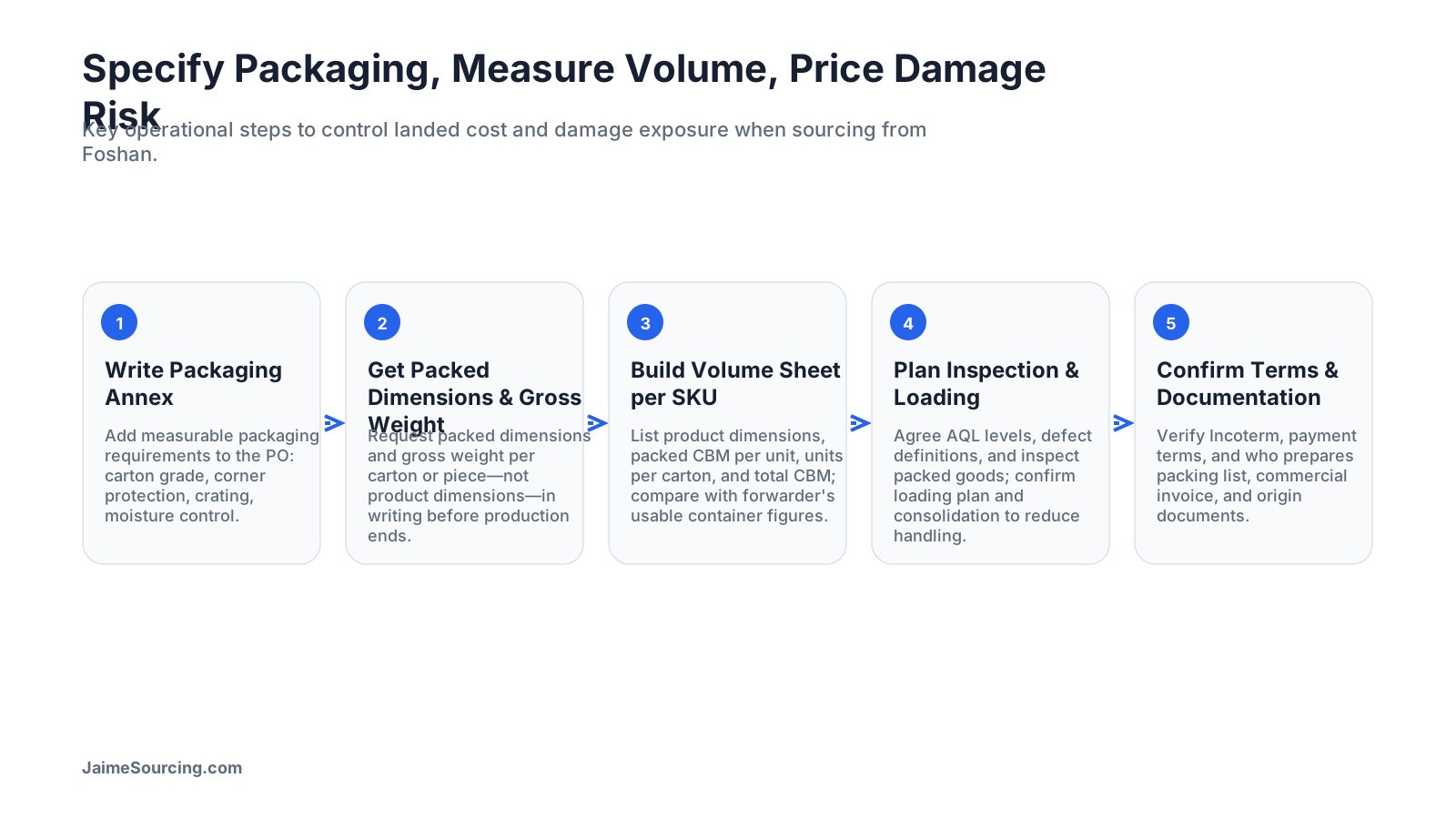
Vague instructions like “pack for export” produce vague results. Build a packaging annex to your purchase order with measurable requirements. The following is a workable structure; adjust the specifics to your product and confirm them with your supplier and freight forwarder.
| Product type | Packaging element to specify | What to inspect at pre-shipment |
|---|---|---|
| Upholstered sofas and chairs | Reinforced carton or woven bag, foam corner guards, stretch wrap, edge board | Compression at corners, fabric contact with packing tape, moisture barrier |
| Wooden casegoods | Corner protection, foam interleaving, desiccant, carton burst strength | Joint protection, drawer and door immobilisation, humidity indicator |
| Glass, mirror, marble, stone tops | Timber crate or frame, foam separation, “fragile” marking, no direct stacking | Crate construction, internal bracing, weight distribution |
| Tiles and sanitaryware | Palletised, edge-protected, shrink-wrapped, pallet grade stated | Pallet integrity, breakage count per pallet, moisture |
| Flat-pack / RTA furniture | Carton grade, hardware bagging, assembly instructions enclosed | Carton drop test result, hardware count, label accuracy |
| Lighting and soft furnishings | Individual cartons, anti-static where relevant, moisture control | Carton condition, plug/voltage labelling for destination |
Two practical rules. First, ask for the packed dimensions and gross weight per carton or per piece in writing before production ends — not the product dimensions. Second, ask the factory to photograph the packing process, not just the finished pallet. Packing photos taken at the factory are the cheapest evidence you will ever get, and they are far more useful than a photo of a showroom sample.
Volume: The Cost Driver Most Buyers Underestimate
Ocean and air freight are priced on chargeable weight, which is the greater of actual weight and volumetric weight. Furniture is bulky and light, so volumetric weight almost always governs. A sofa that ships “efficiently” in a showroom can be catastrophically expensive once crated. Model volume before you commit.
Build a simple volume sheet per SKU with these columns: product dimensions, packed dimensions, packed CBM per unit, units per carton, cartons per pallet, pallets per container, and total CBM for your order quantity. Then compare that total against container capacity. A 20ft container, 40ft container and 40ft high-cube each have different usable internal volumes, and usable volume is always less than nominal because of pallets, crates and load gaps. Confirm the exact usable figures with your forwarder for your specific loading method — do not assume a nominal number.
Three levers reduce volume cost:
- Knock-down design. Flat-pack or partially disassembled furniture can cut packed volume substantially, but only if the factory is set up for it and the assembly instructions and hardware are complete. Ask whether the model is genuinely designed for RTA or merely disassembled as an afterthought.
- Nesting and stacking. Chairs that nest, tables that stack and casegoods that cube out well change the economics. Ask the factory for a loading plan, not just a CBM figure.
- Consolidation. If you buy from several Foshan suppliers, consolidating at one warehouse before container loading reduces re-handling and lets you optimise the load. Foshan-based forwarders operate consolidation warehouses for exactly this reason, and sourcing agents coordinate the handover of packing and shipping documents.
For LCL shipments, you pay for the space you occupy, and LCL cargo is handled more times than FCL cargo. More handling means more damage exposure, which is why packaging grade matters more, not less, on small reseller orders.
Damage Risk: Where Breakage Actually Comes From
Damage in Foshan-origin furniture and building materials tends to cluster in predictable places. Understanding the mechanism lets you target inspection.
- Corner and edge impact. Casegoods, tables and crated stone take hits at corners during loading, transhipment and delivery. Corner protection and crate bracing are the controls.
- Compression and stacking. Upholstery and cartons crushed under heavier freight. Load planning and “do not stack” marking are the controls, but marking is only as good as the handler.
- Moisture and humidity. Long ocean transit through humid zones causes mould on leather, fabric and wood, and corrosion on metal hardware. Desiccant, moisture-barrier wrapping and container condition are the controls.
- Handling damage on LCL and parcel legs. Every additional touch point adds risk. Consolidating and shipping FCL where volume allows reduces touch points.
- Concealed manufacturing defects. Loose joints, insufficient foam density, incorrect hardware — these are quality issues that packaging cannot fix. They are caught by pre-shipment inspection, not by better cartons.
This is where AQL inspection earns its place. Under ISO 2859-1 / ANSI/ASQ Z1.4, a common starting point for consumer goods is General Inspection Level II with Critical 0 / Major 2.5 / Minor 4.0 — but treat that as an example, not a universal rule. Critical defects are those that make the product unsafe or unsaleable (structural failure, sharp edges, electrical hazards); Major defects are functional or appearance failures a customer would reject; Minor defects are cosmetic deviations within tolerance. Agree the defect definitions and the AQL levels with your inspector and supplier in writing before the inspection, and inspect packed goods where possible so you also see the packaging.
Incoterms, Payments and the “Tax-Inclusive DDP” Trap
Packaging and volume decisions interact with your Incoterm. Under EXW, you take control at the factory and own the entire export, freight and import chain — maximum control, maximum administrative burden. Under FOB, the supplier delivers to the named port and handles export clearance, and you control the main carriage and import. Under DDP, the seller delivers to your door with duties paid, which sounds simple but concentrates risk: you often cannot see the origin charges, the classification or the duty treatment, and non-compliant “tax-inclusive” DDP arrangements that understate value or misclassify goods can create liability for you as the importer of record. For furniture and building materials, where duty rates and product rules vary by destination, confirm the current official tariff and product-compliance rules for your jurisdiction (US, UK, EU, Canada or Australia) before agreeing to DDP.
On payment, overseas buyers paying Chinese suppliers typically use T/T with a deposit and balance against pre-shipment inspection or bill of lading. Watch bank charges (often deducted from the received amount), FX exposure between quote and payment, and platform fees if you use Trade Assurance. Pay the company that appears on the contract and the invoice — corporate accounts, not personal accounts — and agree in writing who bears sample-payment and remittance fees.
What to Verify Before You Proceed
Before you release a deposit on a Foshan furniture or building-materials order, verify the counterparty and the plan.
- Company identity. Use the Chinese National Enterprise Credit Information Publicity System to confirm the legal name, Unified Social Credit Code, establishment date and registered capital. Cross-check on Tianyancha or Qichacha for shareholders, branches, abnormal-operation listings and litigation. Registered capital is not paid-in capital — a high registered figure does not prove the company has cash or capacity — and a recently established entity may be a trading shell rather than a factory.
- Factory versus trader. Ask for the business licence address and compare it with the production address. A showroom in Lecong is not evidence of a factory.
- Packaging annex. Confirm packed dimensions, gross weight, carton grade, crating specification and who pays for export packing.
- Volume sheet. Get packed CBM per SKU and a loading plan, and validate it against your forwarder’s usable container figures.
- Inspection scope. Agree AQL levels, defect definitions, inspection timing (pre-shipment, packed goods) and who attends.
- Incoterm and payment terms. Confirm EXW/FOB/DDP, origin charges, duty responsibility, deposit percentage and bank-fee allocation in writing.
- Documentation handover. Confirm who prepares packing lists, commercial invoice, certificate of origin and any product-compliance documents, and check the current official requirements for your destination.
FAQ
How much does export packaging add to the unit cost of Foshan furniture?
Export-grade packaging typically adds a meaningful but variable amount per unit, driven by carton grade, crating and labour, and there is no universal percentage. Ask each supplier to quote standard and export packing separately so you can see the delta, then compare it against your expected damage and replacement cost — for bulky or fragile items, better packing usually pays for itself.
Is LCL or FCL better for a small Shopify furniture order?
LCL is workable for small volumes but exposes goods to more handling, so packaging grade matters more. FCL becomes more economical and lower-risk once your volume fills a meaningful share of a container. Model both against your packed CBM and confirm current rates with your forwarder, since the crossover point moves with freight markets.
Can I rely on the factory’s own photos as proof of packaging quality?
Factory photos are useful evidence but not verification. Ask for dated photos of the packing process, packed cartons with dimensions visible, and pallet or crate construction. For higher-value orders, a third-party pre-shipment inspection of packed goods gives independent confirmation. Photos alone cannot confirm carton strength or moisture control.
What causes mould on furniture shipped from Foshan?
Mould usually comes from moisture trapped in packaging during long humid transit, often combined with inadequate desiccant or a damp container. Specify moisture-barrier wrapping and desiccant, and ask about container condition. Leather, fabric and wood are the highest-risk materials, so include moisture checks in your inspection scope.
Do I need a sourcing agent if I already have a freight forwarder?
A forwarder moves cargo; it does not manage supplier follow-up, packaging specifications or pre-shipment inspection across multiple factories. If you are buying from several Foshan suppliers, an agent coordinates the purchasing plan, inspection and packing handover. Many buyers use both — the agent manages the supplier side, the forwarder manages the carriage.
Manage the Risk, Don’t Absorb It
The real exposure in Foshan sourcing is not a single bad carton — it is quality drift across production runs, factory follow-up that stalls when you are asleep, and the physical and time-zone distance between your desk and a loading bay in Shunde. Those risks compound quietly until a container arrives with crushed corners, mismatched hardware or a moisture problem you cannot prove was the factory’s fault.
That is the gap a ground team closes. Jaime Sourcing supports overseas buyers with supplier research and verification, inspection and quality control, consolidation, packing coordination and shipment coordination — so packaging specifications are enforced at the factory, packed volume is checked before you book freight, and someone is physically present when it matters. If you are planning a Foshan furniture or building-materials order, talk to Jaime Sourcing about a supplier check or a workflow review before you release a deposit.
Turn your product and order requirements into a controlled sourcing brief.
Share the product, supplier link, quantity, destination and current order stage. We will identify the practical verification, quality-control, packing and shipping steps.