Below roughly 15 CBM, LCL is usually the cheaper way to move a China order. Above roughly 15–20 CBM, FCL almost always wins on total cost per CBM — but only if you price the full LCL invoice, not just the per-CBM ocean rate. LCL quotes look simple and are not: they carry origin and destination charges that FCL bundles into the container rate. For your next replenishment, compare landed cost per sellable unit, not freight per CBM, and treat the 15 CBM line as a prompt to quote both modes rather than a rule.
What LCL and FCL actually mean for your order
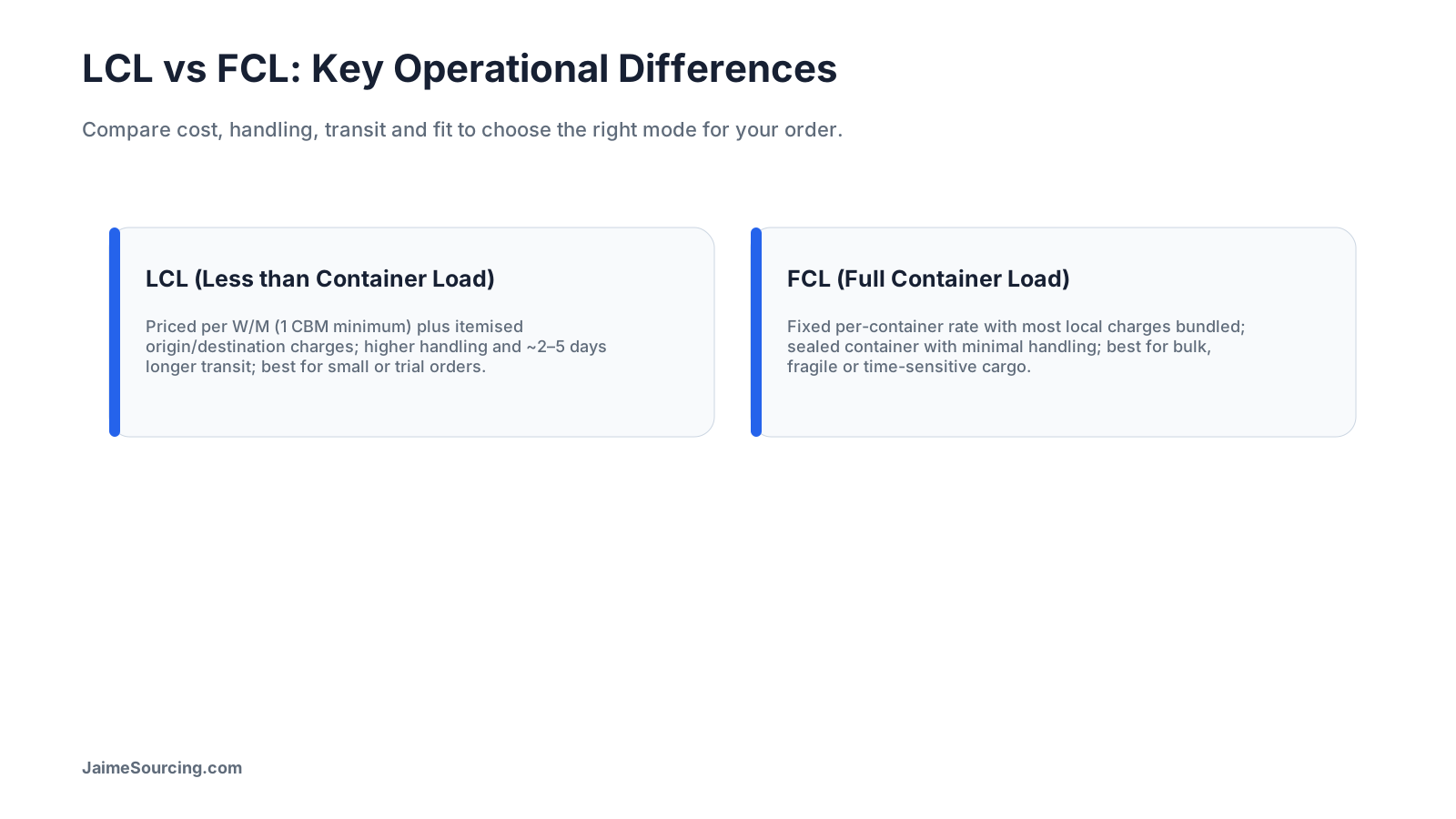
FCL (full container load) means one shipper books an entire container — commonly 20ft or 40ft — and pays a fixed rate whether or not it is full. The container is loaded, sealed at origin and opened at destination, with one shipper, one consignee and one bill of lading. LCL (less than container load) means your cartons share a container with other shippers’ cargo; you pay only for the space you occupy, and the freight forwarder consolidates at origin and deconsolidates at destination.
That structural difference drives everything else. LCL cargo is handled more times — into the CFS, into the container, out of the container, out of the destination CFS — which is why carriers and forwarders describe higher damage risk and longer transit for LCL than FCL. FCL keeps your goods inside one sealed box from origin yard to destination yard, which is why high-value, fragile or time-sensitive categories are often steered toward FCL.
One terminology point worth getting right before you negotiate: FCL/LCL describes the transport mode, while CY-CY and CFS-CFS describe the handover points written on the bill of lading. CY is the container yard for sealed full containers; CFS is the warehouse where LCL cargo is consolidated and split. A forwarder quoting “CFS-CFS” is quoting standard LCL; “CY-CY” is standard FCL. Mixed combinations exist — for example, several suppliers’ LCL cargo consolidated into one FCL at origin (buyer’s consolidation) — and they change who touches your goods and where.
The cost comparison: why the per-CBM rate misleads
LCL is priced on W/M — the greater of weight in metric tonnes or volume in cubic metres — so a quote of, say, $100 W/M on 10 CBM of light cargo bills as $1,000. Published China-origin LCL rates in the research sit around $35–$60 per CBM on major lanes, with a 1 CBM minimum chargeable volume and additional per-shipment fees averaging $150–$350. FCL is priced per container: a 20ft box (roughly 28 CBM of nominal capacity) is quoted at $1,500–$4,500 depending on lane, season and market.
The critical difference is what sits outside the headline rate. On an LCL invoice you typically see origin and destination local charges itemised separately — handling, documentation, terminal operations, CFS work — because you are paying a share of shared container handling. On FCL, much of that container handling is bundled into the all-in freight. This is why a cheap LCL per-CBM rate can lose to FCL once the fixed per-shipment charges are added, especially as volume climbs.
| Factor | LCL | FCL |
|---|---|---|
| Pricing basis | Per W/M (greater of CBM or tonnes), 1 CBM minimum | Fixed per container, regardless of load |
| Typical China-origin rate | ~$35–$60 per CBM plus $150–$350 per-shipment fees | ~$1,500–$4,500 per 20ft container |
| Local charges | Itemised at origin and destination, scaled to your W/M | Largely bundled into container freight |
| Practical break-even | Usually economical below ~15 CBM | Usually cheaper per CBM above ~15–20 CBM |
| Transit time | FCL time plus roughly 2–5 days for consolidation/deconsolidation | Baseline ocean transit |
| Cargo handling | Multiple handlings at CFS both ends; higher damage risk | Sealed container, minimal handling |
| Best fit | Small, trial or mixed-SKU orders | Bulk, fragile, high-value or time-sensitive cargo |
Two cautions on these numbers. First, they are indicative ranges from the supplied research, not quotes — ocean rates move with season and capacity, and peak-season surcharges can add 10–30%. Second, the break-even is not a law. At exactly 15 CBM the research itself shows LCL at roughly $925 versus FCL at roughly $2,500 before local charges and surcharges, with the gap closing as volume rises. Request both quotes on the same Incoterm, same lane and same week, then compare total door-to-door cost.
Risk, transit time and the hidden cost of sharing a container
LCL adds roughly 2–5 days to ocean transit because your cargo waits for consolidation at origin and is deconsolidated at destination. For a Shopify brand running a lean inventory cycle, that extra week can matter more than the freight saving — it affects reorder points, ad spend timing and whether you air-freight an emergency top-up at $4–$8 per kg.
The physical risk is real but manageable. Shared containers mean more loading and unloading, so cartons face more handling and compression. Non-stackable or dangerous goods can attract surcharges on LCL. The practical mitigations are unglamorous: export-grade cartons with adequate burst strength, clear and durable shipping marks so your cargo is identifiable in a warehouse full of other shippers’ goods, inner protection for fragile items, and a pre-shipment inspection that checks packing as well as product. If your product is high-value, fragile or has a hard launch date, the FCL premium is often cheaper than the cost of a damaged or late LCL arrival.
There is also a control dimension. FCL gives you more control over loading, timing and who touches the box; LCL gives you flexibility but less control. For a first order or a test batch, that trade is usually worth it. For a repeat hero SKU, it usually is not.
Incoterms, DDP and where the money actually goes
Your mode decision is inseparable from your Incoterm. Under EXW, you carry risk and cost from the factory door, including China inland haulage and export clearance. Under FOB, the supplier delivers to the port and you take over from there — ocean freight, destination charges, import duty and clearance are yours. Under DDP, the supplier or forwarder quotes a delivered price, but the quality of that arrangement varies enormously: a “tax-inclusive DDP” quote that does not clearly state the declared value, duty rate, importer of record and VAT/GST treatment is a compliance risk, not a convenience. Customs rules differ by jurisdiction — US, UK, EU, Canada and Australia each have their own valuation, duty and import VAT/GST regimes — so confirm the current official rule for your destination and make sure the importer of record is a legitimate entity.
For payments to Chinese suppliers, the practical controls are the same regardless of shipping mode: agree T/T terms in writing (deposit and balance against inspection or bill of lading), budget for bank charges on both ends, and understand FX exposure if you are quoted in RMB but sell in USD, GBP or EUR. Trade Assurance-style platform protection carries fees and only covers what is documented in the order. Pay the company account named on the contract and business licence, not a personal account, unless you have verified the relationship in writing. For samples, agree upfront who absorbs courier and transfer fees — small amounts are where disputes start.
Supplier verification before you book any container
Before you commit to a mode, verify the supplier behind the cargo. Use the Chinese National Enterprise Credit Information Publicity System for the official registration record, and cross-check with commercial databases such as Tianyancha or Qichacha. Read four fields carefully: the Unified Social Credit Code (match it exactly to the code on the contract and invoice), the establishment date (a company registered months ago is not automatically a problem, but it changes how much you verify), registered capital versus paid-in capital (registered capital is a subscribed figure, not money in the bank — paid-in capital is the better signal of financial substance), and the business scope (confirm manufacturing or trading scope covers your product). Also check for abnormal-operation listings and legal disputes. None of this replaces a factory audit or a pre-shipment inspection, but it filters out the obvious mismatches before you wire a deposit.
What to Verify Before You Proceed
- Quote both modes on identical terms. Same lane, same Incoterm, same week, itemised origin and destination charges for LCL and an all-in FCL rate.
- Confirm chargeable volume, not carton volume. Measure the packed pallet or carton dimensions; W/M uses the greater of weight or volume.
- Check the handover terms on the draft bill of lading. CY-CY versus CFS-CFS tells you where your cargo is touched.
- Stress-test transit time against your reorder point. Add the 2–5 day LCL consolidation buffer to your planning.
- Verify the supplier’s Unified Social Credit Code, paid-in capital and business scope via the National Enterprise Credit Information Publicity System, Tianyancha or Qichacha.
- Confirm the importer of record and duty/VAT treatment for your destination jurisdiction before accepting any DDP quote.
- Inspect packing and shipping marks, not just the product, before consolidation.
FAQ
Is LCL always cheaper than FCL for small orders?
Usually yes below roughly 15 CBM, but not automatically — LCL carries itemised origin and destination charges that can erode the saving on very small shipments. Compare total door-to-door cost, including local fees, rather than the per-CBM ocean rate alone.
At what volume should I switch from LCL to FCL?
The research points to roughly 15 CBM as the practical break-even, with FCL usually cheaper per CBM above 15–20 CBM. Treat that as a trigger to quote both modes, not a fixed rule, because lane, season and cargo weight all shift the number.
How much longer does LCL take than FCL?
LCL typically adds about 2–5 days to ocean transit because cargo must be consolidated at origin and deconsolidated at destination. On a Shanghai–Los Angeles lane, FCL runs roughly 15–25 days, so plan your reorder point with that buffer included.
Is LCL riskier for fragile or high-value products?
Yes — shared containers mean more handling, and forwarders generally flag higher damage risk for LCL than FCL. For fragile, high-value or launch-critical cargo, the FCL premium is often cheaper than the cost of a damaged or delayed arrival.
Does DDP remove my customs responsibility?
No. A DDP quote shifts commercial responsibility to the seller, but a vague “tax-inclusive” arrangement can hide undeclared value or incorrect duty and VAT treatment, which remains a compliance exposure for you. Confirm the importer of record, declared value and destination-country rules before accepting it.
The distance problem is the real problem
Choosing between LCL and FCL is a spreadsheet decision you can make in an afternoon. What actually erodes margin is everything around it: quality drifting between the approved sample and the production run, a factory that goes quiet for two weeks, packing that looked fine in photos and arrives crushed, and a 12-hour time-zone gap that turns every follow-up into a two-day loop. Those risks do not care which container mode you booked.
That is where having a ground team in China changes the economics. Jaime Sourcing supports overseas buyers with supplier research and verification, inspection and quality control, consolidation, packing and shipment coordination — the physical, on-the-ground work that sits between your purchase order and your freight booking. If you are weighing LCL against FCL for an upcoming order, or you want a second pair of eyes on a supplier before you wire a deposit, talk to Jaime Sourcing about a supplier check or a workflow review.
Turn your product and order requirements into a controlled sourcing brief.
Share the product, supplier link, quantity, destination and current order stage. We will identify the practical verification, quality-control, packing and shipping steps.