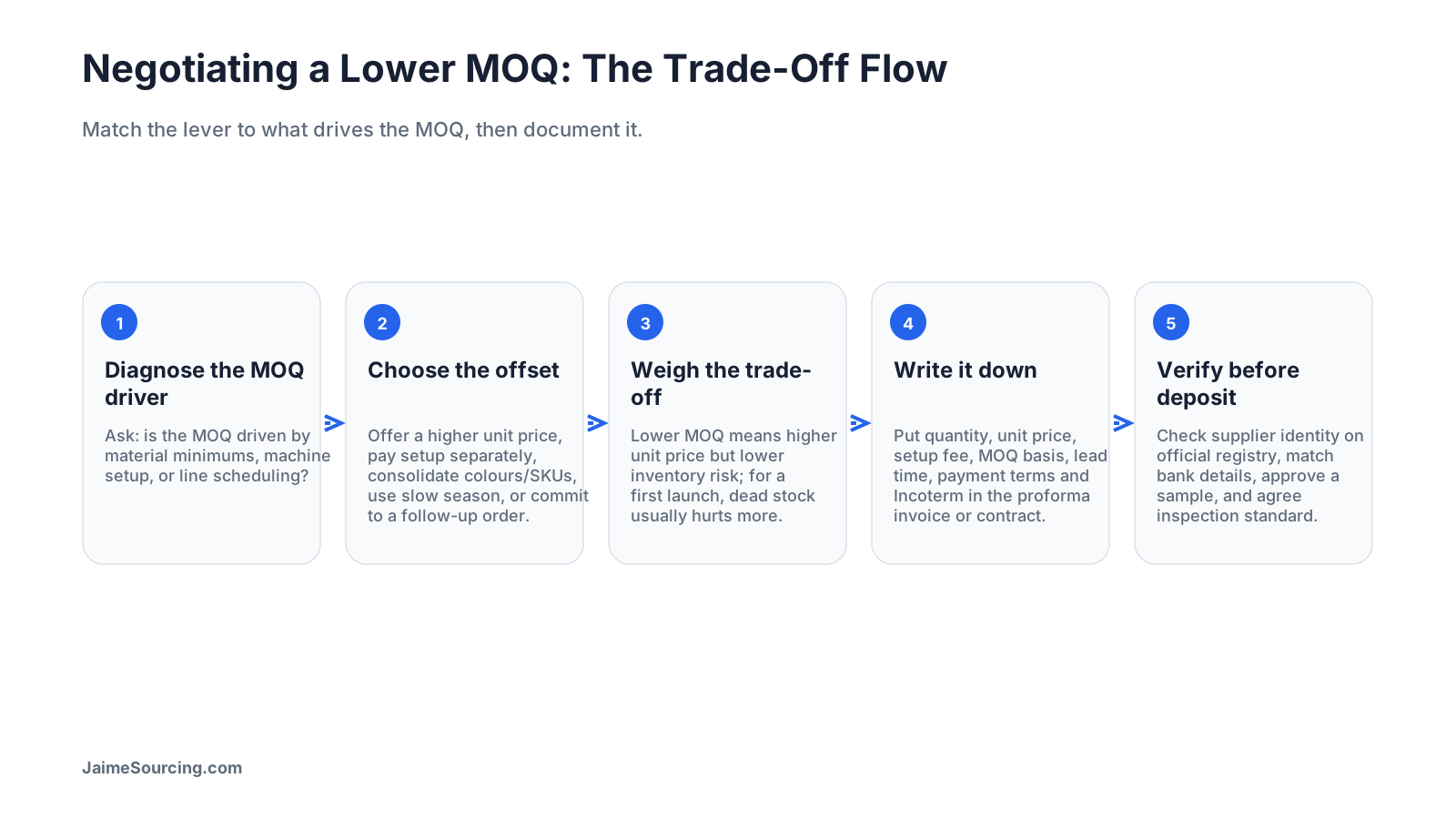
You can usually negotiate a lower MOQ with a Chinese manufacturer by addressing the reason the MOQ exists rather than asking for a discount on quantity. In practice that means offering to pay a higher unit price, covering setup or tooling costs, consolidating colours or SKUs into one production run, ordering in the factory’s slow season, or committing to a documented follow-up order. Most consumer-goods MOQs sit around 500–2,000 units per SKU, and trial-order reductions of roughly 20–50% are commonly achievable, usually at a 10–30% unit-price premium. The rest of this guide shows a Shopify reseller how to run that negotiation without wrecking margin, cash flow or the supplier relationship.
Why the MOQ Exists (and Where the Real Leverage Is)
MOQ is not arbitrary. More than 60% of Chinese suppliers set MOQ around production-line efficiency and raw-material purchasing. A factory amortises fixed costs — machine setup, colour matching, mould changes, minimum material buys — across the batch. If you order 100 units against a fixed setup cost of ¥1,000, that cost is ¥10 per unit; at 3,000 units it falls to about ¥0.30 per unit. That is why a tiny order either loses the factory money or gets priced to compensate.
Your leverage comes from reducing or sharing those fixed costs. Before you negotiate, ask the supplier one diagnostic question: “Is your MOQ driven by material minimums, machine setup, or line scheduling?” The answer tells you which tactic below will actually work.
Also clarify the unit of MOQ. Suppliers may quote MOQ per SKU, per colour, or per total order. A supplier asking for 1,000 units per colour is a very different negotiation from 1,000 units total across three colours.
The Core Trade-Offs: What Lower MOQ Actually Costs You
Lower MOQ is not free. Expect the unit price to rise 10–30% when you cut batch size, because fixed setup costs are spread over fewer pieces. A toy factory with a $1,000 setup charge adds $1 per unit at 1,000 units but $2 per unit at 500. Smaller raw-material buys can also raise material cost.
| Lever you offer | Typical effect on unit price | Effect on your cash/inventory risk | Best used when |
|---|---|---|---|
| Pay a higher unit price for a smaller batch | +10–30% | Lower inventory exposure | Testing a new product |
| Pay the setup/tooling fee separately | Cost shifted to a one-off fee | Predictable, but upfront cash | Custom colours or moulds |
| Mix colours/SKUs in one run | Often neutral or small premium | Spreads risk across variants | You sell multiple variants |
| Order in the factory’s slow season | Sometimes no premium | Same as normal | You can plan ahead |
| Commit to a follow-up order | May hold price flat | Requires discipline to honour it | You have demand evidence |
The right choice depends on whether your bigger risk is margin (then protect price and accept higher MOQ) or dead stock (then accept a higher unit price for a smaller first batch). For a first Shopify launch, unsold inventory usually hurts more than a 15% unit-price premium.
Seven Negotiation Tactics That Work
1. Lead with a trial order and a plan. Frame the first order as a market test with a stated intention to reorder. Suppliers respond to credible long-term potential. Share your launch plan and, if you have one, evidence of your sales channel.
2. Offer a higher unit price. Explicitly trade price for quantity: “We’ll pay $X per unit for 500 instead of the standard 1,000.” A 10–15% premium to cover fixed costs is a recognised approach.
3. Pay setup or tooling separately. If the MOQ is driven by a mould or colour-matching cost, offer to pay that as a one-off line item so the per-unit economics still work for the factory.
4. Consolidate colours and SKUs. Ask whether the MOQ can apply to the total order rather than per colour — e.g. 1,000 units split across three colours instead of 1,000 each.
5. Use the slow season. Factories with spare capacity are more willing to take small runs. Ask about their production calendar.
6. Standardise materials or design. Accepting a standard material or existing design can lower the factory’s setup burden and soften MOQ.
7. Get competing quotes — carefully. Alternative quotes give you a benchmark, but use them as leverage without damaging the relationship.
Across these tactics, the principle is the same: understand the supplier’s cost structure, then offer something that offsets the smaller batch.
Turning the Deal Into a Written Agreement
A verbal MOQ concession is worthless at production time. Put the agreed quantity, unit price, any setup fee, the MOQ basis (per SKU vs. total), lead time and payment terms into the proforma invoice or contract. This protects you if a different salesperson or production planner handles your order later.
For payment, overseas buyers typically use T/T. Clarify who absorbs bank fees on both ends, whether the quote is in USD or RMB (and who carries FX risk), and whether any platform Trade Assurance fee applies. Pay the company’s corporate account, not a personal one, and agree in writing how sample costs and courier fees are allocated before you send money.
What to Verify Before You Proceed
Before you commit to any reduced-MOQ order, verify the supplier is a real, operating business — not just a responsive chat account.
- Chinese National Enterprise Credit Information Publicity System: the official registry. Check the company’s Unified Social Credit Code, establishment date, business scope and status.
- Tianyancha / Qichacha: commercial databases that add shareholder, litigation and change-history context. Useful for cross-checking the official record.
When reading these records, distinguish registered capital (a declared figure) from subscribed vs. paid-in capital (what shareholders have actually contributed). A high registered capital with low paid-in capital is common and not automatically a red flag, but it tells you the company may be thinly funded. Confirm the establishment date — a very new entity warrants more caution — and make sure the Unified Social Credit Code on the registry matches the name on your proforma invoice and bank details.
If the order involves custom tooling or a large first batch, arrange a pre-production sample and, where practical, a third-party inspection. For quality control, AQL sampling under ISO 2859-1 / ANSI/ASQ Z1.4 at General Inspection Level II is a common framework. Critical, Major and Minor defects are classified separately; Critical 0 / Major 2.5 / Minor 4.0 is a frequently used example, not a universal rule — agree the levels with your inspector and supplier in advance.
Landed Cost and Incoterms: Don’t Let a “Cheap” MOQ Hide the Real Cost
A lower MOQ changes your freight economics. Small batches usually ship via express or air, while larger batches justify sea freight; full-container loads are typically cheaper per unit than less-than-container loads, but only if you can actually sell the volume. Excess stock ties up cash and adds storage cost.
Be precise about Incoterms:
- EXW (Ex Works): you bear origin charges, export clearance and all onward logistics.
- FOB (Free On Board): the supplier covers costs up to loading at the origin port; you take over from there.
- DDP (Delivered Duty Paid): the seller handles everything to your door — but be wary of vague “tax-inclusive” DDP quotes that under-declare value. Non-compliant declarations can cause customs seizures or returns, and the liability can land on you as importer.
For customs and product-compliance rules, the requirements differ by jurisdiction (US, UK, EU, Canada, Australia) and change over time — always check the current official rule for your destination and product category rather than relying on a supplier’s assurance.
Pre-Deposit Checklist
Run this before paying a deposit on any reduced-MOQ order:
- MOQ basis confirmed in writing (per SKU, per colour, or total).
- Unit price, setup fee and any premium documented on the proforma invoice.
- Supplier identity matched across registry, invoice and bank account.
- Sample approved and inspection standard (e.g. AQL levels) agreed.
- Incoterm and who pays origin charges, freight, duty and clearance stated clearly.
- Payment terms, bank-fee allocation and FX currency agreed.
Frequently Asked Questions
How much can a small brand realistically reduce a Chinese supplier’s MOQ?
Trial-order reductions of roughly 20–50% are commonly achievable, especially for new products or first orders, usually at a 10–30% higher unit price. The exact figure depends on what drives the MOQ — material minimums, setup costs or scheduling — so ask the supplier directly before proposing a number.
Is it better to pay more per unit or accept a higher MOQ?
For a first Shopify launch, paying more per unit to keep the batch small usually protects you from dead stock, which often costs more than a modest price premium. Once you have proven demand, shift toward larger batches to recover margin.
Can I mix colours or SKUs to meet the MOQ?
Often yes. Ask whether the MOQ applies to the total order rather than per colour, so three colours can share one 1,000-unit run instead of requiring 1,000 each. Confirm the agreed basis in writing so production doesn’t revert to per-colour minimums.
Does a lower MOQ make shipping more expensive per unit?
Usually yes. Small batches tend to ship by express or air, while larger volumes can use sea freight with lower per-unit cost. Factor this into your landed cost before assuming a smaller order is cheaper overall.
How do I confirm a supplier is legitimate before negotiating?
Cross-check the company on the Chinese National Enterprise Credit Information Publicity System and commercial databases like Tianyancha or Qichacha. Verify the Unified Social Credit Code, establishment date and paid-in capital, and ensure the bank account name matches the registered company.
Manage the Distance, Not Just the Price
Negotiating a lower MOQ is only the first move. The harder, ongoing risks are quality drift between the approved sample and mass production, factory follow-ups when a small order slips down the production queue, and the time-zone and physical distance that make problems slow to catch from the US, UK, EU, Canada or Australia. A reduced batch leaves little room for rework, so inspection and communication discipline matter more, not less.
Jaime Sourcing acts as your ground team in China — covering supplier research, verification, inspection, quality control, consolidation, packing and shipment coordination. If you’re planning a reduced-MOQ order and want a second pair of eyes on the supplier or the workflow, talk to Jaime Sourcing for a supplier check or workflow review before you place your deposit.
Turn your product and order requirements into a controlled sourcing brief.
Share the product, supplier link, quantity, destination and current order stage. We will identify the practical verification, quality-control, packing and shipping steps.