If you are a Shopify reseller deciding between OEM, ODM, white label and private label, start with how much of the product you actually control — not the label a supplier puts on its quotation. White label is the quickest route to market because the product already exists; private label adds your own brand and packaging to a product you help define; ODM lets you reuse a manufacturer’s existing design platform with limited customisation; OEM gives you the deepest control but demands the most engineering, tooling and verification work. The real decision is about design ownership, IP, compliance responsibility and total cost — not terminology.
This guide is written for overseas buyers sourcing from China, not for mainland sellers exporting abroad. It explains how the four models differ in practice, where suppliers blur the definitions, and what to check before you pay a deposit.
The Four Models, Defined by Who Controls What
The terms are used inconsistently across industries and contracts, so treat any definition as a working one and confirm the actual scope in writing. What matters is who controls design, who does the engineering, who owns each output, and who may reuse it.
- OEM (Original Equipment Manufacturer): the supplier manufactures to your design or detailed specification, and the product carries your brand. You hold design authority; the factory converts your drawings, BOM and specs into a product and does not own the IP or sell the finished item under its own name.
- ODM (Original Design Manufacturer): the supplier invests in development and offers an existing design platform, which you then customise to an agreed degree before branding. The factory’s engineering team shortens your development path, but it typically retains deeper technical knowledge of the platform.
- White label: you select a relatively mature, existing product and sell it under your brand with minimal physical change. The manufacturer produces generic goods sold to multiple retailers under different brands.
- Private label: a third-party manufacturer produces to specifications associated with the retailer, and the retailer markets it under its own brand. Private label is usually positioned as unique to one retailer, whereas white label is generic and shared across many.
Paying for the goods does not automatically transfer ownership of drawings, moulds, firmware or test fixtures, and a supplier doing development does not automatically own the results either — ownership is set by contract and applicable law.
Comparison Table: Speed, Control, Cost and Risk
| Dimension | White label | Private label | ODM | OEM |
|---|---|---|---|---|
| Who designs the product | Supplier (existing product) | Shared; you specify, supplier executes | Supplier platform, you customise | You |
| Time to first sale | Fastest | Fast to moderate | Moderate | Slowest |
| Upfront engineering burden | Minimal | Low | Medium | High |
| Differentiation potential | Lowest | Low to medium | Medium | Highest |
| Typical IP ownership question | Brand and packaging only | Brand, packaging, some specs | Platform IP vs project outputs | Your design, plus tooling and files |
| Main risk | Many sellers offer the same item | Supplier dependency and consistency | Blurred ownership of improvements | Tooling cost, validation and certification load |
| Best fit | Testing a category quickly | Building a branded range on proven products | Custom look on proven engineering | Defensible, spec-driven products |
The table exposes trade-offs rather than prescribing a winner. White label is often fastest because the product and supply chain already exist, ODM can shorten part of development by starting from a mature platform, and OEM offers the deepest differentiation but usually requires more engineering, prototypes, tooling, validation and certification work. None of these patterns sets your quotation — MOQ and unit price also depend on material purchasing, surface finishing, electronics, packaging, testing time, line changeovers, warranty provisioning and forecast stability.
How to Choose: A Decision Sequence for Ecommerce Brands
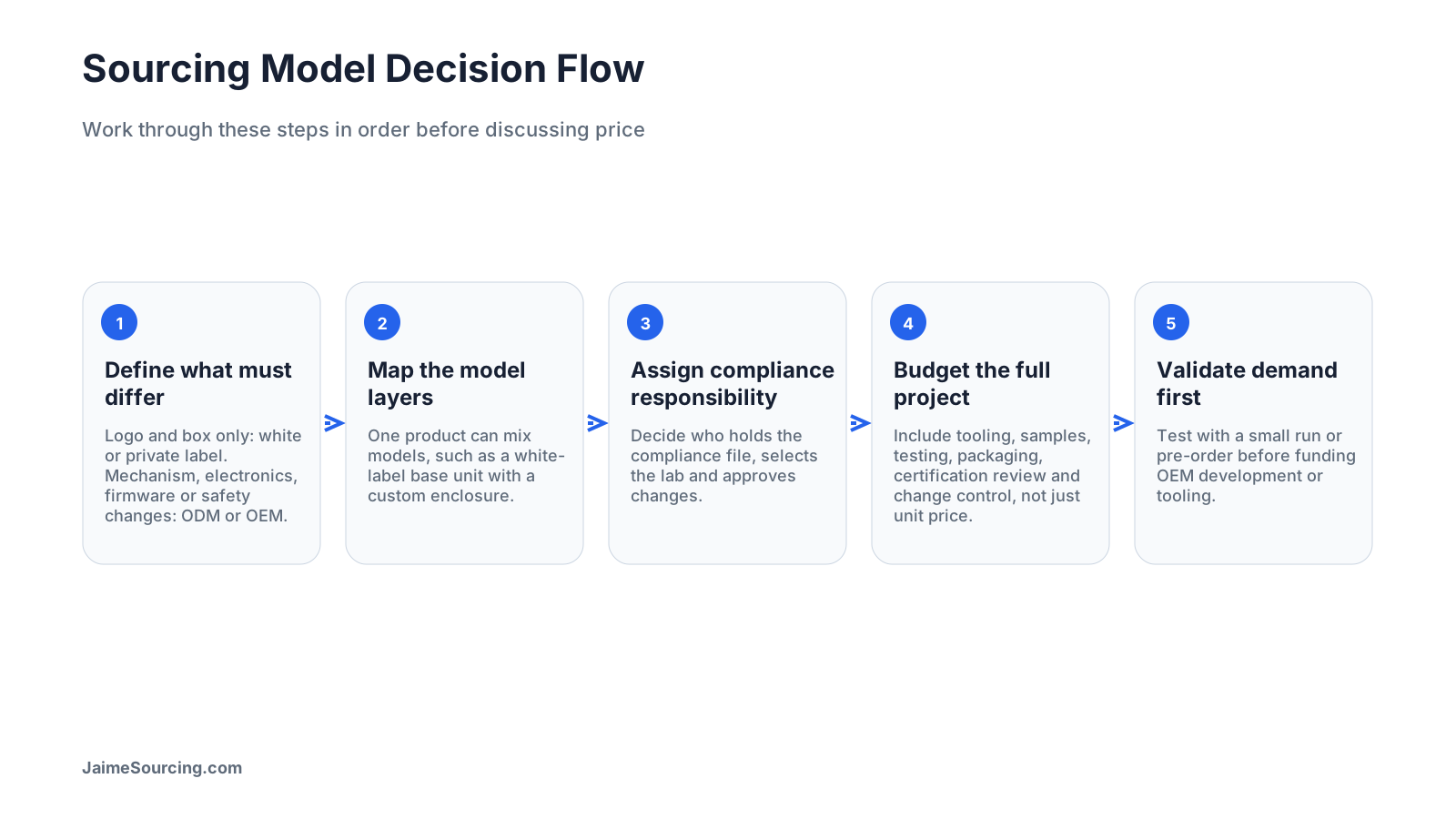
Work through these steps in order rather than starting with a supplier’s price list.
- Define what must be different. If the answer is “only the logo and box,” white label or private label is proportionate. If the answer involves a changed mechanism, electronics, firmware or safety configuration, you are in ODM or OEM territory.
- Map the layers. A single product can mix models — for example, a white-label base unit with a custom enclosure. Bathroom products illustrate this: changing colour and packaging is a different job from redeveloping ceramics, valve modules, PCBs, firmware state machines or certification configurations.
- Decide who holds the compliance file. Ask who identifies requirements, selects the lab, prepares samples, holds the product listing, pays for failed tests, maintains technical documentation, approves changes and handles surveillance audits or renewals.
- Budget the full project, not the unit price. Include tooling, samples, testing, packaging, certification review and the cost of change control. A cheap first quote with undefined change, evidence and ownership can carry the highest total cost.
- Test the market before committing to tooling. Validate demand with a small run or pre-order before funding OEM development; the OEM route suits brands that can absorb that development work.
Supplier Checks: Reading a Chinese Factory’s Registration Data
Before you discuss models, confirm the entity you are dealing with. Use the Chinese National Enterprise Credit Information Publicity System (National Enterprise Credit Information Publicity System) for official registration data, and commercial databases such as Tianyancha or Qichacha for cross-checks and history. These tools are named for identification only; verify current data directly.
Key fields and what they actually tell you:
- Unified Social Credit Code (Unified Social Credit Code): the 18-character identifier for the legal entity. Match it exactly against the name on the quotation, proforma invoice and bank account.
- Registered capital (registered capital): a subscribed figure, not cash in the bank. It signals scale on paper, not capability.
- Subscribed vs paid-in capital (subscribed vs paid-in): subscribed is what shareholders committed; paid-in is what has actually been contributed. A large subscribed figure with little paid-in capital is common and should not be read as proof of financial strength.
- Establishment date (establishment date): a very recent entity trading under an older brand name deserves a question about related companies and factory ownership.
- Business scope (business scope): check that manufacturing activity is within scope; a trading-only scope with a “factory” claim is a prompt for further verification.
Pair the database check with a physical or video factory review of the raw-material warehouse and production line, and confirm quality standards and lead times with the person who actually controls production. A factory visit or demo provides context but does not replace evidence for the specific model you are buying.
Quality Control and Inspection: Setting AQL Before Production
Agree the inspection standard in the purchase contract, not after defects appear. Many buyers use AQL sampling based on ISO 2859-1 / ANSI/ASQ Z1.4, General Inspection Level II, with defect classes defined as:
- Critical: a defect that could cause harm or make the product illegal to sell — commonly set at 0 acceptance.
- Major: a defect likely to cause failure or a return — commonly 2.5.
- Minor: a cosmetic or non-functional deviation — commonly 4.0.
Treat Critical 0 / Major 2.5 / Minor 4.0 as a common starting example, not a universal rule. Your product category, price point and regulatory exposure should drive the numbers, and the sampling plan, defect definitions and acceptance criteria belong in writing before the first bulk run. For OEM and ODM projects, also define who approves engineering changes and who re-validates the product after a change — appearance, electrical, material, firmware or manufacturing-location changes can each require review before shipment.
Landed Cost, Incoterms and Paying a Chinese Supplier
Model choice changes your cost structure, so compare quotes on the same Incoterm.
- EXW (Ex Works): your cost starts at the factory door. You carry inland transport, export clearance and origin charges — usually a poor fit for first-time buyers.
- FOB (Free On Board): the supplier handles export clearance and delivery to the named port; you pay main freight, insurance, import duty and destination charges. This is the most transparent basis for comparing factories.
- DDP (Delivered Duty Paid): the supplier quotes a door-delivered price including duty. Be careful with “tax-inclusive” DDP arrangements that under-declare value or use non-compliant import channels; the importer of record can carry the liability. Confirm who is the importer, what value is declared and which duty rate applies in your jurisdiction.
On payment, overseas buyers typically use T/T with a deposit and balance against pre-shipment inspection. Watch bank charges (often deducted from the received amount — agree who bears them), FX exposure between quotation and payment, and platform fees if you pay through Trade Assurance. Pay the legal entity named on the contract, not a personal account, unless you have documented the relationship. For samples, agree upfront whether the sample fee is refunded against a bulk order and who pays courier and bank charges.
What to Verify Before You Proceed
- Contract scope: design responsibility, deliverables, change control and acceptance criteria written into the agreement, not implied by the model name.
- IP schedule: background IP, project outputs, improvements, moulds, firmware and source files — each with owner, custodian, permitted use, release conditions and post-termination access.
- Exclusivity: defined by product, territory, customer and time period, not assumed from a private-label arrangement.
- Certificates: confirm the certificate or listing covers your specific brand, model, structure, factory and market; do not assume a supplier’s existing certificate transfers to your product.
- Quality records: test methods, raw results, failure records and corrective actions, plus audit rights, warranty, spares and recall responsibility.
- Entity and payment: Unified Social Credit Code matched to contract and bank account; paid-in capital and establishment date reviewed with context.
- Inspection plan: AQL levels, defect definitions and the inspection point agreed before production.
FAQ
Is OEM the same as private label?
No. OEM means the supplier manufactures to your design or detailed specification, while private label means a manufacturer produces to retailer-associated specifications that the retailer sells under its own brand. In practice the two overlap, so define design ownership and scope in the contract rather than relying on the label.
Can I use a supplier’s existing certificate for my private-label product?
Not automatically. A certificate or listing may only cover a specific brand, model, structure, factory or market, and changes to appearance, electrics, materials, firmware or manufacturing location may require review before shipment. Confirm with the relevant authority or your compliance adviser in your destination market.
Does paying for tooling mean I own the mould?
Not necessarily. Payment for a mould does not answer where it is stored, who maintains it, whether it can be transferred, its expected life or who pays for repairs. List each important asset with its owner, custodian, permitted use and release conditions in the agreement.
Which model is cheapest for a first product?
White label is usually the lowest upfront commitment because the product already exists, but the cheapest first quote can carry the highest total cost if change, evidence and ownership are undefined. Compare full project cost, including testing, packaging and change control.
How do I verify a factory before choosing a model?
Check the legal entity on the National Enterprise Credit Information Publicity System and cross-check with Tianyancha or Qichacha, then review the production line and agree quality standards and lead times with the people who control production. Database data informs the decision; it does not replace model-specific evidence.
Managing Distance, Drift and Follow-Up
Whichever model you choose, the operational risk sits in the gap between your specification and what actually ships: quality drift across production runs, follow-ups that stall across time zones, and the physical distance between your market and the factory floor. That gap is where a local ground team earns its place. Jaime Sourcing supports overseas buyers with supplier research, verification, inspection, quality control, consolidation, packing and shipment coordination in China — so your specification is checked on site rather than assumed from a quotation. If you are weighing OEM against ODM or private label, talk to Jaime Sourcing about a supplier check or a workflow review before you place a deposit. </ARTICLE_TO_EDIT>
Turn your product and order requirements into a controlled sourcing brief.
Share the product, supplier link, quantity, destination and current order stage. We will identify the practical verification, quality-control, packing and shipping steps.