
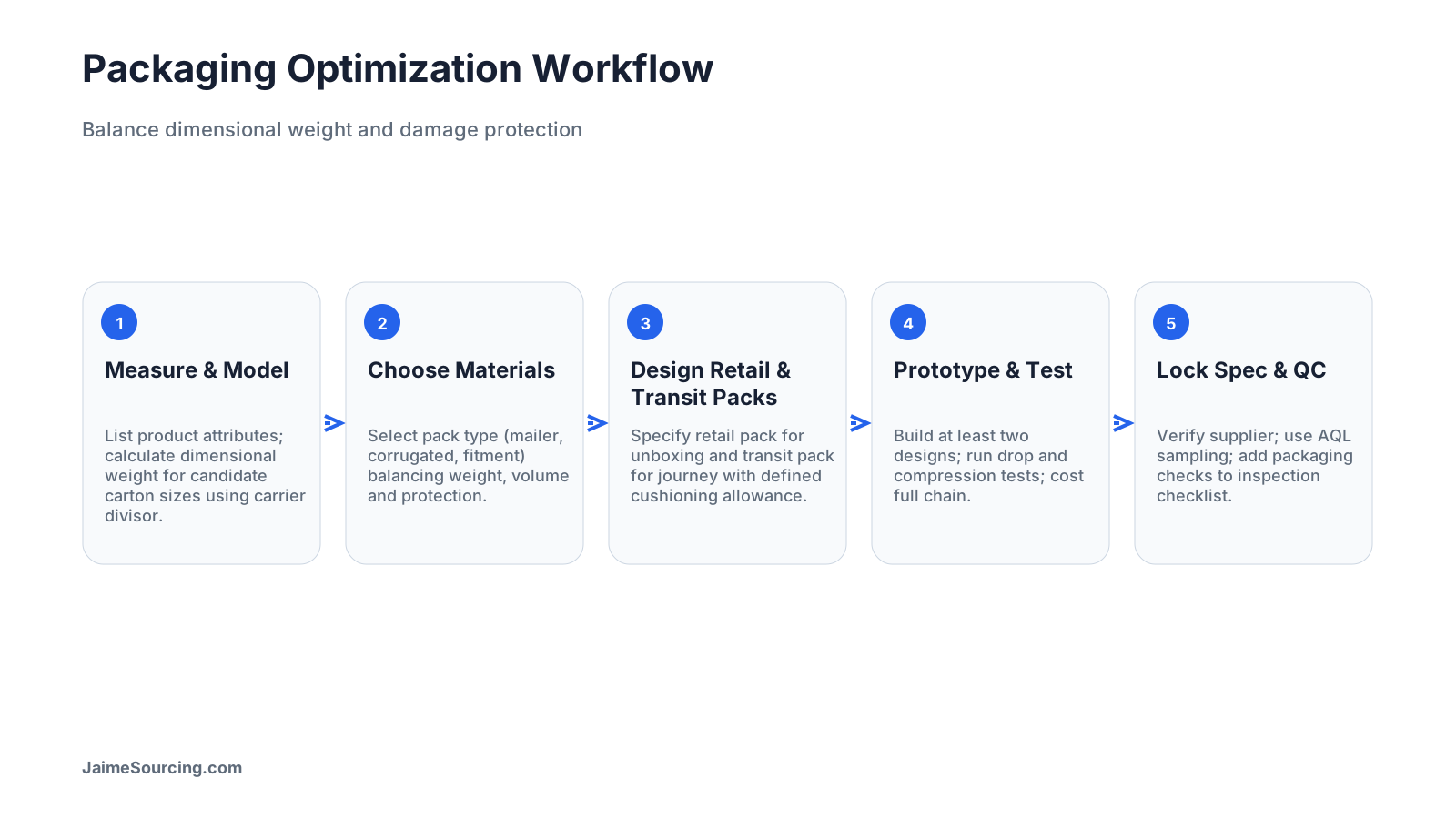
Damaged parcels and rising freight bills usually trace back to the same decision: how the packaging was designed before the carton was sealed. Carriers bill on the greater of actual weight or dimensional (volumetric) weight, so oversized or overbuilt packaging can push a light product into a higher rate tier even when the goods themselves are cheap to move. Under-engineered packaging drives damage, returns and reshipments that quietly erase margin. For a Shopify reseller importing from China, packaging optimization is a two-sided problem: shrink the billable cube without sacrificing protection.
This guide was reviewed on November 8, 2026. Regulations, tariff treatment and platform rules can change. Confirm the current requirements with the destination-country authority, customs broker or qualified compliance adviser before placing an order.
Why Dimensional Weight and Damage Are the Same Problem
Carriers typically charge by whichever is higher—actual weight or dimensional weight—so a large, light carton can cost more to ship than a small, heavy one. Every unnecessary inch of internal void space is a cost you pay twice: once in the box, and again in the rate tier. Poorly sized, overweight or awkwardly shaped packaging directly inflates freight costs because the shipper pays for unused space.
Damage is the mirror image. Packaging too flimsy for the journey produces breakage, returns and replacement shipments, a major hidden cost of poor packaging. The design goal is neither “more packaging” nor “less packaging” but the right packaging: enough structure to survive handling, and no more cube or mass than the product needs.
Treat packaging as a system with three levers:
- Cube — the outer dimensions that feed dimensional weight.
- Mass — the actual weight that feeds the other half of the billing formula.
- Protection — the cushioning and structure that prevent damage.
Optimizing one lever in isolation usually backfires. Shrinking the box without rethinking cushioning raises damage; adding padding without resizing the box raises dimensional weight. Move all three together.
Step 1: Define the Product and Its Fragility Before You Design
Start with a written product profile: dimensions, weight, material, fragility, and whether the item has a shelf life or special handling need. A long, thin item such as a curtain rod needs a different carton geometry than a dense, heavy item such as a paperweight, and thin glass needs protection designed around impact rather than around stacking.
For each SKU, record:
- Finished product dimensions and weight (measured, not from the spec sheet).
- The most fragile component and how it fails (crack, dent, scratch, leak).
- Whether retail packaging must survive display, or only transit.
- Any regulatory labeling required in the destination market.
This profile becomes the brief you give your Chinese supplier. Vague briefs (“pack it well”) produce whatever the factory already has on the shelf. A measured profile lets you compare supplier proposals on the same terms.
Step 2: Right-Size the Carton and Choose the Right Format
The single highest-leverage move is matching the carton to the product. Review your order history to find the most common parcel sizes, then standardize packaging around those dimensions rather than defaulting to a few generic box sizes. Fewer, better-fitting carton sizes simplify packing, reduce waste and cut cost.
Format matters as much as size:
- Poly mailers and padded envelopes suit non-fragile goods such as apparel; they are lighter and smaller than cartons and can reduce both weight and cube.
- Corrugated cartons are stronger and lighter than ordinary boxes because of the air channels between layers, which helps where rigidity is needed.
- Rigid retail packaging (glass, liquids, chemicals) needs protective transit packaging around it, such as bubble wrap or molded inserts, to prevent breakage.
A practical rule: choose the lightest format that still passes a drop and compression test for that specific product. A carton is not automatically safer—sometimes a well-padded mailer outperforms an oversized box that lets the product rattle.
Step 3: Engineer Cushioning and Void Fill Deliberately
Void fill has two jobs: immobilize the product and absorb impact. Lightweight fill materials—air pillows, packing paper, bubble wrap, foam inserts or paper void-fill rolls—can stabilize the product while keeping added weight low. The mistake is using heavy fill to compensate for a badly sized box; that raises mass and often fails to stop movement.
Design the interior so the product cannot shift. A product that moves inside its carton generates its own impact energy on every handling drop. Where the product is fragile, specify the cushioning type, thickness and placement in the packaging spec, and ask the supplier for a physical sample rather than a photo.
Step 4: Test the Design Before You Scale
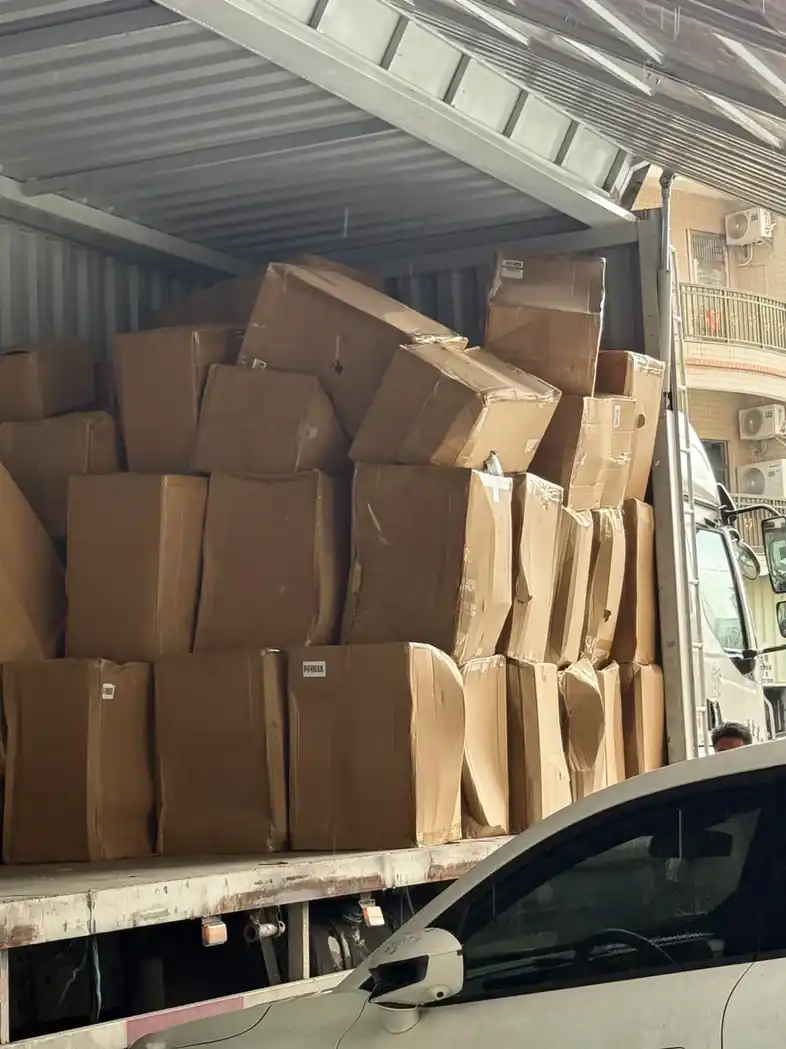
Packaging that looks fine on a drawing can fail in transit. Build a small validation step into your sourcing workflow:
- Request pre-production packaging samples from the supplier.
- Run a drop test from a height appropriate to your parcel weight and carrier handling (confirm the current standard with your carrier).
- Run a compression test to simulate stacking in a container or warehouse.
- Inspect the product after testing for cosmetic and functional damage.
Record pass/fail per SKU. This is also where you catch over-packaging: if a design passes easily with a smaller carton or thinner cushioning, you have found dimensional-weight savings without added risk.
Step 5: Control Packaging Quality at the Factory
Packaging is a manufactured component, and it drifts like any other. The carton your supplier quotes may not be the carton they ship six months later—board grade, flute type and print can all change silently. Build packaging into your inspection scope using AQL sampling under ISO 2859-1 / ANSI/ASQ Z1.4, General Inspection Level II, and define defect classes clearly:
- Critical — defects that make the product unsafe or unsellable (for example, a packaging failure that exposes the product or breaches legal labeling). A common starting point is Critical 0.
- Major — defects a buyer would reject, such as wrong carton dimensions, crushed corners or missing inserts. A common example is Major 2.5.
- Minor — cosmetic or tolerance issues that do not affect function, such as print scuffs. A common example is Minor 4.0.
Treat 0 / 2.5 / 4.0 as a common example, not a universal rule—set limits that reflect your product and risk tolerance. Measure carton dimensions and board grade against the approved spec, not just the product inside.
Step 6: Verify the Supplier and the Commercial Terms
Packaging savings disappear if the supplier or the shipping terms are wrong. Before committing, verify the supplier’s legal identity using the Chinese National Enterprise Credit Information Publicity System, and cross-check with Tianyancha or Qichacha. Read the registration carefully:
- Registered capital is the subscribed amount, not cash in the bank.
- Subscribed vs. paid-in capital — a high subscribed figure with low paid-in capital can signal thin actual funding.
- Establishment date — a very new entity may lack a track record.
- Unified Social Credit Code — confirm it matches the entity on the contract and invoices.
On logistics, distinguish the Incoterms clearly. EXW leaves origin charges and export clearance with you; FOB puts origin charges and export clearance on the supplier but leaves main freight and destination customs to you; DDP shifts delivery and duty to the seller, but “tax-inclusive DDP” arrangements can be non-compliant if declarations are understated—verify how duty and VAT are declared rather than accepting a single all-in price. For payments, overseas buyers typically use T/T; confirm who pays bank fees, how FX exposure is handled, whether Trade Assurance fees apply, and whether you are paying a corporate or personal account. Allocate sample-payment fees in writing before the first sample order.
| Decision | What it controls | Buyer check |
|---|---|---|
| Carton dimensions | Dimensional weight tier | Measure against product + cushioning |
| Board grade / flute | Compression strength | Match to approved spec at inspection |
| Cushioning type | Damage rate | Drop and compression test results |
| Incoterm (EXW/FOB/DDP) | Origin charges, customs duty | Confirm declaration basis for DDP |
| Payment terms (T/T) | Bank fees, FX, account type | Corporate account, fees allocated |
What to Verify Before You Proceed
- Measured dimensions and weight for every SKU, taken from a physical sample—not the spec sheet.
- Packaging spec sheet signed off by both parties, covering carton size, board grade, cushioning and labeling.
- Test results from drop and compression trials, retained for each SKU.
- Supplier identity confirmed via the National Enterprise Credit Information Publicity System, Tianyancha or Qichacha, including Unified Social Credit Code and paid-in capital.
- Incoterm and payment terms in writing, with duty/VAT declaration basis confirmed for any DDP quote.
- Destination labeling and compliance checked against the current official rule for the destination country.
Frequently Asked Questions
How much can packaging optimization actually reduce shipping costs?
Savings vary by product and carrier, but right-sizing cartons and cutting unnecessary mass can move parcels into lower rate tiers and reduce per-unit freight over volume. The effect compounds across thousands of orders, where small per-parcel savings become meaningful monthly totals. Measure your own before-and-after rates rather than assuming a fixed percentage.
Is a poly mailer always cheaper than a carton?
For non-fragile goods such as apparel, a poly mailer is typically lighter and smaller than a carton and can reduce cost. For fragile or rigid items, a carton with proper cushioning is usually necessary to prevent damage. Choose the format that passes your drop test at the lowest cube and mass.
Does DDP mean I do not need to worry about customs?
No. DDP shifts delivery and duty responsibility to the seller, but you remain responsible for compliant declarations and product compliance in your market. “Tax-inclusive DDP” quotes can be non-compliant if values are understated, so confirm the declaration basis. Check current rules with the destination-country authority or a customs broker.
How do I stop packaging quality from drifting between orders?
Put packaging on the inspection plan with defined Critical, Major and Minor limits under ISO 2859-1 / ANSI/ASQ Z1.4, General Inspection Level II, and measure cartons against the approved spec. Retain a signed golden sample. Periodic re-inspection catches board-grade or dimension changes before they reach your customers.
Manage Quality Drift and Distance With a Ground Team
Packaging specs drift, factories substitute materials, and a problem spotted in a photo is already three weeks old by the time it reaches you across time zones. The practical control is presence: someone physically checking cartons, measuring board grade and running sample tests at the factory before shipment. Jaime Sourcing supports overseas buyers with supplier research, verification, inspection, quality control, consolidation, packing and shipment coordination in China. If you want a second pair of eyes on a packaging spec or a supplier check before you commit, review your workflow with Jaime Sourcing and confirm the details that matter for your next order.
Turn your product and order requirements into a controlled sourcing brief.
Share the product, supplier link, quantity, destination and current order stage. We will identify the practical verification, quality-control, packing and shipping steps.