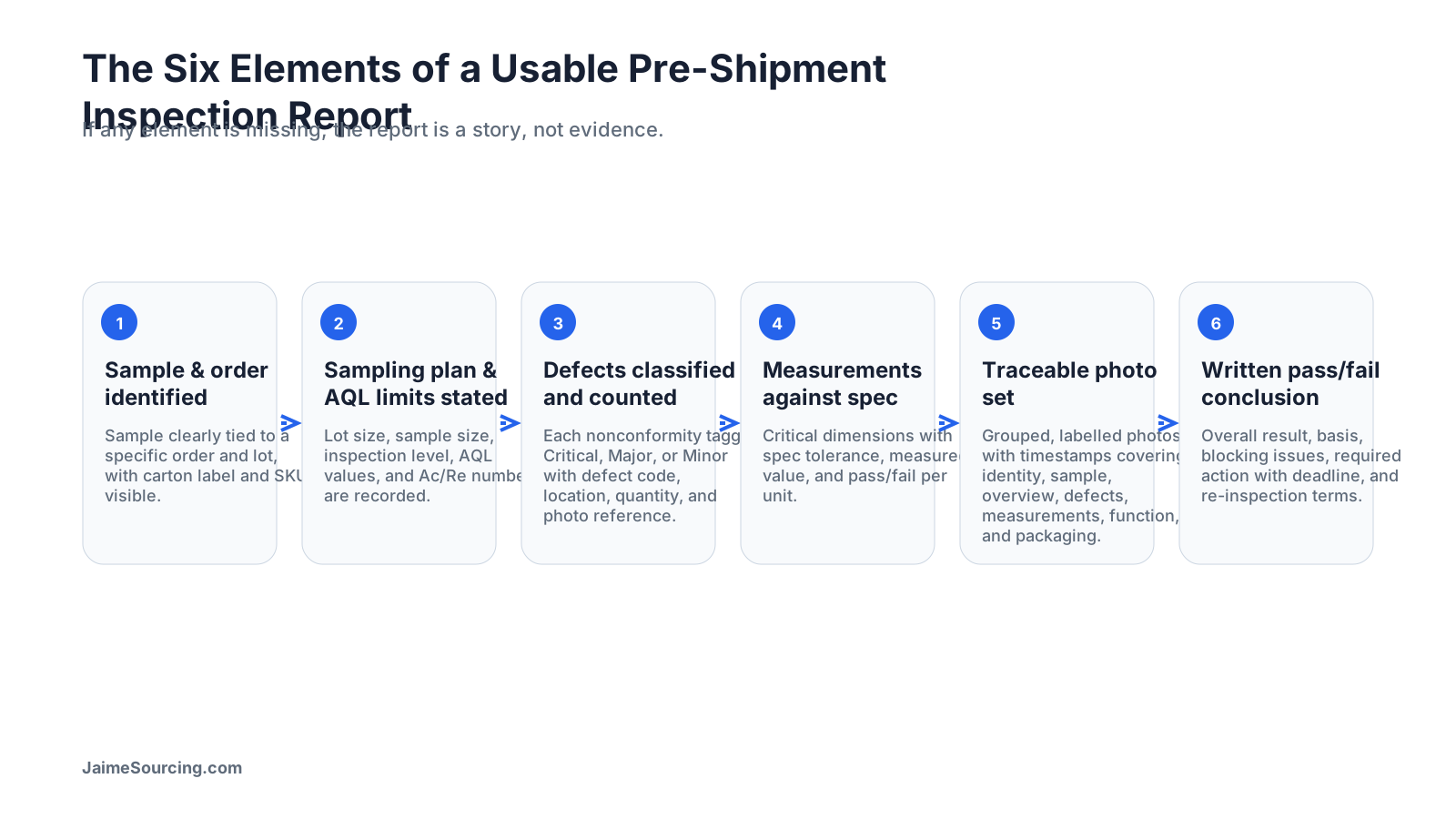
A usable pre-shipment inspection (PSI) report must let you decide, without being at the factory, whether to release the balance payment and book the shipment. At minimum it should contain: a clearly identified sample and order, a stated sampling plan and AQL limits, defect counts by Critical/Major/Minor class, measured values against your spec sheet, a traceable photo set, and a written pass/fail conclusion with the corrective action required. If any of those six elements is missing, the report is a story, not evidence.
This guide is written for overseas buyers and Shopify resellers sourcing from China. It covers what to demand in the report template, how to read it, and where reports commonly fail you.
Start With the Sampling Plan, Not the Photos
Photos are the part everyone looks at first, but the sampling plan is what makes the conclusion defensible. A PSI is normally performed when production is largely complete — QIMA describes its PSI as an on-site check carried out once at least 80% of the order is finished and packed. Confirm your inspector’s trigger point in writing, because inspecting at 50% completion tells you little about the final batch.
Most third-party inspectors draw samples using ANSI/ASQ Z1.4, which corresponds to ISO 2859-1, at General Inspection Level II. Your report should state:
- Lot size — total units in the finished batch.
- Sample size — how many units were physically pulled.
- Inspection level — normally General Level II unless your product justifies tightened or reduced inspection.
- AQL values — the acceptance limits per defect class.
- Ac/Re numbers — the accept and reject counts for each class.
A common starting point is Critical 0, Major 2.5, Minor 4.0. Treat that as an example, not a rule: electronics, children’s products and anything with a safety function often warrant Critical 0 / Major 1.0 or tighter, while low-risk accessories may tolerate looser limits. What matters is that the AQL values in the report match the values in your purchase order or quality agreement. If they don’t, the pass/fail conclusion is meaningless.
The report should also record the DPU (defects per unit) where your inspector calculates it. One sourcing guide notes that a buyer facing a rejected lot used the AQL plan plus a DPU figure — roughly 7.3 defects per hundred units — to move a factory from denial to agreement on rework. Numbers end arguments that adjectives start.
Defect Classification: Critical, Major, Minor
Every nonconformity (NC) in the report should be tagged by severity, and the definitions should be written into the report itself, not left to the inspector’s mood.
| Class | Typical definition | Common handling |
|---|---|---|
| Critical | Safety hazard, regulatory breach, or makes the product unusable | Zero acceptance; reject lot or 100% rework and re-inspection |
| Major | Affects function, performance or expected service life | Rework, sorting, partial credit or replacement |
| Minor | Cosmetic or labelling deviation that does not affect use | Often accepted as-is or used as negotiating room |
Two practical notes. First, insist the report lists each NC with a defect code, location, quantity found and a photo reference number — a line that says “scratch on surface” with no photo is not actionable. Second, ask for the NC list to be sorted by severity and by whether the defect is isolated or batch-wide. A single scuffed unit and a systematic colour shift are completely different problems, and a good report makes that distinction visible before you get on a call with the supplier.
The Photo Set: What “Enough Photos” Actually Means
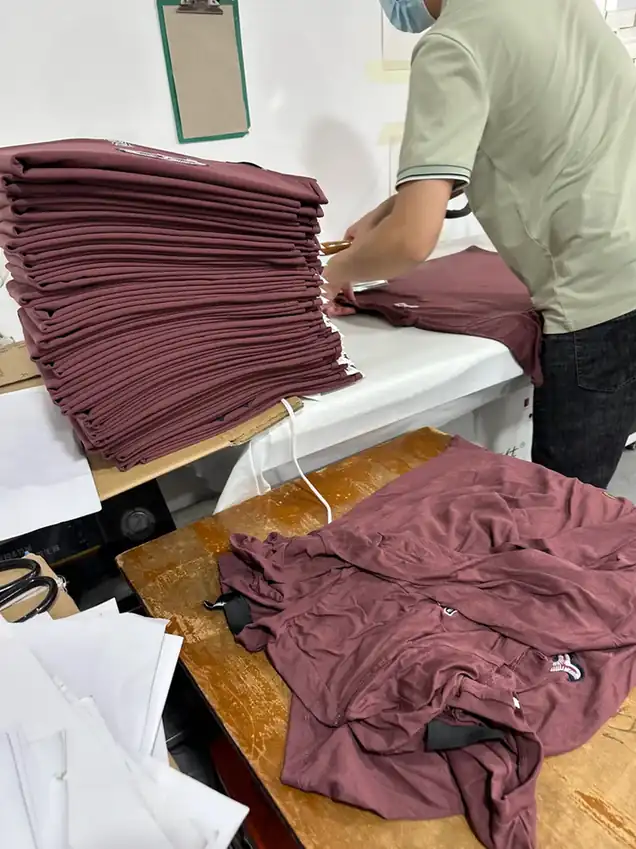
Photo evidence is where cheap reports cut corners. A credible PSI photo set is structured, not a random camera roll. Based on how inspection and photo-report providers describe their standard sets, you should expect grouped, labelled images covering:
- Identity photos — factory gate or building, production line, warehouse area, and the shipping marks on cartons.
- Sample identity — the pulled units laid out with the carton label and SKU visible, so the sample can be tied to the lot.
- Product overview — front, back, sides, top and bottom of a representative unit.
- Detail and defect photos — one close-up per NC, with a scale reference (ruler or caliper) where size matters, and the defect code visible.
- Measurement photos — the caliper or tape in frame with a readable value, matched to the measurement recorded in the report table.
- Function test photos — the unit powered on, assembled, or being operated, plus any test setup.
- Packaging photos — retail box, inner protection, master carton, closure and any drop-test result.
- Before/after photos — where rework or a re-test occurred.
Two rules make the set trustworthy. First, every photo should carry a timestamp and, where the platform supports it, a location tag; digital inspection systems that log data in real time at the factory are harder for a supplier to dispute than a static PDF. Second, photos must correspond to the report’s data — the measurement in the table and the number visible on the caliper in the photo should be the same number. If they don’t match, ask why before you accept the conclusion.
Quantities and Measurements: The Numbers Buyers Skip
Quantity checks are boring and essential. The report should confirm the finished and packed quantity against the PO, the units per carton, the number of cartons, and the carton dimensions and gross/net weight. For furniture and similar goods, templates commonly include packaging completeness, carton marking checks, barcode scanning, net/gross weight and packaging dimension measurement as standard line items. Those numbers feed directly into your freight quote, so a wrong carton weight is a landed-cost error, not a clerical one.
Measurements should be tied to your spec sheet, not to “looks about right.” A workable template lists each critical dimension, the spec value with tolerance, the measured value, and a pass/fail per unit. Typical items include:
- Overall length, width, height and weight of the unit.
- Critical fit dimensions (hole spacing, thread size, connector pitch).
- Colour check against an approved sample or colour standard, recorded as a visual match or a measured value if your inspector uses a colorimeter.
- Label and artwork check — spelling, font, size, position, and the correct market-specific label.
If your product has a regulatory label requirement (for example US, UK, EU, Canadian or Australian marking rules), the report can confirm what is printed on the unit and carton, but it cannot certify compliance. Confirm the current official rule for your destination market separately.
The Conclusion Section: Pass, Fail, or Conditional
The conclusion is the part your supplier will read most carefully, so it needs to be specific. A good conclusion contains:
- Overall result — pass, fail, or pass with conditions.
- The basis — which AQL values and which defect counts drove the result.
- The blocking issues — the Critical and Major NCs that must be resolved.
- The required action — rework, sorting, replacement, or re-inspection, with a deadline.
- Re-inspection terms — whether a follow-up inspection is needed and at whose cost.
Avoid conclusions that only say “FAIL.” A report that fails without naming the remedy invites a circular argument. One sourcing practitioner’s account of a rejected lot shows the productive pattern: the buyer separated Critical and Major items from Minor ones, proposed rework for the fixable defects, and kept the Minor items as a concession rather than a demand. That structure belongs in the report itself, so the conversation starts from a shared document.
What to Verify Before You Proceed
Before you release payment or approve shipment based on a report, run these checks:
- Supplier identity. Match the factory name and address on the report to your PO and to the business licence. Use the Chinese National Enterprise Credit Information Publicity System for the official record, and Tianyancha or Qichacha for a faster cross-check. Confirm the Unified Social Credit Code, the establishment date, and whether registered capital is subscribed or paid-in — a large subscribed figure with little paid-in capital tells you the balance sheet is thinner than the headline suggests.
- Report integrity. Check the inspection date, the inspector’s name, the sample size and whether the photos are timestamped and consistent with the stated inspection date.
- Spec alignment. Confirm the AQL values and tolerances in the report match your PO or quality agreement, not the factory’s default template.
- Photo-to-data match. Spot-check three measurement photos against the report table.
- Defect closure. For any Major or Critical NC, get a written corrective action with a completion date before the balance payment.
- Commercial terms. Know whether your price is EXW, FOB or DDP. Under EXW you carry origin charges and export clearance; under FOB the seller handles origin charges and export clearance while you carry main freight, insurance and import duty; under DDP the seller nominally handles everything to your door. Be cautious with “tax-inclusive” DDP arrangements that route goods through informal channels — if the import declaration is not in your name and compliant, your exposure sits with you, not the seller. For payment, clarify T/T terms, who absorbs bank fees, FX exposure between order and balance payment, any platform Trade Assurance fee, and whether you are paying a corporate or personal account. Paying a personal account weakens your dispute position.
FAQ
How many photos should a pre-shipment inspection report include?
A credible report groups photos by purpose — identity, sample, overview, defects, measurements, function tests and packaging — with at least one clear image per defect and per measured value. Quality matters more than volume: a hundred unlabelled photos prove less than thirty timestamped, cross-referenced ones.
Is AQL 2.5 the standard for major defects?
AQL 2.5 for Major defects is a common default, not a universal standard. Tighter limits such as Major 1.0 are normal for electronics, children’s products or anything with a safety function. Set the values in your PO or quality agreement and confirm the report uses the same numbers.
Can I rely on a factory’s own inspection report?
A factory’s self-inspection is useful for production tracking but is not independent evidence. A third-party or buyer-side inspection gives you an unbiassed sample and a report you can hold a supplier to. If budget is tight, at least commission an independent PSI on your first order and any order after a supplier change.
What should I do if the report fails but the factory disagrees?
Ask for the specific NC items, the AQL basis and the photo references, then request the factory’s own evidence for the disputed units. Keep Critical and Major items separate from Minor ones, and negotiate rework or sorting for the fixable defects before discussing credits. A documented, itemised position is far stronger than a general complaint.
Managing Quality Drift From a Distance
The real risk in China sourcing is not one bad report — it is quality drift between orders, slow factory follow-ups when a corrective action is promised but not implemented, and the physical distance and time-zone friction that turns a two-day fix into a three-week delay. A report template only helps if someone on the ground can act on it: re-inspect the rework, photograph the corrected units, and confirm the carton count before the container is loaded.
Jaime Sourcing works as your ground team in China, covering supplier research and verification, inspection and quality control, consolidation, packing and shipment coordination. If you are tightening your inspection template or want a second pair of eyes on a supplier before the next order, talk to Jaime Sourcing about a supplier check or a workflow review.
Turn your product and order requirements into a controlled sourcing brief.
Share the product, supplier link, quantity, destination and current order stage. We will identify the practical verification, quality-control, packing and shipping steps.