Before you hire a China sourcing agent, ask five categories of questions in writing: scope (what exactly they will and won’t do), fees and conflicts (how they are paid and whether they take factory rebates), verification (how they confirm a supplier is a real manufacturer), quality control (what inspection standard and evidence you receive), and payments and logistics (who holds the money, who owns the shipment, and what Incoterm applies). Get the answers in a written quote or contract, not a WeChat voice note. The quality of those answers—and whether the agent will put them in writing—tells you more than any sales pitch.
This guide is written for overseas buyers and Shopify resellers sourcing from China, not for mainland sellers exporting abroad. It focuses on the operational tradeoffs, total cost and verification steps that decide whether an agent relationship is worth the fee.
Why the First Conversation Matters More Than the Quote
A sourcing agent sits between you and a factory you cannot easily visit. That position creates both value and conflict. Agents typically charge 5–10% of order value as commission, and the biggest financial risk is the undisclosed factory rebate—where a factory pays the agent extra to steer orders its way. Because the agent market is largely unregulated, verification is your job.
The first conversation is where you find out whether the agent will disclose conflicts, define scope, and give you evidence. A vague, friendly chat that avoids specifics is a warning sign, not a bargain.
Scope Questions: What Are You Actually Buying?
Most agent services cluster around supplier research and verification, price negotiation, sample coordination, order follow-up, quality control and logistics coordination—but not every agent offers all of them. Some focus only on factory finding; others run end-to-end from factory selection to warehouse delivery. Ask:
- Which of these steps do you perform yourself, and which do you subcontract?
- Will you work with a new supplier I found, or only suppliers from your own network?
- Do you handle consolidation, packing and shipment coordination, or stop at the factory gate?
- What is your response time and reporting cadence during production?
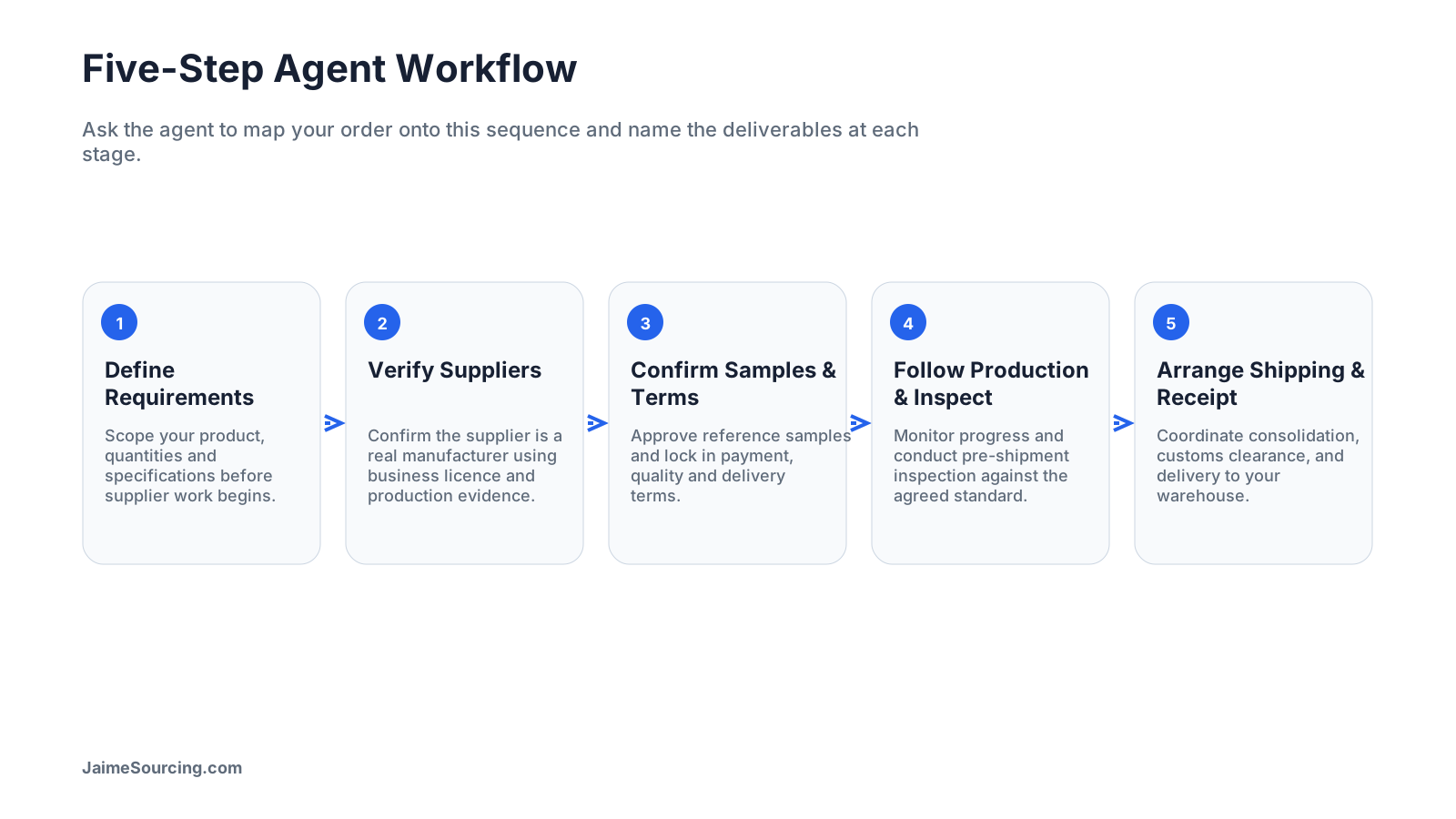
A credible agent will map your project onto a defined workflow. A common five-step frame is: define requirements, verify suppliers, confirm samples and terms, follow production and inspect, then arrange shipping, customs and receipt. Ask the agent to place your order on that map and name the deliverables at each stage.
Fees, Rebates and Conflicts of Interest
This is the section where you separate professionals from brokers. Commission models create an incentive to inflate order value, because a higher invoice means a higher fee. Fixed-fee and hybrid models tie payment to work performed rather than order size. Ask directly:
- How are you paid—commission, fixed fee, or hybrid?
- Do you receive any payment, rebate or benefit from factories or their affiliates? Put the answer in writing.
- Do you hold equity or a financial interest in any factory you might recommend?
- Will you sign a contract clause disclosing all factory remuneration?
Reputable agents will agree to a written rebate-disclosure clause; a contract with no disclosure language at all is a red flag. Also ask whether the agent charges the factory a service fee that gets baked into your unit price—trade companies sometimes add 5–15% over factory cost, and you should know whether that margin is the agent’s or the supplier’s.
| Fee model | How it works | Main risk to you |
|---|---|---|
| Commission (5–10% of order) | Agent earns a percentage of order value | Incentive to raise order value or unit price |
| Fixed fee per service | Charged per factory visit, inspection or project | Scope creep if tasks aren’t defined |
| Hybrid | Lower commission plus fixed fees for audits/inspections | More transparent, but confirm what’s included |
| Undisclosed rebate | Factory pays agent outside your fee | Wrong factory recommended; hidden cost in price |
Supplier Verification: How Do You Prove This Is a Real Factory?
Roughly 70% of suppliers on wholesale platforms are trading companies rather than factories, which raises cost and complicates communication. Ask the agent how they distinguish the two, and require evidence:
- Will you obtain the Chinese business licence and independently check the registered entity and stated business scope?
- Can you confirm the production address and arrange a live video walk-through of the relevant line?
- Do you check that the name on the licence, contract, invoice and receiving bank account match?
For your own cross-check, use the Chinese National Enterprise Credit Information Publicity System (the official registry) and commercial databases such as Tianyancha or Qichacha. When you read a company record, understand what you are seeing:
- Unified Social Credit Code — the 18-character identifier that uniquely ties the entity to official records.
- Establishment date — a very new entity claiming long production history deserves scrutiny.
- Registered capital vs. subscribed vs. paid-in capital — registered capital is a declared figure; subscribed is what shareholders committed; paid-in is what has actually been contributed. A high registered figure with low paid-in capital tells you little about factory capacity.
None of these tools prove manufacturing capability on their own. They confirm the legal entity exists and help you spot mismatches before money moves.
Quality Control: What Standard, What Evidence?
Ask the agent to define inspection before production starts, not after a problem appears. A widely used framework is AQL sampling under ISO 2859-1 / ANSI/ASQ Z1.4, commonly at General Inspection Level II. Under AQL, defects are classified as:
- Critical — safety or legal issues; often set at 0 acceptance.
- Major — functional or visible defects likely to cause returns.
- Minor — cosmetic issues within tolerance.
A common starting point is Critical 0 / Major 2.5 / Minor 4.0, but this is an example, not a universal rule—tighten it for regulated or high-return products. Ask:
- Who performs the inspection—your staff or a third-party company?
- What report do I receive, and does it include photos and defect counts by class?
- What happens if inspection fails—rework, re-inspection, and who pays?
Also separate design approval from production approval. Confirm how pre-production samples are made and whether they use the actual production materials, tooling and process, and keep a signed reference sample with the order.
Payments, Incoterms and Landed Cost
Payment and shipping terms decide your real cost and your risk. On payment, most Chinese factories ask for a 30% deposit with the 70% balance before shipment. For overseas buyers paying Chinese suppliers, clarify:
- T/T terms — exact deposit and balance triggers, and what evidence releases the balance.
- Bank fees and FX — who absorbs wire charges and currency movement between quote and payment.
- Corporate vs. personal accounts — never pay a personal account or an unrelated company name without investigating first.
- Account changes — verify any changed bank details through a known contact before sending money.
- Sample payments — confirm sample fees, courier costs and whether sample fees are credited against the first order.
- Platform protection — if relying on Alibaba Trade Assurance, check the current terms and pay through the platform order path so the protection applies.
On shipping, distinguish the Incoterms clearly:
- EXW — you take over at the factory; you carry origin charges and export responsibility.
- FOB — the supplier handles export clearance and loading; you pay freight and destination costs.
- DDP — the seller delivers duty-paid; be cautious of “tax-inclusive” DDP quotes that may under-declare value or use non-compliant clearance. Confirm who is the importer of record and that duties and taxes are declared correctly for your destination.
Customs and product-compliance rules vary by jurisdiction (US, UK, EU, Canada, Australia). Confirm the current official requirements for your product and destination rather than relying on an agent’s summary.
What to Verify Before You Proceed
Before signing or paying, run this checklist and keep the evidence:
- Written scope — the agent’s services, deliverables and reporting cadence in the contract.
- Rebate disclosure — a signed clause covering all factory remuneration and conflicts.
- Entity check — business licence plus a registry/database cross-check of the supplier’s Unified Social Credit Code and entity details.
- Factory evidence — production address and a live video or visit record.
- Sample record — approved reference sample tied to the order and specification.
- QC standard — AQL level, defect classes and the inspection report format.
- Payment map — named account holder, currency, fees and balance-release conditions.
- Incoterm and importer — who clears customs and who is the importer of record.
- Pilot project — start with one scoped task, such as a factory search or a single pre-shipment inspection, and judge the work before scaling.
FAQ
How much do China sourcing agents charge?
Most agents charge 5–10% of order value as commission, with some using fixed fees per service or a hybrid model. A 7% fee on a $20,000 order is $1,400. Always confirm whether factory rebates sit on top of that fee.
Should I ask an agent to disclose factory rebates?
Yes—ask for a written clause disclosing all payments received from factories or affiliates. Rebates are common and often undisclosed, and they can distort which factory gets recommended. A reputable agent will agree to put this in the contract.
Do I need an agent for simple products on Alibaba?
Not always. For simple, standardised products or repeat orders from an existing supplier, direct sourcing is often more cost-effective. Agents add most value in unfamiliar categories, complex products, or when you need someone physically in China.
How do I check a Chinese supplier is a real factory?
Request the business licence, confirm the production address, and ask for a live video walk-through of the line. Cross-check the entity on the National Enterprise Credit Information Publicity System or Tianyancha/Qichacha, and confirm the licence, contract, invoice and bank account names match.
What AQL should I use for pre-shipment inspection?
A common starting point is General Inspection Level II under ISO 2859-1 / ANSI/ASQ Z1.4, with Critical 0 / Major 2.5 / Minor 4.0 as an example. Tighten the limits for regulated, safety-related or high-return products, and agree the standard in writing before production.
Manage the Distance, Not Just the Price
The real risk in sourcing from China is not the first quote—it is quality drift between the approved sample and mass production, factory follow-ups that slip when you are asleep in another time zone, and the physical distance that makes problems expensive to fix late. A good agent is your ground team for supplier research, verification, inspection, quality control, consolidation, packing and shipment coordination. If you want a second opinion before you commit, Jaime Sourcing can review your supplier check or sourcing workflow and help you build the evidence trail before money moves.
Turn your product and order requirements into a controlled sourcing brief.
Share the product, supplier link, quantity, destination and current order stage. We will identify the practical verification, quality-control, packing and shipping steps.