For a first order with a Chinese supplier you have never met, the cheapest useful step is usually a structured remote video audit—not a casual video call, and not necessarily a full onsite audit. A simple walkthrough tells you the factory exists and can hold a phone steady. A full audit tells you whether its systems, capacity and compliance claims survive scrutiny. A remote video audit sits between them: it can screen out obvious trading companies and mismatched capacity at low cost, but it cannot confirm documents, worker interviews or process discipline the way an auditor on the floor can.
The practical question is which level of evidence your order value, product risk and supplier history justify—and where each method stops being reliable.
The three options, defined by what they actually prove
Simple walkthrough (live or recorded video). The supplier walks you through the workshop on WeChat, WhatsApp or Zoom. You see machines, people and stock. What you do not control is the route, the timing or what is off-camera. Camera-led tours are prone to blind spots, and a factory can stage a clean line for the call. Treat a walkthrough as a plausibility check, not verification.
Remote video audit. A structured session—often combining 360° panoramic capture with a live video call—run against a checklist by someone who knows what to look for. Panoramic formats let the buyer pan, zoom and even gauge aisle widths and equipment spacing, which a single moving camera cannot. The strongest version pairs static panoramic capture with a live call to spot-check specific machines or batches on request.
Full factory audit (onsite). An auditor physically attends, verifies business licence and site details, counts equipment, reviews quality records, walks storage and QC areas, and—depending on scope—interviews workers and checks social-compliance or security conditions. It produces a rated assessment report used to decide whether to work with the factory and how much volume to allocate.
| Dimension | Simple walkthrough | Remote video audit | Full onsite audit |
|---|---|---|---|
| Core question | Does this factory exist? | Does the visible operation match the supplier’s claims? | Is the factory capable, compliant and systemically reliable? |
| Who controls the route | Supplier | Auditor or buyer, against a checklist | Auditor |
| Documents verified | Rarely | Sometimes, by screen share | Yes, originals inspected |
| Equipment and capacity check | Superficial | Countable from panoramic footage | Countable and cross-checked against records |
| Worker interviews / social compliance | No | No | Yes, where in scope |
| Typical use | First contact, repeat suppliers | New-supplier screening, annual re-checks, multi-factory shortlists | New high-value suppliers, compliance-driven buyers |
| Main limitation | Easy to stage | Blind spots remain; identity of site must be proven | Cost and travel time |
What a remote video audit can and cannot see
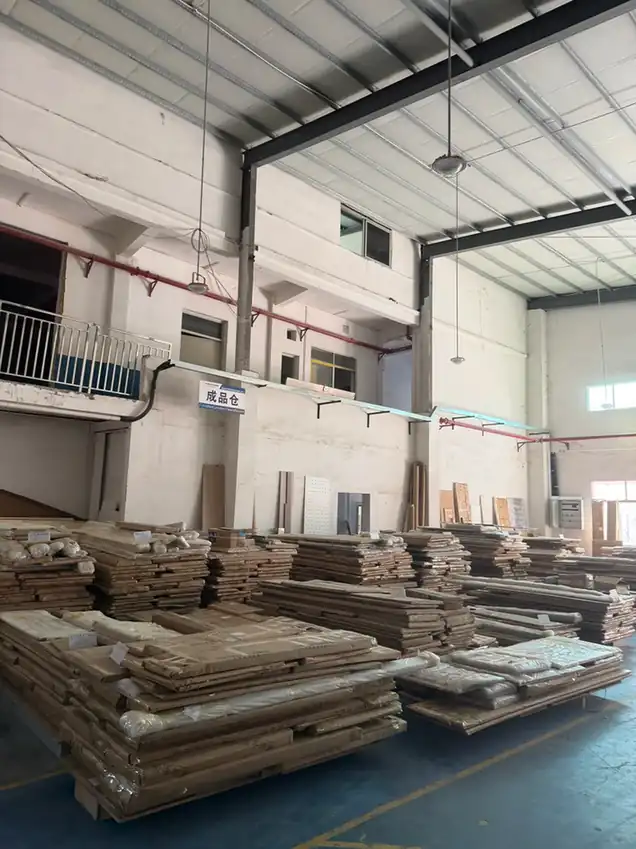
A remote audit is strongest on physical facts that are hard to fake at scale. Experienced reviewers focus on whether production elements match the supplier’s declarations: the number of injection moulding machines, SMT lines or sewing stations actually on the floor versus the number claimed; maintenance tags and check sheets on equipment; oil leaks and clutter around machines. They follow the physical flow from incoming materials through processing, semi-finished holding, packing and dispatch, looking for segregated storage, marked aisles and clear access to fire hydrants and distribution boards. Warehouse depth is a useful proxy for order volume: stacking heights, shelf labels and turnover markings. A QC area with tensile testers, salt-spray chambers or abrasion testers—and an inspector actually using them—is visible in a panoramic walk-through.
What it cannot do is equally clear. It cannot confirm that the site you are viewing is the entity that will produce your order unless the capture is tied to a verified address, GPS data and signage. It cannot replace worker interviews, payroll review or chemical testing, which remain onsite or laboratory activities. And it says nothing about whether this specific order will be run well—factory capability and batch quality are separate questions.
Sequencing: screen remotely, audit onsite, inspect every order
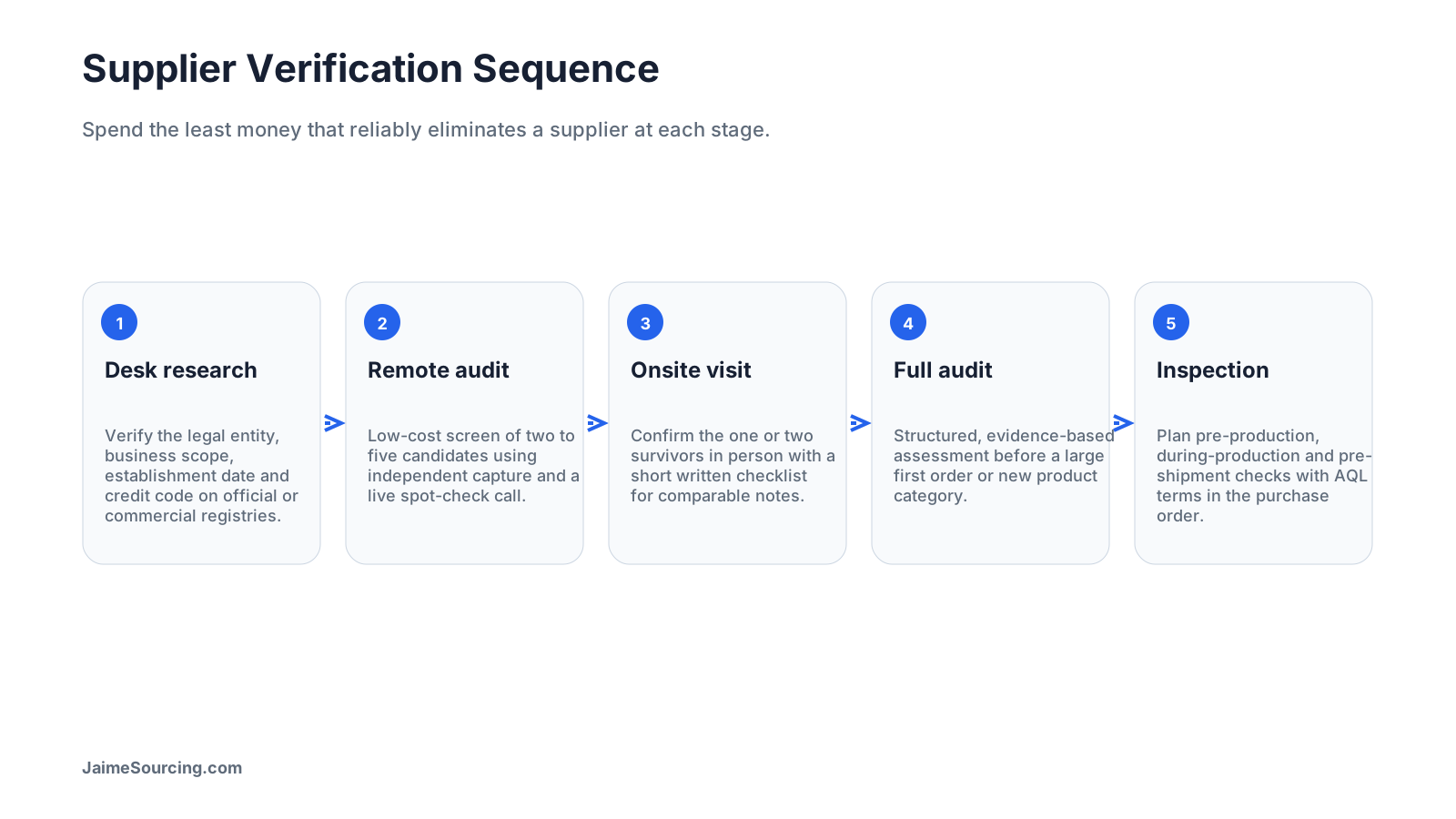
The most cost-effective structure for most small brands is a three-stage funnel.
- Desk research first. Before any video call, verify the legal entity. Use the National Enterprise Credit Information Publicity System (National Enterprise Credit Information Publicity System) for the official registration record, and Tianyancha or Qichacha for a faster commercial view. Check the Unified Social Credit Code against the code on the supplier’s invoice or contract; confirm establishment date, registered address and business scope; and understand that registered capital is not paid-in capital—a high registered figure says nothing about cash actually contributed or current solvency. Compare the legal name with the name on the quotation, the export licence and the bank account.
- Remote video audit for shortlisting. Use it to compare three to five candidate factories without flying, and to re-check existing suppliers annually or after a move, expansion or management change. Insist the session is run by an independent party or at minimum recorded end-to-end with timestamps and location data.
- Full onsite audit before a large first order. For a new supplier taking a significant commitment, skipping this step means capacity, quality-system and compliance problems surface only at final inspection, when rework or re-sourcing is too late. Buyers with social-compliance obligations (BSCI, Sedex/SMETA, RBA and similar programmes) generally need an onsite audit scoped to that standard, since results are reported against specific criteria rather than a generic pass/fail.
- Inspection on every order. Audits assess the factory; inspections assess the batch. Pre-production, during-production and pre-shipment checks, plus container loading supervision, are separate paid activities that should run regardless of how good the audit looked.
Using AQL properly at the inspection stage
When you reach inspection, agree the sampling plan in writing. The common framework is ISO 2859-1 / ANSI/ASQ Z1.4, General Inspection Level II, with defects classified as Critical (safety, legal, or functionally unusable), Major (likely to cause customer complaints or returns) and Minor (cosmetic deviations within tolerance). A frequent starting point is Critical 0, Major 2.5, Minor 4.0—but this is an example, not a universal rule; tighten it for regulated or high-return categories and state the Acceptable Quality Limit in the purchase order. Chemical and electrical safety items cannot be judged visually and require laboratory testing.
Commercial terms that change your risk exposure
Verification decisions interact with Incoterms. Under EXW you take responsibility from the factory gate, including export clearance and origin charges. Under FOB the supplier handles export clearance and delivers to the vessel, with origin charges typically built into the price. Under DDP the seller arranges everything to your door—convenient, but “tax-inclusive DDP” arrangements that under-declare value or use non-compliant routing create customs and liability exposure for the importer of record. Confirm who is the importer, what value is declared, and which party bears duty and VAT. For payments, agree T/T terms and who absorbs bank charges on both ends, note FX exposure between quotation and settlement, check whether platform fees such as Trade Assurance apply, and pay the legal entity’s corporate account rather than a personal one. Allocate sample and courier costs explicitly before the first remote audit.
What to Verify Before You Proceed
- Legal identity: Unified Social Credit Code, legal name, establishment date and business scope match the quotation, invoice and bank account.
- Site identity: factory address on the licence matches the address shown on video, with signage and location data captured live.
- Capacity claims: machine counts and warehouse volume consistent with declared monthly output.
- Audit scope: written checklist, auditor independence, and whether social-compliance or security modules are included.
- Inspection plan: AQL levels, defect definitions and sampling stage agreed before production starts.
- Payment and terms: Incoterm, importer of record, declared value, bank charges and FX responsibility documented.
FAQ
Can a remote video audit replace an onsite factory audit in China?
No—it can replace much of the travel for screening and re-checks, but not document verification, worker interviews or physical sampling. Use it to shortlist and to monitor existing suppliers, then commission an onsite audit before a large first order or when compliance evidence is required.
How do I stop a supplier showing me someone else’s factory on video?
Require live capture tied to the licensed address, with signage, GPS metadata and an unedited recording, ideally by an independent auditor. Then cross-check the site against the business licence and ask for a live spot-check of a specific machine producing your item.
Is a factory audit the same as a product inspection?
No. An audit evaluates the factory’s capability and systems before you commit; an inspection samples a specific batch during or before shipment. Passing an audit does not guarantee a given order will be made well, so both are needed.
How often should an existing supplier be re-audited?
Typically annually, or whenever the factory relocates, expands, changes ownership or management, or your order volume rises sharply. Between audits, rely on per-order inspections to catch quality drift.
Do I need a social-compliance audit as well as a quality audit?
Only if your buyers, market or platform require it. Social-compliance programmes such as BSCI, Sedex/SMETA and RBA assess labour, health, safety and environmental criteria and are reported against their own standards, so confirm the exact scheme your customer accepts before booking.
Managing distance, drift and follow-up
The real risk in China sourcing is rarely a single bad factory—it is quality drift between orders, unannounced subcontracting, and the time-zone gap that lets problems sit for days before anyone responds. A remote audit is a snapshot; the controls that matter are the ones you repeat: re-verification when things change, inspections on every batch, and someone physically able to walk the floor when a discrepancy appears.
Jaime Sourcing supports overseas buyers with supplier research, verification, inspection, quality control, consolidation, packing and shipment coordination in China. If you are weighing a remote video audit against a full onsite audit, or want a supplier check and workflow review before your next order, talk to Jaime Sourcing about acting as your ground team in China.
Turn your product and order requirements into a controlled sourcing brief.
Share the product, supplier link, quantity, destination and current order stage. We will identify the practical verification, quality-control, packing and shipping steps.