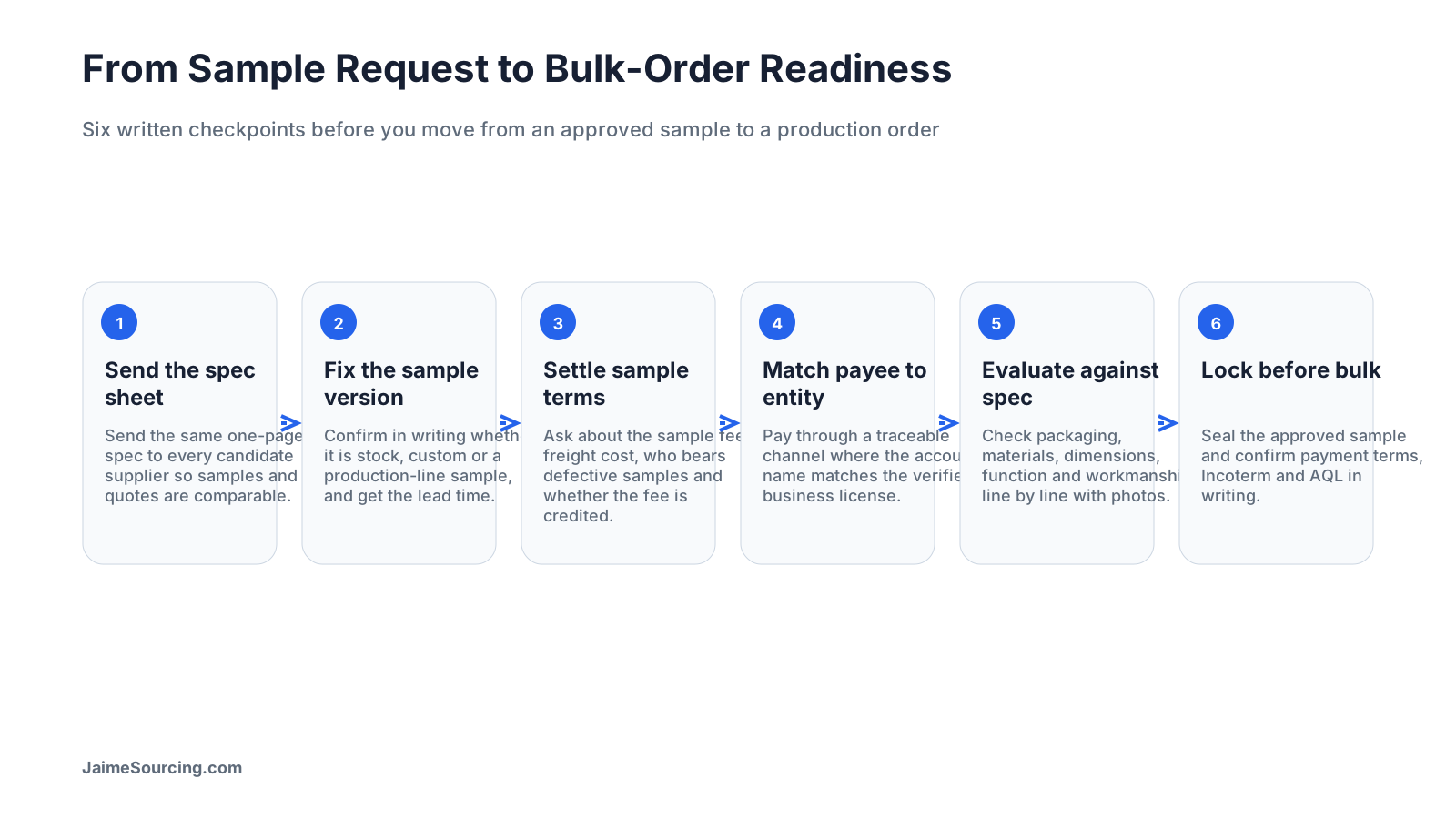
Request a sample from a Chinese supplier by sending a written spec sheet first, then confirming the exact sample version, sample fee, freight cost and lead time in writing before you pay. Pay through a traceable channel tied to the company you verified, and evaluate the sample against your written spec—not against the supplier’s photos. Treat the sample as a paid test of both the product and the supplier’s communication, because a slow or vague response at sample stage is a reliable warning sign for the bulk order.
This guide is written for overseas buyers—Shopify resellers and small brands—not for mainland sellers exporting abroad. It covers how to ask, how to pay, and how to judge what arrives.
Step 1: Send a Written Spec Before You Ask for a Sample
Most sample disputes start before the sample is made. Suppliers quote and sample against whatever they think you mean, and photos hide the details that matter. Prepare a one-page spec sheet and send the same document to every candidate supplier so their samples and quotes are comparable.
Your spec sheet should include:
- Materials and construction — substrate, thickness, coating, stitching, hardware.
- Dimensions and tolerances — nominal size plus acceptable variance.
- Colors — reference a physical standard (Pantone, or a mailed swatch) rather than a screen image.
- Function and performance — load limits, water resistance, battery life, whatever applies.
- Packaging — retail box, polybag, labeling, barcodes, insert cards.
- Compliance targets — the destination market’s requirements (see the compliance note below).
- Sample version requested — see the next section.
Without a common spec, a cheaper quote may simply reflect a supplier who left items out of the scope.
Step 2: Confirm Which Sample You Are Actually Getting
Ask explicitly whether the sample will be:
- A stock/catalog sample pulled from existing inventory,
- A custom sample made to your spec, or
- A golden sample produced on the actual production line you will use.
Request a sample from the real production line rather than a showroom sample, because showroom pieces are often hand-finished and not representative. For custom work, confirm whether the sample is a pre-production sample (PPS) that will be sealed and used as the bulk reference. Get the sample lead time in writing; sampling and negotiation commonly take around 2–6 weeks depending on complexity.
Step 3: Negotiate the Sample Fee, Freight and Credit Terms
Sampling is normally paid by the buyer, and international freight is usually your cost. That is standard and not a red flag. What matters is whether the terms are clear and whether the sample fee is creditable against the bulk order.
Ask these questions in one message:
- What is the sample fee per unit, and does it include tooling or setup?
- Is the sample fee refundable or deductible from the first bulk order?
- What is the freight cost, which carrier, and what is the declared value?
- Who bears the cost if the sample is defective or off-spec?
Some suppliers will credit the sample fee against a first order; others will not. Get whichever answer in writing, because it affects your true sampling cost.
Step 4: Pay Safely — Channels, Fees and Account Names
For overseas buyers paying Chinese suppliers, the payment channel is a risk control, not an admin detail.
Match the payee to the verified company. The bank account name should match the business license name of the supplier you verified. Payment to a personal account, or to a third-party company name that does not match the license, is a warning sign. If a supplier insists on an irreversible method such as Western Union, treat it as a serious red flag.
Understand what Trade Assurance does and does not cover. Platform protections such as Alibaba’s Trade Assurance can help, but they apply to orders placed and paid through the platform, and platform verification of certificates is carried out by independent third parties rather than the platform itself. Confirm current terms on the platform before relying on them.
Budget for bank fees and FX. International T/T transfers typically carry sending and receiving bank charges, and the FX rate applied by your bank will differ from the mid-market rate. For small sample payments, fixed bank fees can be a meaningful percentage of the total—factor this into your sampling budget rather than being surprised by it.
Keep records. Pay from a business account where possible, keep the invoice, the payment confirmation and the chat log together. Written confirmation of specifications, lead times and payment terms by email is your evidence if a dispute arises.
Step 5: Evaluate the Sample Against Your Spec
When the sample arrives, inspect it systematically rather than by feel. Work through your spec sheet line by line and record pass/fail for each item: packaging, function, materials and workmanship.
A practical evaluation checklist:
| Area | What to check | Record |
|---|---|---|
| Packaging | Retail box integrity, labeling, barcode scan, insert accuracy | Pass / Fail + photo |
| Materials | Substrate, weight, finish, smell, color vs. reference | Pass / Fail + photo |
| Dimensions | Measured against nominal and tolerance | Measured values |
| Function | Operate the product through its intended use cycle | Pass / Fail + notes |
| Workmanship | Stitching, seams, burrs, alignment, print quality | Defect count |
| Documentation | Test reports, material declarations, certificates | Copy on file |
If the sample is close but not right, send a consolidated correction list with photos and ask for a revised sample. Confirm in writing that the bulk order will match the approved and sealed sample.
Using AQL to Judge Sample and Bulk Quality
A single sample tells you about workmanship, not about the defect rate across a production run. For bulk inspection, buyers commonly use AQL sampling under ISO 2859-1 / ANSI/ASQ Z1.4, General Inspection Level II, which defines how many units to inspect and how many defects are allowed.
Defects are usually classified as:
- Critical — a safety or legal issue (e.g., a choking hazard, prohibited substance). Critical defects are typically set at 0 acceptance.
- Major — a defect that makes the product unsellable or returns it to the customer (e.g., a broken function, a wrong size).
- Minor — a cosmetic or tolerance deviation that does not affect function or safety.
A common starting point is Critical 0 / Major 2.5 / Minor 4.0, but this is an example, not a universal rule. The right levels depend on your product, your returns tolerance and your customer expectations. Agree the AQL levels and defect definitions with the supplier in writing before production, so inspection criteria are not invented after the fact.
Step 6: Verify the Supplier Behind the Sample
A good sample does not prove a good factory. Before you place a bulk order, verify the legal entity.
In mainland China, use the National Enterprise Credit Information Publicity System (the official registry) to confirm the company exists and to check its registration status. Commercial databases such as Tianyancha and Qichacha add context. When reading these records, distinguish:
- Unified Social Credit Code — the 18-character identifier that uniquely ties the company to its registration.
- Establishment date — a very recently registered company may be a trading intermediary rather than a factory.
- Registered capital vs. paid-in (subscribed) capital — registered capital is the amount committed at registration; paid-in capital is what has actually been contributed. A high registered figure with low paid-in capital tells you less about financial strength than it appears to.
- Business scope — whether manufacturing is actually within the registered scope.
Also request the business license, customer references and export records, and consider a factory audit or third-party verification if the order value justifies it. Note that platform “verified” badges and certificate checks are performed by independent third parties, so confirm the underlying documents directly with the supplier.
Step 7: Understand Incoterms Before You Compare Sample and Bulk Prices
Sample freight and bulk freight are quoted on different terms, and mixing them up distorts your cost comparison.
- EXW (Ex Works) — the supplier’s price excludes everything after their door. You arrange and pay for pickup, export clearance and freight.
- FOB (Free On Board) — the supplier delivers to the named port and covers origin charges and export clearance; you pay international freight, insurance and destination customs.
- DDP (Delivered Duty Paid) — the seller handles freight, import clearance and duties. Be cautious with “tax-inclusive” DDP offers that under-declare value or use non-compliant clearance routes; the importer of record can still face the consequences.
For sample shipments, courier terms are usually simpler, but confirm who is the importer of record and what value is declared. For bulk, confirm the Incoterm in writing, because it determines who pays origin charges and who carries customs responsibility.
What to Verify Before You Proceed
Before you move from sample to bulk order, confirm all of the following in writing:
- Entity match — bank account name matches the business license name; Unified Social Credit Code checked on the official registry.
- Spec lock — the approved sample is sealed and referenced in the purchase order.
- Sample credit — whether the sample fee is deductible, and on what conditions.
- Payment terms — deposit percentage, balance trigger, and the account details you will pay to.
- Incoterm — EXW, FOB or DDP, with origin charges and customs responsibility clearly assigned.
- AQL and defect definitions — agreed before production, not after.
- Compliance — the destination market’s requirements confirmed against the current official rule for your product category and jurisdiction (US, UK, EU, Canada or Australia), since these change.
Frequently Asked Questions
How much should I expect to pay for a sample from a Chinese supplier?
Sample fees vary widely by product and whether the sample is stock or custom, so there is no reliable universal figure. Expect to pay the sample fee plus international freight, and ask whether the fee is creditable against your first bulk order. For custom tooling or multi-round samples, budget for more than one round.
Should I pay a Chinese supplier’s sample fee by bank transfer or platform payment?
Either can work if the payee matches the verified company name and you keep full records. Platform payments may carry additional protection if the order is placed and paid through the platform, but confirm the current terms yourself. Avoid irreversible methods such as Western Union, which leave you with no recourse.
What should I do if the sample is good but the bulk order is not?
That is quality drift, and the control is a sealed approved sample plus a written agreement that bulk must match it. Agree AQL levels and defect definitions before production, and plan an inspection against those criteria before shipment. A good sample alone does not guarantee a good production run.
Can I request samples from 1688 suppliers as an overseas buyer?
It depends on the supplier, because 1688 is primarily a domestic Chinese wholesale platform and many sellers are set up for domestic transactions. Confirm whether the supplier will ship internationally, what payment method they accept, and who handles export clearance before you pay. If direct dealing is difficult, a sourcing partner can act on your behalf.
How long should sampling take before I can order?
Sampling and negotiation commonly take around 2–6 weeks depending on product complexity and revision rounds. Build that window into your launch or restock plan, and add time for freight, because a delayed sample cascades into a delayed bulk order.
Managing the Gap Between a Good Sample and a Good Order
A sample proves what a supplier can make. It does not prove what they will make across a production run, on schedule, to the spec you approved. The real risks are quality drift after the sample is signed off, weak factory follow-up when your contact goes quiet, and the physical distance and time-zone friction that makes every unanswered question cost days.
That is where a ground team helps. Jaime Sourcing supports overseas buyers with supplier research, verification, inspection, quality control, consolidation, packing and shipment coordination—so the sample you approve is the standard your bulk order is actually checked against. If you are about to request samples or want a second opinion on a supplier before you pay, get in touch for a supplier check or a workflow review.
Turn your product and order requirements into a controlled sourcing brief.
Share the product, supplier link, quantity, destination and current order stage. We will identify the practical verification, quality-control, packing and shipping steps.