If you sell through more than one channel, the short answer is this: Shopify itself imposes almost no physical barcode standard—it only requires that every variant has a unique SKU and a unique barcode in your product data. Amazon FBA imposes strict, channel-specific label rules (FNSKU, FBA box labels, prep requirements). An overseas 3PL sits in between: it usually accepts your own SKU/barcode scheme, but only if the labels are scannable, unique and match the data you sent them. The practical risk is not the platform rule—it is whether your Chinese supplier prints and applies labels that satisfy the strictest channel you ship into.
This article breaks down where the three systems diverge, what to put in your supplier’s labeling spec, and how to verify labels before cartons leave China.
The Core Difference: Data Rules vs. Physical Label Rules
Shopify’s fulfillment documentation is explicit that before inventory goes to a 3PL, each product variant must have a unique SKU and a unique barcode, and that you should not reuse the same SKU or barcode across different variants. That is a data integrity rule, not a printing standard. Shopify does not tell your factory which symbology to print or where to place it.
Amazon FBA, by contrast, is a physical receiving system. Every unit must be identifiable at the warehouse, which is why FBA has its own label conventions and prep expectations. A 3PL is a hybrid: it receives on your behalf and picks against your order data, so it needs labels that scan reliably and match the SKU records in its system.
| Dimension | Shopify (store data) | Amazon FBA | Overseas 3PL |
|---|---|---|---|
| Who sets the physical label rule | No platform standard; you and your 3PL decide | Amazon’s FBA prep and labeling requirements | The 3PL’s receiving guide |
| SKU uniqueness | Required per variant; duplicates block transfers | Required; drives listing and inventory identity | Required; drives pick accuracy |
| Barcode uniqueness | Required per variant | Unit-level identifier tied to the listing | Must match the 3PL’s WMS record |
| HS code | Needed only for cross-border sales | Relevant to import, not store data | Relevant to inbound customs docs |
| Main failure mode | Duplicate or changed SKUs breaking sync | Wrong/missing unit labels, rejected inbound | Unscannable labels, SKU mismatch, relabel fees |
The table simplifies who owns each rule; it is not a claim about any specific provider’s current policy. Pull the current receiving guide from your actual 3PL and the current FBA prep requirements from Amazon Seller Central before printing.
Shopify: What the Platform Actually Requires
Shopify’s own guidance is narrow and worth reading literally. Before creating an outbound transfer of inventory to a 3PL, you must verify that every product variant has a unique SKU, that no two variants share a SKU, and that each variant has a unique barcode. If a barcode you send has already been used by another merchant for a different product, the 3PL may assign your product a new barcode.
Two operational consequences follow:
- Freeze SKUs before you ship. Shopify’s documentation warns against changing a product’s SKU after submitting it to your 3PL. A mid-season SKU change is one of the most common causes of inventory that exists physically but cannot be sold because the store record no longer matches the warehouse record.
- Watch multi-location conflicts. Using other fulfillment apps alongside a fulfillment network can prevent the same SKU being shared across locations; Shopify suggests storing inventory at multiple locations or duplicating variants as workarounds.
HS codes only become relevant when you sell across borders, where they tell customs which duties apply. They belong in your product data, but they are not a label-printing instruction.
Amazon FBA: The Strictest Layer
FBA is where labeling discipline pays for itself. Because Amazon receives on your behalf and charges for remediation, a mislabeled unit becomes a cost event rather than a customer-service event. The exact FBA prep and labeling requirements change over time and by marketplace, so treat any blog summary—including this one—as a prompt to check Seller Central for your specific marketplace and product type.
What does not change is the logic: FBA needs a unit-level identifier that ties the physical item to your listing, plus carton-level labeling that lets the shipment be received against your inbound plan. If you also sell the same inventory through Shopify via Amazon Multi-Channel Fulfillment, Amazon treats FBA and MCF inventory as a single pool used to fulfill both Amazon orders and orders from channels outside Amazon. That is efficient—but it means your FBA labeling standard effectively becomes the labeling standard for your Shopify orders too.
Overseas 3PLs: Flexible in Theory, Strict in Practice
A 3PL will generally accept your own SKU and barcode scheme, because its job is to pick against your order data. But “flexible” does not mean “forgiving.” European 3PLs commonly describe verifying SKUs by barcode and relabeling or re-bagging where necessary before put-away —that relabeling is a billable service, and it is a signal that inbound labels frequently fail.
The integration layer matters as much as the label. Shopify’s app ecosystem includes 3PL connectors and fulfillment apps that sync orders, inventory and tracking, and dedicated tools that import 3PL shipment files, validate them against live orders, SKUs, quantities and location status, and route problem rows to an exceptions inbox before any Shopify data is updated. That exception workflow is exactly where label and SKU mismatches surface—usually days after the cartons arrived.
A caution on 3PL selection: public app reviews are not a reliable quality signal on their own. One China-based fulfillment app listing carries both positive reviews and a detailed complaint about quoted-versus-charged shipping and exit fees. Read the negative reviews for fee structure language, and get the receiving guide, relabel fee schedule and exit terms in writing before you ship inventory.
Building a Label Spec Your Chinese Supplier Can Actually Follow
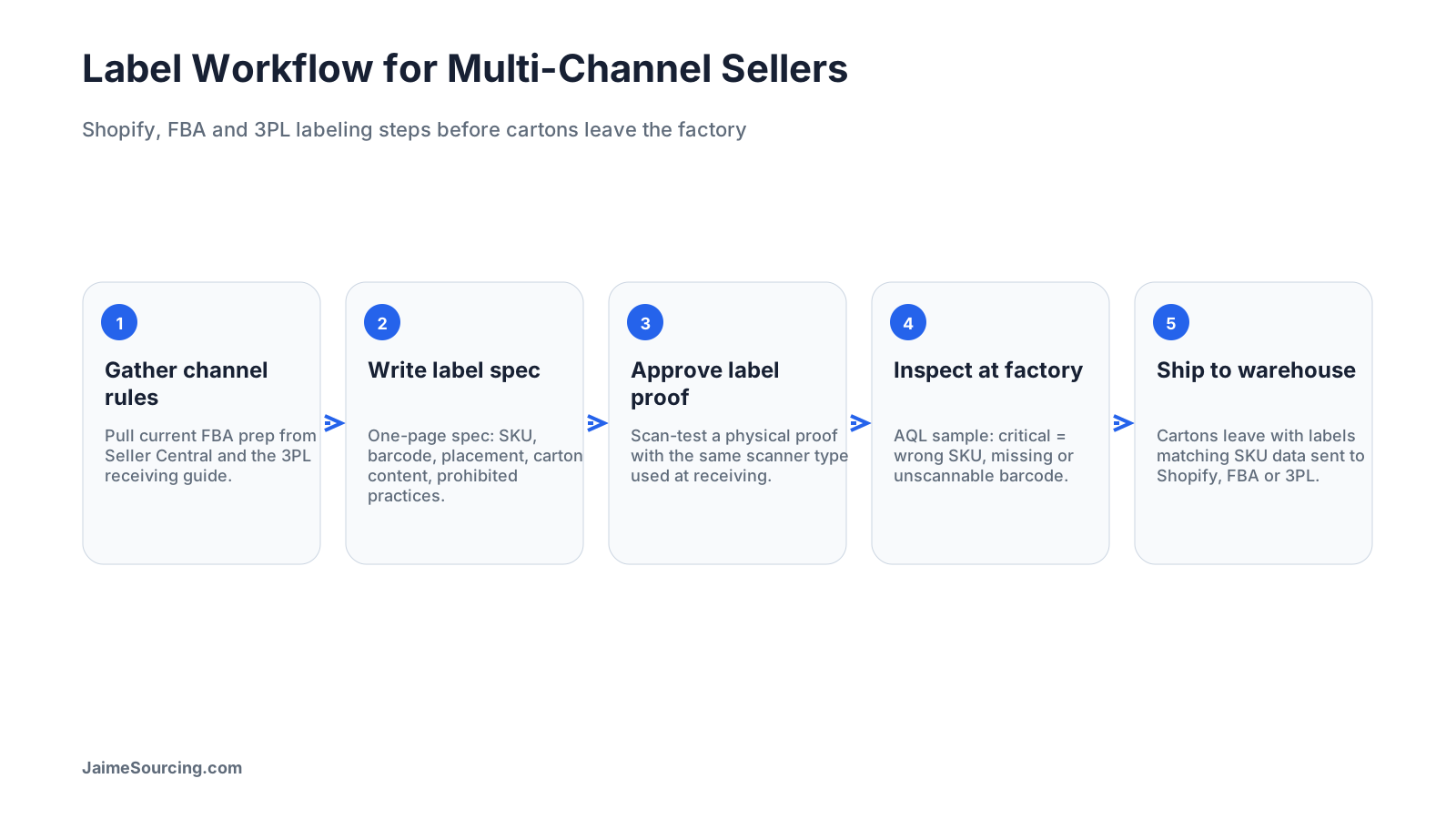
Most labeling failures originate at the factory, not the warehouse. The fix is a one-page labeling specification attached to the purchase order, covering:
- Unit label content: SKU exactly as it appears in Shopify (case-sensitive), barcode symbology, and the human-readable number beneath it.
- Placement: which panel of the retail packaging or poly bag, and whether the label must survive outer carton removal.
- Carton label content: SKU, quantity per carton, carton number (e.g., 1 of 12), gross weight, dimensions, and your PO number.
- Prohibited practices: no handwritten SKUs, no stickers over stickers, no reusing a label from a previous run.
- Artwork control: the label file version number and the date it was approved.
For FBA-bound goods, add the FBA-specific unit and carton requirements from Seller Central to the same document so the factory prints one compliant label set rather than two.
Where Quality Control Fits: Inspecting Labels, Not Just Products
Label accuracy is a defect category, and it should be inspected like one. Under ISO 2859-1 / ANSI/ASQ Z1.4, General Inspection Level II, you sample cartons and units and classify defects as Critical, Major or Minor. A common starting point—not a universal rule—is Critical 0 / Major 2.5 / Minor 4.0.
Applied to labeling, a workable classification is:
- Critical: wrong SKU on the unit label, missing barcode, or a barcode that will not scan—any of these makes the unit unsellable in the destination channel.
- Major: label on the wrong panel, illegible human-readable number, carton count mismatch against the packing list.
- Minor: cosmetic label skew, minor adhesive lift that does not affect scanning.
Scan-test a sample of labels with the same scanner type your 3PL or FBA warehouse uses. A barcode that scans on a phone screen can still fail on a warehouse laser scanner if print contrast or quiet zones are marginal.
Supplier Verification Before You Commit to a Label Run
Before you approve a label print run, confirm the company you are dealing with. China’s National Enterprise Credit Information Publicity System publishes registered business scope, establishment date, registered capital and the Unified Social Credit Code. Commercial databases such as Tianyancha and Qichacha add shareholder and change history.
Read the numbers carefully: registered capital is not paid-in capital, and a high registered figure says nothing about whether the factory can execute your order. Check that the establishment date is consistent with the trading history the supplier claims, that the Unified Social Credit Code matches the entity named on your PI and bank details, and that the business scope covers the product category. A mismatch between the contracting entity and the receiving bank account is a stop signal.
What to Verify Before You Proceed
- Pull the current receiving guide from your actual 3PL and the current FBA prep requirements from Seller Central for your marketplace; do not rely on secondary summaries.
- Confirm every Shopify variant has a unique SKU and unique barcode, and freeze SKUs before the first inbound shipment.
- Get the 3PL’s relabel, re-bag and exception-handling fees in writing before shipping.
- Approve a physical label proof—scanned, not just photographed—before the full print run.
- Match the supplier’s legal entity, Unified Social Credit Code and bank account name before paying a deposit.
- Decide Incoterms explicitly. Under EXW the buyer carries origin charges and export clearance; under FOB the supplier handles export and the buyer pays freight and destination costs; under DDP the seller quotes a delivered price, and “tax-inclusive” DDP arrangements that under-declare value are a compliance risk you inherit. Confirm who is the importer of record.
- For payments, agree T/T terms, who absorbs bank fees, and how FX movement is handled; keep corporate accounts on both sides, and state clearly whether sample and courier fees are deducted from the bulk order.
Frequently Asked Questions
Does Shopify require a specific barcode format?
No. Shopify requires that each variant has a unique barcode in your product data, but it does not mandate a symbology or printing standard. The physical label standard comes from your 3PL or from Amazon if the same inventory is FBA-bound.
Can I use the same SKU across Shopify, FBA and a 3PL?
Often yes, but verify each system’s constraints first. Shopify blocks duplicate SKUs across variants, and some fulfillment app combinations prevent sharing a SKU across locations. A single clean SKU scheme reduces relabeling, but confirm it with your 3PL’s receiving team before printing.
Who pays if labels arrive wrong at the 3PL?
Almost always the seller. Relabeling and re-bagging are standard billable 3PL services, and FBA remediation is charged similarly. The cheapest control is a scanned label proof and an AQL inspection at the factory before cartons ship.
Do I need HS codes on my labels?
Not usually on the unit label. HS codes are needed in your product data when selling across borders so customs can assess duties. They belong on commercial invoices and customs paperwork, not necessarily on retail packaging.
How do I check a Chinese supplier before a label print run?
Use the National Enterprise Credit Information Publicity System for registration data, and Tianyancha or Qichacha for change history. Compare the Unified Social Credit Code, establishment date and business scope against the PI and bank details, and remember registered capital is not paid-in capital.
Labeling problems are cheap to fix in China and expensive to fix in a warehouse 8,000 km away. The real risks are quality drift between the approved label proof and the production run, factory follow-ups that stall across time zones, and the physical distance that turns a two-minute scan test into a three-week reshipment.
Jaime Sourcing works as your ground team in China—supplier research and verification, inspection and quality control, consolidation, packing and shipment coordination—so label specs are checked at the factory rather than discovered at receiving. If you are about to approve a label run or reconcile SKUs across Shopify, FBA and a 3PL, talk to Jaime Sourcing for a supplier check or a workflow review.
Turn your product and order requirements into a controlled sourcing brief.
Share the product, supplier link, quantity, destination and current order stage. We will identify the practical verification, quality-control, packing and shipping steps.