If you run a Shopify store and you are buying from China for the first time, most of your risk sits in four places: an unverified supplier, an unclear specification, an inspection you never commissioned, and a shipping term you did not read closely. MOQ haggling, sample fees and payment channels matter, but they are downstream of those four. This article maps the questions overseas Shopify resellers ask most often and gives the operational answer to each, including the checks you can run yourself before money leaves your account.
One framing note. The Chinese-language Shopify guidance most sellers find online is written for mainland Chinese merchants exporting outward — it covers domestic payment collection and cross-border fulfilment from a China-based seller’s perspective. Your situation is the mirror image: you are the overseas buyer, and the supplier is your counterparty. Read those guides for logistics mechanics, but do not assume the compliance and payment advice applies to you.
The Questions Resellers Ask Most, Grouped by Stage
Across sourcing forums, supplier chats and Shopify’s own supply-chain guidance, the recurring questions cluster into predictable stages. The table below is a working checklist you can adapt.
| Stage | The question resellers ask | What actually resolves it |
|---|---|---|
| Supplier vetting | “Is this factory real, or a trading company?” | Business-registry check plus a video or third-party audit |
| Quoting | “Why did three suppliers quote wildly different prices?” | Compare on identical spec, Incoterm and packaging |
| Sampling | “Should I pay for samples, and who pays freight?” | Agree sample cost and freight allocation in writing first |
| MOQ | “Can I start smaller than the stated MOQ?” | Ask about stock colours, mixed SKUs, or trial runs |
| Quality | “How do I know the bulk matches the sample?” | AQL inspection against a signed golden sample |
| Shipping | “Is DDP worth it, and is it compliant?” | Understand who is importer of record and what is declared |
| Payment | “T/T, Trade Assurance, or something else?” | Match the channel to the relationship stage and amount |
| After-sales | “What happens when a batch is defective?” | A written remedy clause before the PO is signed |
Supplier Verification: The Checks You Can Run Before You Pay
The most common China sourcing problem ecommerce sellers report is paying a supplier whose identity they never confirmed. Registered capital, a glossy catalogue and a WeChat account prove very little on their own.
Start with the Chinese National Enterprise Credit Information Publicity System (National Enterprise Credit Information Publicity System), the official government registry. Search the company’s full Chinese legal name — not the English trading name on the website — and read four fields carefully:
- Unified Social Credit Code (Unified Social Credit Code): the 18-character identifier. It should match what appears on the supplier’s invoice and contract. A mismatch is a red flag.
- Establishment date (establishment date): a company registered a few months ago is not automatically bad, but it changes how much you rely on other checks.
- Registered capital (registered capital): this is a declared figure, not money in the bank. Do not treat it as a proxy for capability.
- Subscribed vs. paid-in capital (subscribed vs. paid-in): under China’s subscription system, shareholders commit to a capital amount that may be paid in later. A large registered figure with zero or minimal paid-in capital tells you the number is aspirational, not funded.
Tianyancha and Qichacha are commercial aggregators that repackage registry data alongside shareholder structures, branch information, litigation records and administrative penalties. They are useful for spotting patterns — frequent legal disputes, sudden address changes, abnormal-operation listings — but treat their summaries as leads to verify, not verdicts. Registry data also does not tell you whether the company actually owns a factory; many legitimate suppliers are trading companies, which is fine as long as you know which you are dealing with.
Samples, MOQs and Specifications: Where Most Disputes Begin
Price quotes that differ by 40% usually reflect different products, not different margins. Before comparing, force every supplier onto the same written spec: materials, dimensions, tolerances, finish, packaging, labelling and carton configuration. A signed golden sample — kept by both parties — is the reference point for everything that follows.
On samples, agree in advance who pays the sample cost and who pays the courier freight, and whether the sample fee is credited against the bulk order. On MOQs, ask specifically whether the number applies per SKU, per colour, or per order; many suppliers will accept a smaller trial run on stock colours even when the headline MOQ looks rigid.
Quality Control: Using AQL Properly
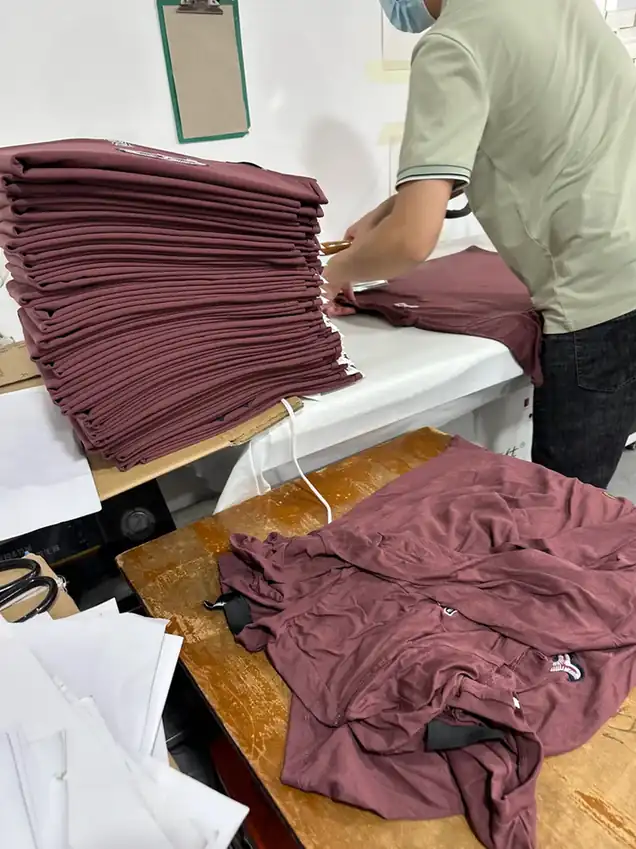
The practical answer to “how do I know the bulk matches the sample” is a pre-shipment inspection using AQL sampling under ISO 2859-1 / ANSI/ASQ Z1.4, typically at General Inspection Level II. You define three defect classes before the inspection:
- Critical: a defect that creates a safety hazard or makes the product illegal to sell in your market — for example, a choking hazard on a children’s item.
- Major: a defect that would cause most customers to return the product or complain — a broken function, a wrong size, a visible flaw on a primary surface.
- Minor: a deviation that does not affect function or saleability but falls short of spec — minor cosmetic marks, loose threads.
A commonly used starting point is Critical 0 / Major 2.5 / Minor 4.0, meaning zero critical defects are tolerated and the acceptance numbers for major and minor defects are drawn from the AQL tables at those levels. Treat this as a common example, not a universal rule: the right levels depend on your product category, price point and return tolerance. Tighten them for high-value or safety-relevant goods; loosen them for low-cost accessories where a few cosmetic marks are acceptable.
Incoterms, Landed Cost and the DDP Trap
The three terms you will meet most often behave very differently:
- EXW (Ex Works): your cost starts at the supplier’s door. You arrange and pay for export clearance, inland transport, main freight, import clearance and duty. Maximum control, maximum admin.
- FOB (Free On Board): the supplier handles export clearance and delivery to the named port; you take over from there. This is the most common term for buyers who want visibility of origin charges.
- DDP (Delivered Duty Paid): the seller quotes a single delivered price including duty. Convenient, but you need to know who is the importer of record and what value and HS code were declared. Non-compliant “tax-inclusive” DDP arrangements — where goods are under-declared or routed through an informal channel — can leave you exposed to customs penalties and seized shipments even though you never touched the paperwork.
Build a landed-cost sheet that includes unit price, packaging, inland freight, main freight, insurance, duty, import VAT/GST, port and broker fees, and a contingency line. Customs rules and duty rates are jurisdiction-specific and change; verify current rates with the official customs authority of your destination country (for example, HMRC in the UK, CBP in the US, or the relevant EU member state’s customs administration) rather than relying on a supplier’s assurance.
Paying a Chinese Supplier: T/T, Fees and FX
For overseas buyers paying Chinese suppliers, T/T (telegraphic transfer) is the default. Practical points:
- Bank fees: both the sending and receiving banks may deduct charges. Agree whether the invoice amount is “net of all bank charges” — otherwise a shortfall can trigger a dispute.
- FX exposure: quote and pay in a currency you can hedge or budget for; a moving exchange rate between PO and payment date changes your true cost.
- Corporate vs. personal accounts: pay the company account named on the contract and matching the registry check. Payments to personal accounts weaken your evidence trail if something goes wrong.
- Trade Assurance: platform escrow-style protection can help on early orders, but it carries its own fee structure and dispute process — read the terms rather than assuming it replaces due diligence.
- Sample payments: small amounts often attract disproportionate fixed fees; agree upfront who absorbs them.
What to Verify Before You Proceed
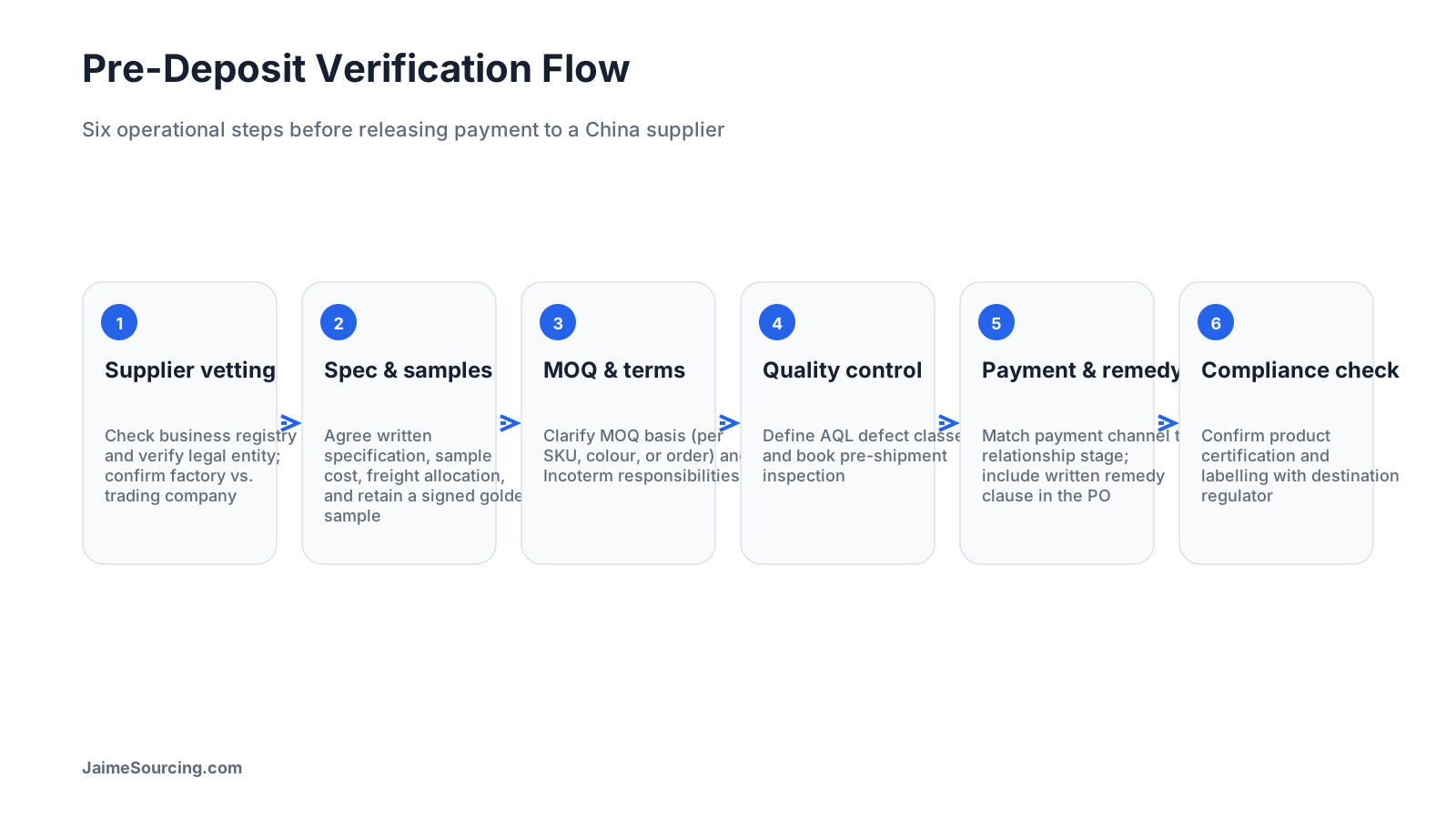
Run this list before releasing a deposit:
- Registry match: legal Chinese name, Unified Social Credit Code and bank account name all align.
- Capital reality: you have read subscribed vs. paid-in capital and drawn your own conclusion.
- Spec signed: a written specification and a retained golden sample exist.
- Inspection booked: AQL levels and defect definitions are agreed in writing.
- Incoterm clear: you know who is importer of record and what is declared.
- Remedy clause: defective-batch handling, rework and refund terms are in the PO.
- Compliance check: product certification and labelling requirements confirmed with your destination market’s official regulator.
Frequently Asked Questions
Is a trading company worse than a factory for a Shopify reseller?
Not inherently — a good trading company can consolidate multiple factories and handle export paperwork, which suits small buyers. What matters is that you know which you are dealing with, because it changes who is accountable for quality and lead times. Verify the legal entity either way.
How much should I budget for a pre-shipment inspection?
Inspection cost scales with man-days and location, so no single figure is reliable across categories. Budget it as a fixed line in your landed cost and compare it against the value of the shipment. For first orders and high-return-risk products, the inspection usually pays for itself.
Can I avoid DDP and still get simple shipping?
Yes — many buyers use FOB to a freight forwarder who then handles import clearance and duty. It requires more paperwork on your side but gives you visibility of declared value and HS codes. Ask the forwarder to show you the entry documents.
What is the biggest cause of quality drift between sample and bulk?
Uncontrolled substitutions — a different material batch, a cheaper component, or a rushed line during peak season. A signed golden sample plus an AQL inspection at General Inspection Level II catches most of it before goods ship.
Managing Distance, Drift and Follow-Up
The structural problem with sourcing from China as an overseas Shopify reseller is not finding suppliers — it is staying close enough to notice when something changes. Quality drifts between the sample you approved and the third production run. A factory quietly subcontracts a component. A promised ship date slips while you are asleep in a different time zone. None of these show up in a chat thread until the goods arrive.
That is the gap a ground team closes. Jaime Sourcing supports overseas buyers with supplier research, supplier verification, inspection, quality control, consolidation, packing and shipment coordination — the physical, on-the-ground work that is hard to do from another continent and another time zone. If you want a second pair of eyes on a supplier before you wire a deposit, or a review of your current sourcing workflow, talk to Jaime Sourcing and walk through the checks above with someone who can act on them in China.
Turn your product and order requirements into a controlled sourcing brief.
Share the product, supplier link, quantity, destination and current order stage. We will identify the practical verification, quality-control, packing and shipping steps.