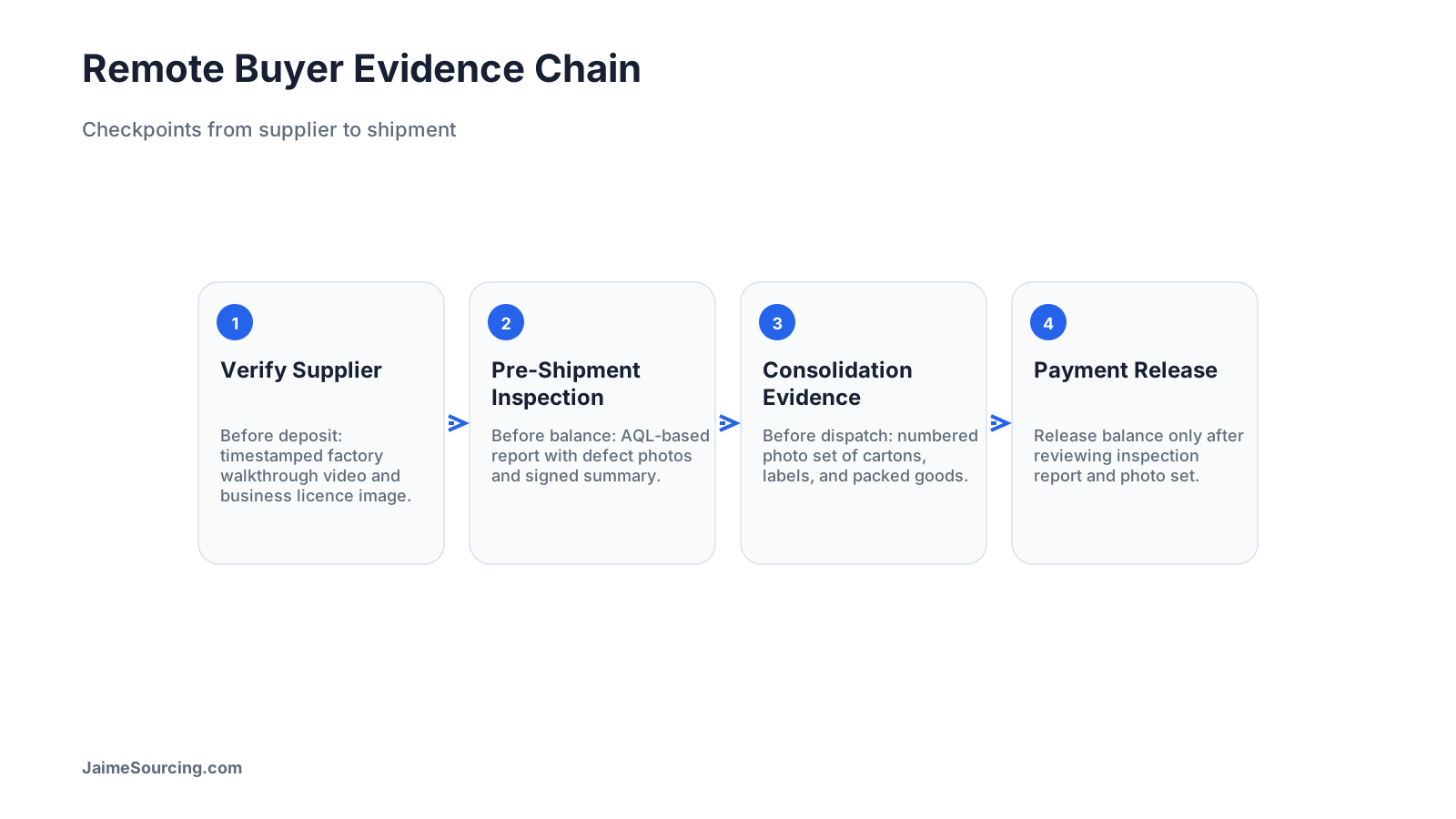
Ask for a defined evidence pack at three checkpoints—supplier verification, pre-shipment inspection, and warehouse consolidation—and make each item traceable to a date, an order number and a physical location. For a Shopify reseller, the minimum viable set is: a timestamped factory walkthrough video, an AQL-based inspection report with defect photos, a carton-and-label photo set taken at the warehouse before consolidation, and a signed inspection summary you can attach to your own supplier records. Without these, you cannot prove what condition the goods were in when they left China.
This article sets out what to request, how to read it, and where the boundaries of an agent’s inspection actually sit.
Why remote buyers need a defined evidence standard, not ad-hoc photos
When goods move from a Chinese factory to a consolidation warehouse and then overseas, the buyer never sees the physical item until it clears customs. If the warehouse or agent only confirms “the package arrived” without photographing condition, colour, quantity or packaging, tracing a problem after the container lands becomes very difficult. The photo record is the only contemporaneous proof you will have.
There is a second reason to be specific. The most expensive sourcing-agent failures are not small ones. One US home-goods company discovered it had overpaid by roughly US$2.4 million over three years because an agent posing as a factory had been marking up prices by close to 40% and quietly switching to a lower-grade manufacturer to protect its margin. In another case, a retailer’s Christmas lighting order arrived in November instead of May because the agent had not paid the actual manufacturer, who then withheld the shipment—and the factory’s direct price was nearly 50% below what the agent had charged. Evidence requests do not prevent every fraud, but a documented chain of who inspected what, where, and when makes substitution and non-payment much harder to hide.
The practical principle: the agent’s basic inspection and photography has clear boundaries. It records visible condition before dispatch; it does not replace your own brand-level quality testing, and it cannot legitimately open every sealed retail package. Set your expectations inside those boundaries and you will get requests that are actually executable.
The evidence pack: what to request at each checkpoint
Checkpoint 1 — Supplier verification (before you pay a deposit)
Request a short video walkthrough rather than a photo collage. A useful clip shows the building exterior with visible signage, the production floor in operation, the specific line or machine that will run your order, and a spoken or on-screen statement of the date. Ask for the business licence image alongside it so the company name on the licence matches the signage and the name on your quotation.
Cross-check the licence yourself. In mainland China, the National Enterprise Credit Information Publicity System is the official registry; Tianyancha and Qichacha are commercial aggregators that repackage similar data. On any of them, look at four fields:
- Unified Social Credit Code — the 18-character identifier; it should match the licence exactly.
- Establishment date — a company registered a few months ago claiming a decade of export history is a red flag.
- Registered capital versus paid-in (subscribed vs. paid-in) capital — registered capital is a pledge, not money in the bank; paid-in capital is what has actually been contributed. A high registered figure with zero or minimal paid-in tells you little about real capacity.
- Business scope — confirm manufacturing or the relevant activity is listed, not just “trading” or “consulting.”
This is desk research you can do without leaving your office, and it is the cheapest fraud control available.
Checkpoint 2 — Pre-shipment inspection (before the balance payment)
This is the core of the evidence pack. Insist on an inspection conducted against a written checklist and an AQL sampling plan, and insist the report arrives before you release the balance.
A defensible inspection report should contain:
| Evidence item | What it proves | What to check |
|---|---|---|
| Inspection date, time and address | The goods existed at a place on a date | Address matches the factory or warehouse you expect |
| Inspector name and signature | Accountability for the findings | Same inspector across repeat orders where possible |
| Sampling plan (lot size, sample size, AQL levels) | The result is statistically meaningful | Levels stated explicitly, not “we checked some” |
| Critical / Major / Minor defect counts | Severity is classified, not blended | Critical defects should be zero-tolerance |
| Photo of each defect found, with a measurement reference | Defects are real and quantified | Ruler or caliper visible in frame |
| Carton drop-test or stacking photos where relevant | Packaging survives transit | Outer carton condition, not just product |
| Product label, hang tag and barcode close-ups | Compliance and retail readiness | Matches your approved artwork and SKU list |
| Accessories and free-gift check | Nothing is missing from the set | All components present per bill of materials |
| Quantity count by SKU | Short-shipment protection | Tally matches your purchase order |
For the sampling plan itself, the widely used framework is ISO 2859-1 / ANSI/ASQ Z1.4, typically at General Inspection Level II. Under that system, defects are classified as Critical (safety or legal issues—should not be accepted at any level), Major (functional failure or a defect a customer would reject), and Minor (cosmetic deviation within tolerance). A common working example is Critical 0 / Major 2.5 / Minor 4.0, but treat that as an example, not a universal rule—the right levels depend on your product category, price point and return tolerance. Agree the levels in writing before the inspection, or the report becomes an argument after the fact.
Checkpoint 3 — Warehouse and consolidation evidence
Before goods are consolidated and dispatched, the warehouse can reasonably photograph the outer box condition (dents, damage, water stains), the shipping label with recipient, tracking number and piece count, the product appearance after unboxing (colour, style, quantity), visible labels and model identifiers, and the package appearance after consolidation. Ask for these as a numbered set tied to your order reference, not a loose camera roll.
Video: what a useful clip looks like versus a staged one
Photos can be selected; video is harder to fake convincingly. Request three short clips rather than one long one:
- A continuous walkthrough from the entrance to your goods, with no cuts, showing the date on a phone screen or a whiteboard at the start.
- A functional demonstration of the product—switches operated, mechanisms cycled, measurements taken on camera. This substitutes for the “pick it up and feel it” part of a factory visit.
- A packing clip showing how your units are boxed, labelled and loaded, so you can compare against your approved packaging spec.
If an agent resists continuous footage or offers only edited highlight reels, that is itself information. Legitimate agents with real ground presence can usually produce raw clips on request.
Reading the evidence critically: substitution, markup and the limits of photos
Evidence is only as good as its traceability. Three failure patterns recur.
Substitution. An agent swaps in a cheaper manufacturer mid-order to protect margin, and the inspection photos are taken at the new, unapproved site. Counter this by requiring the inspection address to match the approved factory, and by comparing product photos against your signed golden sample.
Markup hidden behind “our factory” language. Agents who claim ownership of factories they do not own are a documented pattern. Ask directly whether the entity on the quotation is the manufacturer or an intermediary, and verify the name on the licence. A transparent agent will answer plainly; the answer itself is a test.
Contractual gaps. In one case a European company that rejected defective shoes found itself sued not by the factory but by its agent, whose contract required payment regardless of quality—and because there was no direct contract with the manufacturer, the buyer had little recourse. Your evidence pack should sit alongside a contract that ties payment milestones to inspection outcomes.
Photos also have honest limits. They cannot confirm weight, hand-feel or the sound of a mechanism; that is what physical samples and live video are for. And they cannot substitute for category-specific compliance testing—electronics, batteries, cosmetics and food carry additional requirements that vary by destination, and you should confirm the current rule with the relevant authority in your market rather than relying on an inspection photo.
What to Verify Before You Proceed
- Match the licence to the quotation. Confirm the Unified Social Credit Code, establishment date, paid-in capital and business scope on the National Enterprise Credit Information Publicity System, Tianyancha or Qichacha.
- Agree the AQL plan in writing. State the standard (ISO 2859-1 / ANSI/ASQ Z1.4), the inspection level, and your Critical/Major/Minor thresholds before the inspection is booked.
- Confirm the inspection address matches the approved factory, and require the address to appear in the report.
- Tie payment to evidence. Release the balance only after you have received and reviewed the inspection report and photo set.
- Keep a golden sample. Retain the signed, approved sample so every future photo set has a reference point.
- Check your Incoterms and duty exposure. Under EXW the buyer carries origin charges and export clearance; under FOB the seller handles origin and export and risk transfers at the ship’s rail; under DDP the seller delivers duty-paid. Be cautious with “tax-inclusive” DDP arrangements that under-declare value—the customs risk lands on you, and duty is assessed on the declared invoice, not the factory’s real cost. Confirm current rates with your customs broker or the relevant authority.
- Pay through corporate accounts where possible. For T/T, clarify who absorbs bank fees, note FX exposure between quotation and payment, and understand any platform guarantee fee before you rely on it. Personal-account payments weaken your dispute position.
Frequently Asked Questions
How many inspection photos should I expect for a typical order?
A workable set is roughly 20–40 images covering carton condition, label close-ups, SKU counts, defect shots with a measurement reference, and post-consolidation packaging. Coverage matters more than the number—every SKU and every defect category should appear at least once, with the date and order number visible.
Can a sourcing agent’s photos replace third-party lab testing?
No. Inspection photography records visible condition and quantity; it does not test material composition, electrical safety or restricted substances. For regulated categories, commission testing from an accredited lab and confirm the current requirement with your destination market’s authority.
What should I do if the inspection report shows Major defects above my AQL limit?
Do not release the balance. Ask for the rework plan in writing, require a re-inspection against the same sampling plan, and get fresh photos of the reworked units. If the agent pushes back on a re-inspection, treat that as a warning sign about the relationship, not just the order.
Is a live video call better than a recorded inspection video?
They serve different purposes. A live call lets you direct the camera and ask questions in real time; a recorded clip gives you a file you can archive and compare on the next order. Ask for both on first orders, then rely on recorded evidence for repeat runs.
How do I know the inspection actually happened at my factory?
Cross-check the address in the report against the approved factory, look for continuous footage rather than edited clips, and compare product details against your golden sample. Inconsistent backgrounds, mismatched signage or a refusal to show the building exterior are all reasons to pause.
Managing quality drift when you are 8,000 km away
The real risk is not a single bad batch—it is slow drift. A supplier substitutes a component in month four, a carton spec quietly changes, a label shifts two millimetres, and nobody notices because the evidence pack was never standardised. Physical distance and time-zone friction make that drift invisible until returns start climbing.
The control is a repeatable evidence workflow: the same checkpoints, the same AQL plan, the same photo set, order after order, so that this month’s images can be compared against last month’s. That is the ground work Jaime Sourcing supports—supplier research and verification, inspection and quality control, consolidation, packing and shipment coordination—so you are not relying on a supplier’s own camera roll. If you would like a second pair of eyes on a supplier or a review of your current inspection workflow, talk to Jaime Sourcing and we will help you build an evidence standard you can hold suppliers to.
Turn your product and order requirements into a controlled sourcing brief.
Share the product, supplier link, quantity, destination and current order stage. We will identify the practical verification, quality-control, packing and shipping steps.