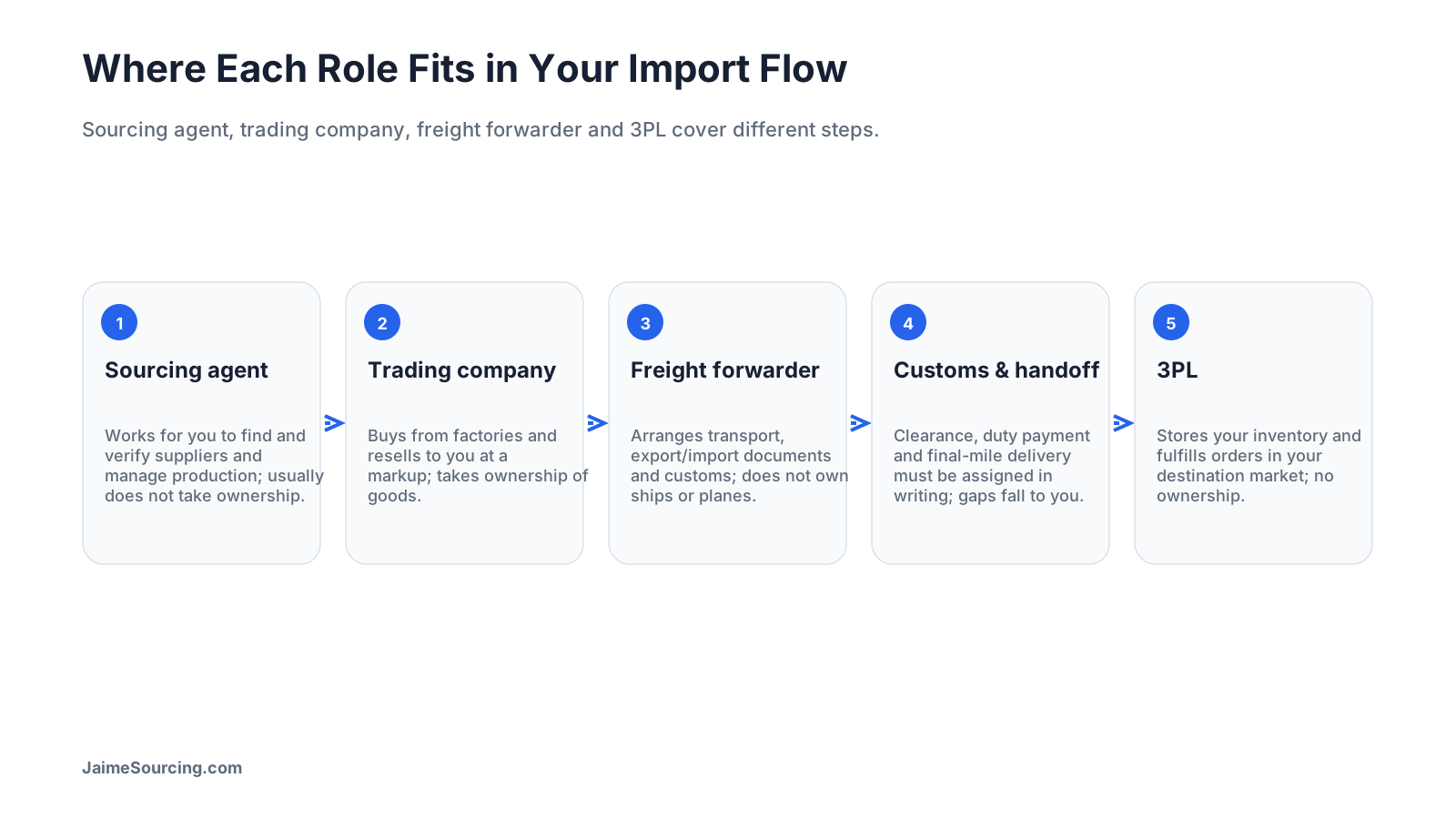
If you are a Shopify reseller importing from China, the four roles you will hear about most are the sourcing agent, the freight forwarder, the trading company and the 3PL. They are not interchangeable, and confusing them is one of the most common ways small brands overpay or lose control of quality. In short: a sourcing agent works for you to find and verify suppliers and manage production; a freight forwarder moves cargo from origin to destination and handles export/import documentation; a trading company buys from factories and resells to you at a markup; and a 3PL stores, manages and fulfills inventory, usually in your destination market. Most growing importers end up using two or three of these at once, so the goal is not to pick one, but to know where each one’s responsibility starts and stops.
The Four Roles at a Glance
The cleanest way to separate them is by whose side they are on and what they physically touch. A sourcing agent represents the buyer and typically does not take ownership of goods; a trading company takes ownership and resells; a freight forwarder arranges transport but usually does not own ships or planes; a 3PL physically handles your stored inventory and fulfills orders.
| Role | Works for | Takes ownership of goods? | Core job | Typical fee model |
|---|---|---|---|---|
| Sourcing agent | Buyer | Usually no | Supplier research, verification, negotiation, QC, shipment coordination | 5–15% of order value or fixed retainer |
| Trading company | Itself (reseller) | Yes | Buys from factories, resells to you | 10–30% markup on factory price |
| Freight forwarder | Shipper (you) | No | Booking, export/import docs, customs, transport | Per-shipment charges |
| 3PL | Buyer | No (holds your stock) | Warehousing, inventory, pick-pack-ship, returns | Ongoing storage + per-order fees |
Read the table as a map of risk transfer. The moment a trading company owns the goods, it also owns the margin and much of the quality risk. The moment a forwarder hands off at the destination port, your 3PL or your own warehouse takes over. Knowing these handoff points prevents the “why am I paying twice for this?” conversation.
Sourcing Agent vs Trading Company: Who Are You Actually Buying From?
This is the distinction that most affects your price and your control. A factory makes the product; a trading company buys from the factory and resells, adding roughly 10–30% to the unit cost; a sourcing agent works on your behalf, usually without taking title to the goods, and charges a service fee of about 5–15% of order value. Many trading companies present themselves as factories on Alibaba and similar platforms, sometimes even displaying factory photos and certificates that belong to their suppliers.
Why it matters operationally: a trading company can offer lower MOQs and one-stop multi-category purchasing, which is genuinely useful for a first order. But it may not disclose which factory actually made your product, which makes quality tracing harder if something goes wrong, and it may switch factories between orders without telling you. A sourcing agent, by contrast, is supposed to give you visibility into the actual production source—but agent quality varies widely, and unlike trading companies there is no uniform regulatory standard, so dishonest agents can misrepresent factories or take supplier kickbacks.
A practical pattern many importers follow: start with a trading company for a low-MOQ first order, move to direct factory supply as volume grows, and bring in a sourcing agent when expanding into new categories or high-value items that need factory audits.
How to verify which one you’re dealing with
The fastest check is the business license. Chinese companies hold a Unified Social Credit Code and a license that states whether the entity is registered as production-type (factory/production) or trading-type (trading). Ask for it before you negotiate. Then cross-check the company on the Chinese National Enterprise Credit Information Publicity System (the official registry), and optionally Tianyancha or Qichacha for a fuller picture. When you read those records, understand what you’re looking at:
- Registered capital is the amount the company committed at registration—not cash in the bank.
- Subscribed vs. paid-in capital: subscribed is what shareholders promised to contribute; paid-in is what has actually been deposited. A large subscribed figure with little paid-in capital tells you the company may be thinly funded.
- Establishment date helps you judge track record—a company registered a few months ago is a different risk profile from one operating for a decade.
- Unified Social Credit Code is the 18-character identifier you should use to confirm you’re looking at the same legal entity across platforms.
Also ask directly which factory produces your specific item. A real factory will show you its production line; a trading company often deflects or arranges a visit to a plant that isn’t its actual supplier.
Freight Forwarder vs 3PL: Moving Goods vs Fulfilling Orders
These two are frequently confused because both are “logistics,” but they solve different problems. A freight forwarder arranges transport: booking space with carriers, preparing bills of lading and commercial invoices, handling export and import customs, and coordinating pickup and delivery. A 3PL stores your goods, manages inventory, picks and packs orders, ships to end customers, and handles returns. The forwarder answers “how does it get there?” and the 3PL answers “how does it get to the buyer once it’s there?”.
The pricing models reflect this. Forwarders charge per shipment—you pay for each move, with costs depending on mode, volume and lane. 3PLs charge ongoing operational fees—storage per pallet or per unit, pick-and-pack per order, plus technology fees, often under a 1–3 year contract. That structural difference is why a forwarder is a poor fit if you need someone to hold and ship your inventory, and why a 3PL is overkill if you only ship a container twice a year to your own warehouse.
For a Shopify reseller, the usual setup is both: the forwarder moves your replenishment shipment from China to your destination market, and the 3PL (or your own fulfillment operation) receives it and ships individual orders. If you sell direct-to-consumer from China instead, the forwarder may handle the international leg to the buyer, but you generally won’t need a destination 3PL.
Where the handoff goes wrong
Most failures happen at the seams. Confirm in writing: who clears customs at destination, who pays duty, who arranges the final-mile delivery from port to warehouse, and who is responsible if the container is delayed. A forwarder’s job typically ends at the named destination (port or warehouse), and the 3PL’s job begins when goods are received and checked in. If neither party owns the gap between those two points, you do.
Incoterms and Landed Cost: EXW, FOB and DDP
Your choice of Incoterm decides who pays origin charges, who clears customs, and where risk passes. Three terms cover most small-importer scenarios:
- EXW (Ex Works): your responsibility starts at the supplier’s door. You arrange pickup, export clearance and everything after. Cheapest on paper, most work for you.
- FOB (Free On Board): the supplier handles export clearance and delivery to the named port; you take over from there, including ocean freight, insurance and import duty. This is the most common term for buyers who want control over freight.
- DDP (Delivered Duty Paid): the seller (or a forwarder acting for them) handles everything through to your door, including import duty. Convenient, but you must understand what “duty paid” actually means.
The DDP risk deserves emphasis. A “tax-inclusive” DDP quote can be structured in ways that under-declare value or misclassify goods to lower the duty bill. If customs later disagrees, the liability can land on the importer of record—often you. Always ask for a breakdown of the DDP price showing freight, insurance, duty and any clearance fees, and confirm the declared value matches your commercial invoice. Customs rules differ by jurisdiction (US CBP, HMRC in the UK, EU customs authorities, CBSA in Canada, ABF in Australia), so verify the current rule with the relevant official authority rather than relying on a forwarder’s verbal assurance.
Payments to Chinese Suppliers: What to Watch
For overseas buyers paying Chinese suppliers, the payment mechanics carry their own risk. Common structures include T/T (telegraphic transfer) deposits and balances, with bank fees and FX exposure on both ends. A few practical points:
- Corporate vs. personal accounts: pay the company’s registered corporate account where possible. Payments to a personal account are harder to recover and harder to tie to the legal entity you verified.
- Trade Assurance fees: platform protection schemes can add a fee; confirm who bears it before you assume it’s free.
- Sample payments: agree up front who pays sample cost and courier fees, and whether the sample fee is credited against a later bulk order.
- FX exposure: the RMB/USD rate can move between deposit and balance; agree which currency and which date’s rate applies.
None of this replaces a contract, but it reduces the chance that a payment dispute becomes unrecoverable.
Quality Control: AQL, Inspections and the Checks That Matter
If you are buying physical goods, quality drift is the risk that quietly erodes margin. The standard tool is AQL (Acceptable Quality Limit) sampling under ISO 2859-1 / ANSI/ASQ Z1.4, commonly run at General Inspection Level II. Inspectors classify defects into three tiers:
- Critical: safety or legal issues (e.g., a choking hazard, prohibited substance). Often set at 0 acceptance.
- Major: defects that make the product unsellable or functionally defective. A common example is 2.5.
- Minor: cosmetic or non-functional flaws. A common example is 4.0.
Treat 0 / 2.5 / 4.0 as a common starting example, not a universal rule—the right levels depend on your product category and your customer’s tolerance. Agree the AQL plan, the defect definitions and the inspection timing (typically during production and/or pre-shipment) in writing before the factory starts. A pre-shipment inspection catches problems while there is still time to rework; a during-production check catches them earlier still.
What to Verify Before You Proceed
Before you commit money, run these checks:
- Confirm the entity type via the business license and the National Enterprise Credit Information Publicity System; cross-check on Tianyancha or Qichacha. Note registered vs. paid-in capital and establishment date.
- Ask which factory makes your item and request evidence (production line photos, a video call, or a third-party audit).
- Get the Incoterm in writing and a cost breakdown for DDP quotes, including declared value.
- Agree the AQL plan (levels, defect definitions, inspection timing) before production.
- Confirm payment details: corporate account, currency, FX date, who pays bank and platform fees, sample fee treatment.
- Map the logistics handoffs: who clears customs, who pays duty, who moves goods from port to warehouse, and who owns delays at each seam.
- Check current customs and product-compliance rules with the relevant official authority in your destination market.
FAQ
What is the difference between a sourcing agent and a trading company?
A sourcing agent works for you and usually does not take ownership of goods, charging a 5–15% service fee; a trading company buys from factories and resells to you at a 10–30% markup. The agent gives you visibility into the real factory; the trading company gives you convenience and lower MOQs.
Do I need both a freight forwarder and a 3PL?
Usually yes, if you hold inventory in your destination market. The forwarder moves your shipment from China to your market; the 3PL stores it and fulfills individual orders. If you ship direct to consumers from China, you may only need the forwarder.
Is a DDP quote always the safest option?
No. DDP is convenient, but “tax-inclusive” quotes can involve under-declared value or misclassified goods, and the liability can fall on you as importer of record. Ask for a cost breakdown and confirm the declared value matches your invoice.
How do I check if an Alibaba supplier is really a factory?
Request the business license and confirm whether it is registered as production-type or trading-type, then cross-check on the National Enterprise Credit Information Publicity System. Ask which factory makes your specific item and request production-line evidence.
What AQL levels should I use for a first order?
There is no universal answer. A common starting point is Critical 0 / Major 2.5 / Minor 4.0 under General Inspection Level II (ISO 2859-1 / ANSI/ASQ Z1.4), but you should set levels based on your product’s risk and your customers’ tolerance.
The Real Risk Is Distance, Not Paperwork
The roles above are easy to describe and hard to manage from 8,000 kilometers away. Quality drifts between the sample you approved and the bulk run; factory follow-ups slip when you’re asleep in a different time zone; and the physical distance means problems surface late, when rework is expensive. That is the gap a ground team closes. Jaime Sourcing supports overseas buyers with supplier research, verification, inspection, quality control, consolidation, packing and shipment coordination—so you have someone physically present to check the factory, catch defects before shipment, and keep the handoffs between your supplier, forwarder and 3PL from falling through. If you’re unsure whether you’re buying from a factory, a trading company or an agent—or you want a second pair of eyes on your sourcing and QC workflow—talk to Jaime Sourcing about a supplier check or workflow review.
Turn your product and order requirements into a controlled sourcing brief.
Share the product, supplier link, quantity, destination and current order stage. We will identify the practical verification, quality-control, packing and shipping steps.