
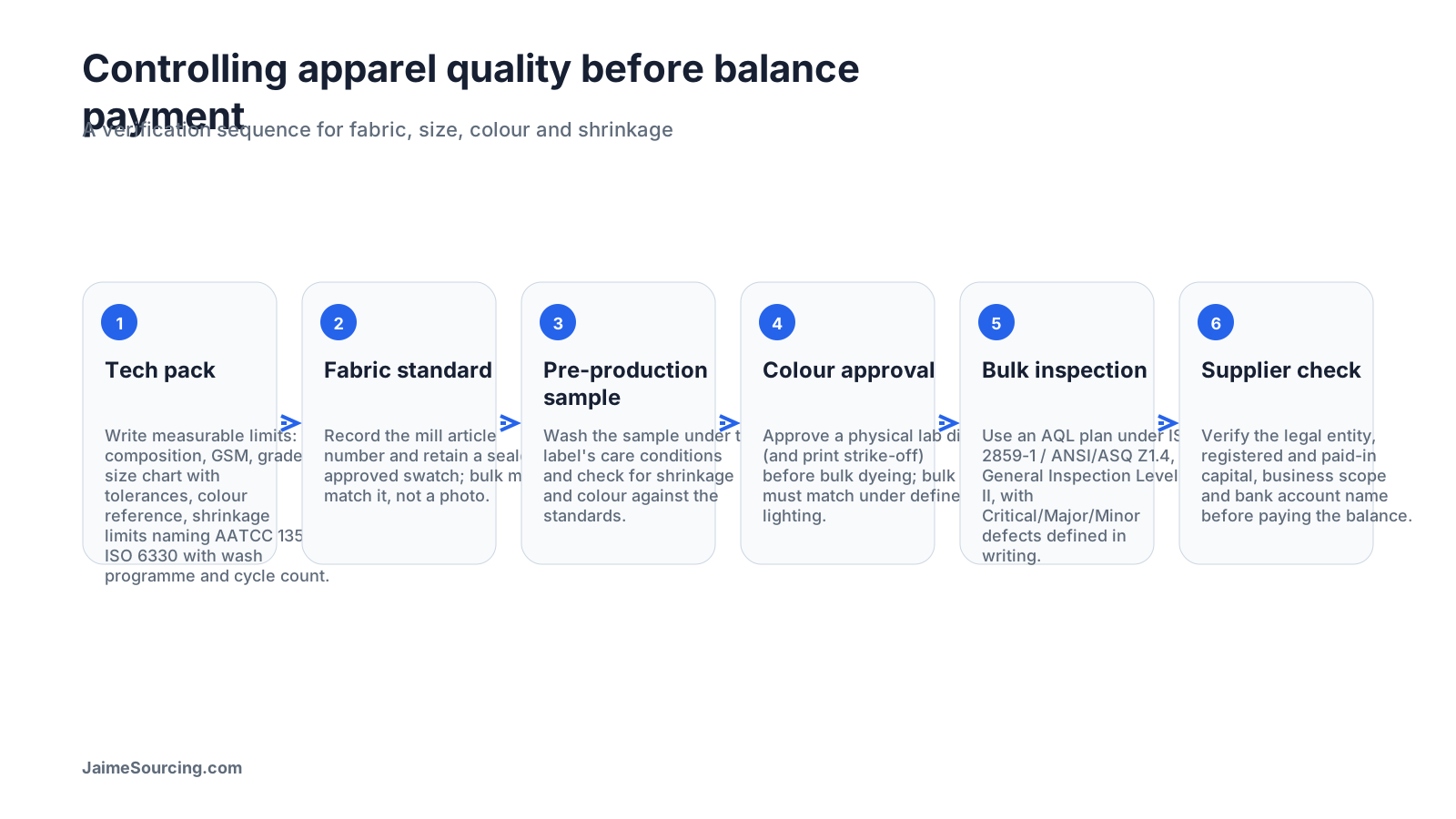
Four defects cause most apparel chargebacks and returns: fabric that does not match the approved standard, a size chart that drifts between sample and bulk, colour shading across dye lots, and shrinkage that only appears after the customer washes the garment. All four are controllable, but only if your tech pack, inspection criteria and payment terms are written to make them enforceable. Lock specifications before sampling, test the actual bulk fabric rather than a generic certificate, and inspect against a written AQL plan before the balance payment leaves your account.
Build a Tech Pack That Can Be Enforced
A tech pack is only useful if a factory can be held to it. Every specification needs a number, a method and a tolerance, not an adjective.
For fabric, record the fibre composition, the construction (single jersey, rib, fleece, woven twill), and the weight in grams per square metre (GSM). Weight is one of the most common drift points: a supplier may substitute a lighter knit to hit a price, and the garment then drapes and wears differently. Practical GSM bands used in the industry include roughly 130–180 GSM for a standard T-shirt, 180–250 GSM for casual trousers, and 200–300 GSM for sweatpants and sports bras. Treat these as starting reference points, not rules; your own product brief should set the number.
For fit, attach a graded size chart with measurement points (chest, waist, hip, inseam, sleeve length), the measuring method, and a tolerance per point. State whether measurements are taken flat or on the body, and whether the garment is relaxed or stretched.
For colour, specify the reference (a Pantone number, a physical approved swatch, or both) plus the light source under which the match will be judged. Colour assessed under one lamp and approved under another is a recurring source of disputes.
For shrinkage, the tech pack must name the test standard, the wash programme, the drying method and the number of cycles. Without all four, a tolerance cannot be enforced.
Control Fabric Quality Before Cutting
Fabric is where most quality problems originate, and it is cheapest to catch before the cutting table.
Ask for a fabric inspection report against the 4-point system, and require the report to identify the specific construction, weight and composition, not a generic certificate covering a family of fabrics. A report for one single-jersey quality tells you nothing about a different double-knit structure.
Verify weight and composition independently. A hands-on inspection should cross-check fibre content, GSM, colour consistency, hand-feel and surface texture against the approved standard, and flag weight shortfalls or large dye-lot variation between the bulk and the original sample. A simple kitchen scale and a known-area fabric cutter will confirm GSM faster than any supplier email.
Confirm the fabric supplier’s role. Mills produce custom fabric, often at high minimum order quantities; converters buy greige or raw fabric and finish it through dyeing, printing or washing; dealers hold leftover stock that may not be repeatable. If your supplier is buying from a dealer, ask what happens on a reorder. A colour you cannot reproduce is a colour you cannot build a collection on.
Order and keep a bulk fabric sample. Retain a sealed hanger of the actual production fabric, signed and dated, so that any later dispute is settled against a physical reference rather than a photograph.
Set Size Charts and Tolerances That Survive Bulk Production
Size drift is usually a process problem, not a dishonesty problem: pattern grading, cutting tension and sewing shrinkage all accumulate between the approved sample and the shipped garment.
Write tolerances per measurement point and per size. A fitted T-shirt tolerates less vertical movement than a loose sweatshirt, so a single blanket tolerance across a range is a weak control. Where a garment is close-fitting, tighten the length tolerance specifically.
Measure a production sample yourself, in the same way the factory does, and compare against the graded chart. Record the results in a table you can hand to an inspector.
| Control point | What to specify | How to verify |
|---|---|---|
| Fabric weight | GSM with tolerance | Weigh a known-area swatch |
| Fibre content | Composition % | Fibre test or supplier report |
| Colour | Pantone / approved swatch + light source | Compare bulk hanger to sealed standard |
| Size chart | Graded measurements + per-point tolerance | Measure production sample flat |
| Shrinkage | Standard, wash programme, dry method, cycles | Wash pre-production sample yourself |
| Trims | Button, zip, label, thread spec | Physical check at inspection |
Keep the approved sample and the sealed fabric standard in the same place, and make sure your inspector has access to both. An inspection without the golden sample is only a visual opinion.
Manage Colour Shading Across Dye Lots
Colour is the specification most often lost between sampling and bulk, because sampling may use a small dye lot while bulk runs across several.
Require the factory to cut garments from a single dye lot per colourway where volume allows, and to keep dye-lot records. Where multiple lots are unavoidable, ask for a shade band showing the acceptable range, and inspect bulk garments side by side under the agreed light source.
At inspection, check for colour shading across panels of the same garment, between garments in the same carton, and between cartons. Shading within a single garment, such as a sleeve noticeably different from the body, is usually a cutting or lot-mixing error and should be treated as a major defect.
Also check colour fastness expectations against your care label. A garment that meets its colour standard but bleeds in the wash will still generate returns.
Test Shrinkage on the Real Garment, Not a Generic Certificate
Shrinkage is the defect that reaches the customer last and costs the most, because it shows up after washing.
The two standards you will see named in tech packs are AATCC 135 (North American home laundering) and ISO 6330 (international home washing and drying procedures). Neither standard sets a pass/fail limit; they define how to measure dimensional change. The commonly used ≤3% figure for cotton knits is a commercial tolerance agreed between buyer and factory, and it only binds a supplier if it is written into your tech pack and contract with the standard, wash programme and cycle count specified.
Distinguish fabric shrinkage from garment shrinkage. Fabric shrinkage is measured on a fabric swatch; garment shrinkage is measured on the finished, cut-and-sewn item and is typically higher, because sewing tension, seam shrinkage and trim behaviour add to the fabric’s own movement. If your tech pack only controls fabric shrinkage, you have not controlled what the customer experiences.
Rib trims and cuffs are the highest-risk components, because they are stretched during sewing and contract after washing. Set separate limits for trims and, where possible, test them as sewn components. Thick fleece and brushed fabrics can hide body shrinkage until hems pucker after the first wash, so specify finished-garment limits for those categories.
The most reliable check is to take the pre-production sample, wash it under the care conditions you intend to print on the label, and measure it yourself. Cross-check the result against the factory’s inspection records. Shrinkage and fabric inspection are separate QC gates, and a fabric can pass a 4-point inspection and still shrink out of tolerance.
Inspect Against a Written AQL Plan
Agree the inspection standard before production, not after. The widely used framework is ISO 2859-1 / ANSI/ASQ Z1.4, with General Inspection Level II and a defined AQL per defect class.
Classify defects explicitly:
- Critical — a safety or legal issue, such as a sharp point, a choking hazard on children’s items, or a label that misstates fibre content. Critical is commonly set at 0.
- Major — a defect that would make the customer return the item or that breaches the specification: wrong measurement beyond tolerance, visible colour shading, a broken zip, a hole.
- Minor — a cosmetic deviation unlikely to drive a return: a loose thread, slight untrimmed seam.
Critical 0 / Major 2.5 / Minor 4.0 is a common starting point, not a universal rule. Set it to your own risk and price point, and write it into the purchase order.
At inspection, check appearance for damage, visible colour difference, pulled or broken yarns, stains and foreign fibres; check measurements against the approved chart; and check trims (buttons, zips, labels and thread) one by one against the specification. Photograph defects with the carton number visible so the factory can trace them.
Verify the Supplier Before You Pay
Before placing a bulk order, confirm the entity you are contracting with actually exists and matches the name on the invoice and bank account.
Use the Chinese National Enterprise Credit Information Publicity System, Tianyancha or Qichacha to check the legal name, Unified Social Credit Code, establishment date, registered address and business scope. Read registered capital carefully: subscribed capital is what shareholders have committed to contribute, while paid-in capital is what has actually been paid. A large subscribed figure with little paid-in capital tells you less than it appears to. Check whether the establishment date is recent, whether the business scope covers garment manufacturing or trading, and whether any abnormal-operations or penalty records are listed.
Match the bank account name to the registered company name. Payment to a personal account, or to a company name that differs from the contract, is a control failure regardless of how the relationship started.
What to Verify Before You Proceed
- Tech pack completeness: standard, wash programme, dry method and cycle count for shrinkage; per-point size tolerances; Pantone or physical colour standard with light source.
- Fabric evidence: a 4-point inspection report tied to the exact construction, weight and composition, plus your own GSM and hand-feel check.
- Sealed standards: an approved sample and a sealed bulk fabric hanger, signed and dated, held by both parties.
- Shrinkage test: your own wash test on the pre-production sample under the label’s care conditions, before bulk approval.
- Inspection plan: AQL level, defect classifications and sampling size written into the PO.
- Supplier identity: legal name, Unified Social Credit Code, paid-in capital and bank account name all consistent.
- Payment terms: T/T structure, who bears bank fees, FX exposure, and whether any platform fee applies, agreed in writing.
Frequently Asked Questions
How do I stop a Chinese factory substituting lighter fabric?
Specify GSM with a tolerance in the tech pack, seal a bulk fabric sample, and weigh a known-area swatch yourself at inspection. Substitution usually happens because the brief left weight vague, so the enforceable fix is a number plus a physical standard the inspector can compare against.
Is ≤3% shrinkage a legal requirement?
No. AATCC 135 and ISO 6330 define how to measure dimensional change but set no pass/fail limit. The ≤3% figure for cotton knits is a commercial tolerance that only binds a supplier when your tech pack names the standard, wash programme and cycle count and your contract adopts it.
Should I test fabric shrinkage or garment shrinkage?
Both, but garment shrinkage is what the customer experiences. Fabric shrinkage is measured on a swatch; finished-garment shrinkage is typically higher because sewing tension and trims add movement. Test the sewn pre-production sample under your label’s care conditions.
How do I handle colour shading across a large order?
Ask the factory to cut from a single dye lot per colourway where volume allows, keep dye-lot records, and provide a shade band if multiple lots are unavoidable. Inspect garments side by side under the agreed light source, and treat shading within one garment as a major defect.
What payment protections matter when paying a Chinese supplier?
Match the bank account name to the registered company, agree who bears T/T bank fees, and clarify FX exposure and any platform fee before paying. For samples, agree in writing whether the sample fee is deducted from the bulk order. Avoid paying a personal account for a company contract.
Where Buyers Usually Lose Control
The failures in apparel sourcing are rarely dramatic. They are a tech pack that said “soft cotton” instead of a GSM, a colour approved under office lighting, a shrinkage certificate covering the wrong fabric, and a balance payment released before anyone measured the bulk. Each is small; together they produce the returns, chargebacks and reorders that erode margin.
Distance and time zones make this harder. A factory follow-up that would take ten minutes in person becomes a week of emails, and quality drift is easiest to correct at the cutting table, not at the port. That is the gap a ground team closes: supplier research and verification, in-line and pre-shipment inspection, quality control, consolidation, packing and shipment coordination, so specifications are checked against physical goods rather than promises.
If you are planning an apparel or activewear run from China, Jaime Sourcing can review your tech pack and inspection workflow, or run a supplier check before you commit.
Turn your product and order requirements into a controlled sourcing brief.
Share the product, supplier link, quantity, destination and current order stage. We will identify the practical verification, quality-control, packing and shipping steps.