If you source tents, rain shells, packs or sleeping bags from China, stop accepting the word “waterproof” and start asking for a number, a test method and a document. A tent that looks flawless in a showroom can leak at the seam, and a jacket that feels solid can delaminate on a wet trail two days in — failures that only appear after your customer has been rained on. This article explains which fabric and weather tests matter, how to write them into a purchase order, and how to verify them before goods ship.
Why “Waterproof” Is a Specification Gap, Not a Feature
Most outdoor-gear failures begin as a specification gap rather than pure workmanship. Nobody wrote down what the product had to survive, so the factory built what it could sell you. The fastest test of a supplier is therefore a performance question, not an appearance question: ask how a tent behaves in sustained rain instead of whether it is waterproof. A maker who understands the category answers with a rating, a test method and a caveat about which conditions the rating does and does not cover.
China’s outdoor ecosystem is deep — siliconized nylon fabrics, modular pole systems and OEM/ODM production for internationally recognized brands are standard across production lines, with clusters in Zhejiang (tents, camping equipment, technical textiles), Fujian (packs and soft goods), Guangdong (apparel and electronic accessories) and Shandong (selected sports and outdoor products). That depth is exactly why you must specify: a capable factory will build to your standard, but only if you set one.
The Fabric and Weather Tests That Actually Matter
You do not need every lab test in existence. You need the tests that map to how your product fails in the field. The table below is a practical starting framework — treat the thresholds as examples to discuss with your supplier and your target market, not as universal rules.
| Test | What it measures | Typical method reference | Where it applies |
|---|---|---|---|
| Hydrostatic head (water column) | Pressure at which water penetrates fabric | Static water-column test, reported in mm | Tent flys, rain shells, bivy bags |
| Spray rating | Surface wetting/beading resistance | Spray test scale (e.g., ISO 4920 / AATCC 22) | DWR-treated shells, pack fabric |
| Seam waterproofing | Leakage at stitched or taped seams | Pressurized seam test or water-spray rig | Tent seams, jacket shoulders |
| Zipper water resistance | Water ingress through zipper | Coated/water-resistant zipper check plus spray | Tent doors, jacket fronts |
| Tear and tensile strength | Fabric durability under load | Grab or strip tensile, tear tests | Packs, tent floors, straps |
| Colorfastness to light/water | Fading and dye bleed | Light and water immersion tests | Dyed shells, printed gear |
| Coating adhesion / delamination | Bond strength of coatings and laminates | Abrasion and flex plus adhesion checks | PU/TPU coatings, laminated fabrics |
Two practical notes. First, hydrostatic head and spray rating measure different things — a fabric can resist pressure yet wet out on the surface, so specify both where relevant. Second, always ask for the test standard, the lab, the sample date and the report itself, not just a headline number. If a supplier cannot name the source of its fabric and poles, investigate before you shortlist them.
Writing Test Requirements Into the Purchase Order
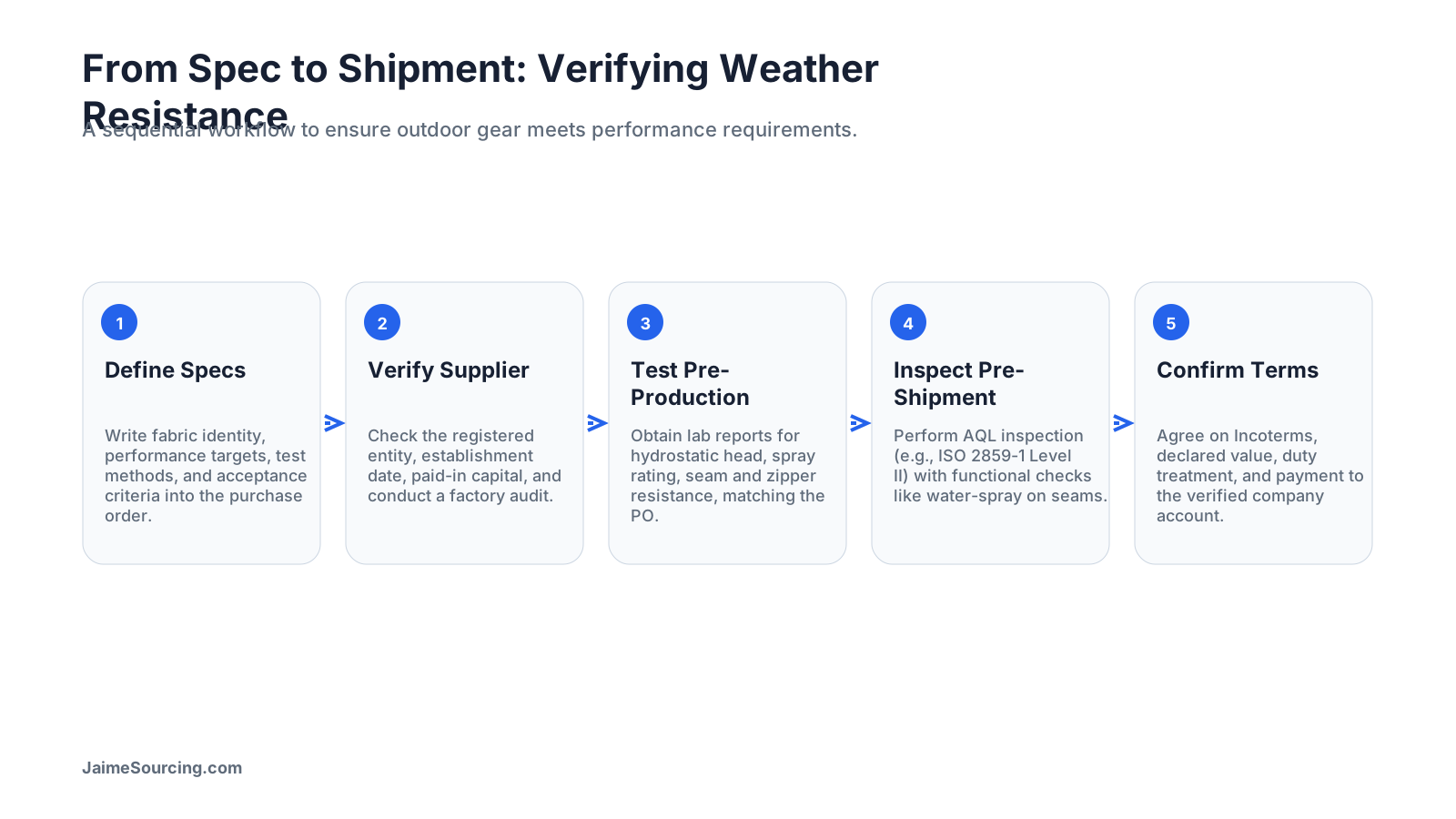
A test only protects you if it is contractual. Build a specification sheet per SKU and attach it to the PO:
- Fabric identity — fiber content, weave, weight (gsm), coating type and colorfastness requirement.
- Performance targets — hydrostatic head, spray rating, seam and zipper requirements, with the test method named.
- Component specs — pole alloy and diameter, zipper brand/type, seam-tape width, DWR finish.
- Test evidence — pre-production lab report plus in-line and pre-shipment checks.
- Acceptance criteria — what happens if a result falls short (rework, replacement, hold shipment).
Ask the supplier to answer in numbers and documents rather than adjectives; a supplier who has neither may not understand or control the production behind the quote. Where a factory subcontracts fabric dyeing, coating or seam taping, name those sub-processes in the spec so responsibility is not lost between vendors.
Factory Verification: Beyond the Showroom Photo
Before you invest in testing, confirm you are dealing with a real production operation. Location is a useful first filter but not proof of what a supplier actually makes. For Chinese companies, check the registered entity in the National Enterprise Credit Information Publicity System, and cross-reference with commercial databases such as Tianyancha or Qichacha. Read these fields carefully:
- Unified Social Credit Code — the company’s unique identifier; confirm it matches the name on the quotation and bank account.
- Establishment date — a very young entity quoting complex technical gear deserves extra scrutiny.
- Registered capital vs. subscribed vs. paid-in capital — registered capital is a declared figure; paid-in capital reflects what shareholders have actually contributed. A high registered figure with minimal paid-in capital tells you little about production capacity.
- Business scope and address — check that the registered address plausibly matches a production line rather than an office, and that the scope covers the goods you are buying.
Then verify capability on the ground: request a factory audit covering production equipment, quality systems, in-house testing and subcontracting. A supplier that cannot explain how it controls coating, seam taping or fabric incoming inspection is a different risk from one that can.
Inspection and AQL: Catching Defects Before They Ship
Lab reports cover materials; inspection covers the finished goods. Use AQL sampling under ISO 2859-1 / ANSI/ASQ Z1.4 at General Inspection Level II, and define defect classes clearly:
- Critical — safety or legal issues (e.g., a child-entrapment hazard, prohibited substances). Commonly set at 0 acceptance.
- Major — functional failures a customer would return the product for (leaking seams, broken zippers, failed pole joints).
- Minor — cosmetic issues that do not affect function (loose threads, minor color variance).
Critical 0 / Major 2.5 / Minor 4.0 is a common starting example, not a universal rule — adjust to your product risk and your marketplace’s expectations. Pair the visual inspection with simple functional checks: a water-spray test on seams and zippers, a pole assembly and stress check, and a hardware pull test. Record results with photos and measurements so you have evidence if a dispute arises.
Landed Cost, Incoterms and Payment Practicalities
Testing and inspection add cost, so budget them into your landed cost from the start. Understand your Incoterms:
- EXW — you take responsibility at the factory gate; you carry origin charges and export clearance.
- FOB — the supplier handles export clearance and loading; you pay freight, insurance and destination costs.
- DDP — the seller delivers duty-paid to your door. Be cautious with “tax-inclusive” DDP arrangements that may under-declare value or use non-compliant routing; you, as importer of record in your market, can carry the compliance risk. Confirm the declared value and duty treatment in writing.
For payments, overseas buyers typically use T/T with a deposit and balance against inspection or shipping documents. Watch bank fees (agree who pays), FX exposure between quote and payment, and platform fees such as Trade Assurance. Pay the company account named on the verified business licence, not a personal account, and agree in advance who absorbs sample and test-sample courier fees.
What to Verify Before You Proceed
- The supplier’s Unified Social Credit Code, establishment date and paid-in capital match the entity quoting and invoicing you.
- A factory audit confirms real production, in-house or third-party testing, and disclosed subcontracting.
- Your PO names fabric specs, performance targets, test methods and acceptance criteria.
- Pre-production lab reports and pre-shipment AQL inspection (ISO 2859-1, Level II) are booked and paid for.
- Incoterm, declared value, duty treatment and payment account are confirmed in writing.
FAQ
How do I test whether a tent fabric is genuinely waterproof?
Ask for a hydrostatic head result in millimetres, the test method used, the lab name and the report date, then verify with a pre-shipment seam and zipper spray test. A number without a method and a document is a claim, not evidence.
Which AQL levels should I use for camping gear?
Most buyers start with Critical 0, Major 2.5 and Minor 4.0 under ISO 2859-1 / ANSI/ASQ Z1.4 General Inspection Level II, then tighten levels for high-risk items. Treat these as a starting point and align them with your product risk and marketplace rules.
Can I rely on a supplier’s own waterproof test report?
Use it as a starting point, not a guarantee. Confirm the lab, method and sample date, and commission independent pre-shipment checks. Supplier reports are most useful when they match the specification you wrote into the PO.
How do I check a Chinese outdoor gear supplier is legitimate?
Look up the company in the National Enterprise Credit Information Publicity System and cross-check with Tianyancha or Qichacha, then commission a factory audit. Confirm the credit code, establishment date, paid-in capital and business scope match what the supplier claims.
What Incoterm is safest for a first outdoor gear order?
FOB is often a practical starting point because it keeps freight and destination costs visible while the supplier handles export clearance. Avoid opaque “tax-inclusive” DDP deals until you have confirmed declared value and duty treatment in writing.
Manage Quality Drift Before It Reaches Your Customers
Outdoor gear fails in weather, load and time — and none of those show up in a warehouse photo. The real risk for an overseas buyer is quality drift between the approved sample and the shipped batch, compounded by factory follow-ups across time zones and the physical distance that makes every problem slower to catch. That is where a ground team helps: Jaime Sourcing supports supplier research, verification, inspection, quality control, consolidation, packing and shipment coordination in China, acting as your eyes on the factory floor. If you are planning an outdoor or camping range, talk to Jaime Sourcing about a supplier check or a workflow review before your next order.
Turn your product and order requirements into a controlled sourcing brief.
Share the product, supplier link, quantity, destination and current order stage. We will identify the practical verification, quality-control, packing and shipping steps.