
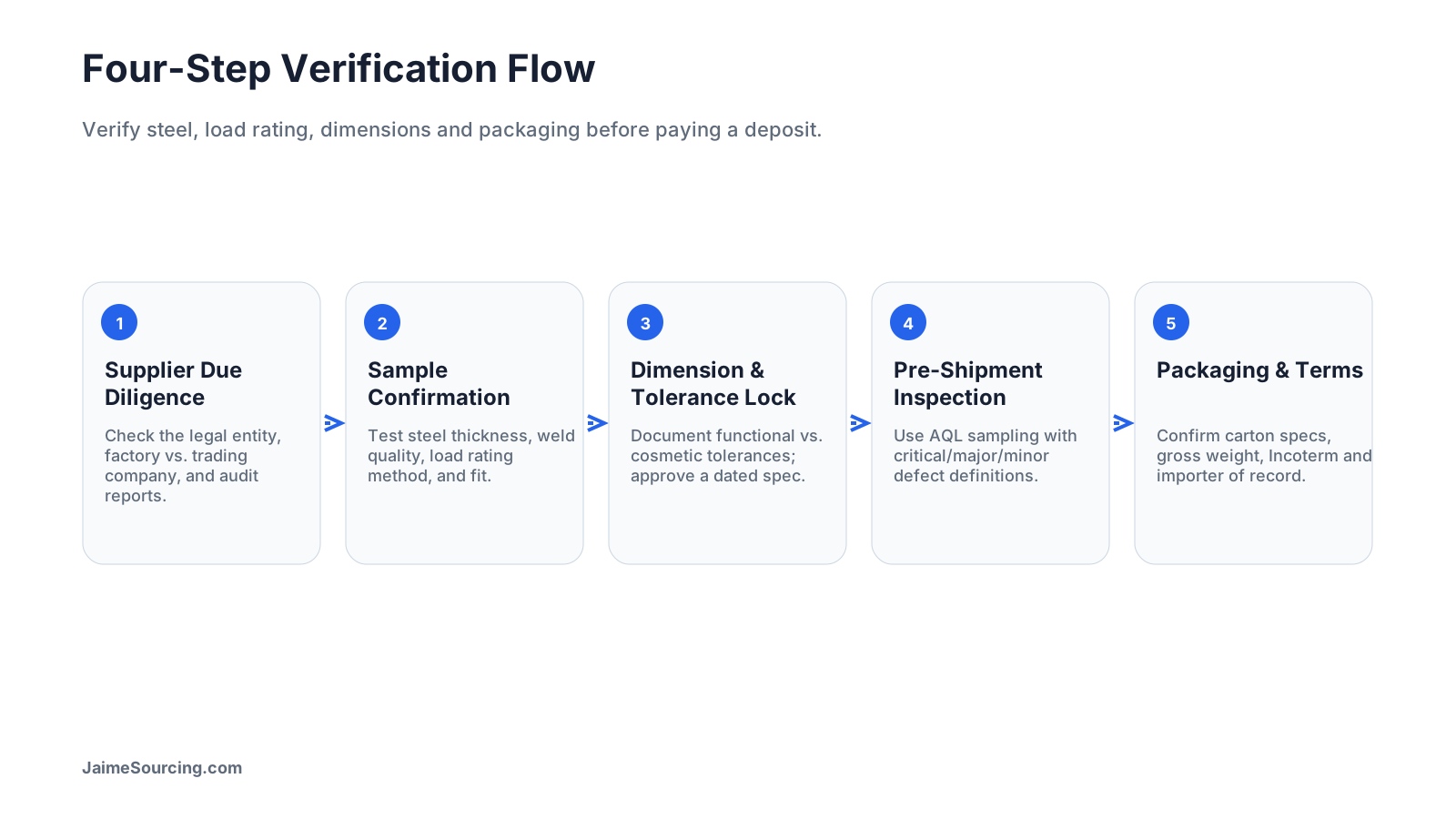
If you are a Shopify reseller or small brand sourcing racks, benches, dumbbell sets or compact cardio machines from China, protect your margin by treating “looks the same” as unverified until proven otherwise. Verify four things in writing and with evidence before you pay a deposit: the steel specification, the load rating and how it was tested, the finished dimensions and tolerances, and the packaging that protects the product in transit. Each can be checked at sample stage and again at pre-shipment inspection, and each should be tied to a dated record you can compare against the next order.
This guide follows the order a real order happens—supplier due diligence, sample confirmation, production checks, packaging and shipping terms—so you can build a repeatable checklist instead of relying on a supplier’s reassurance.
Why “similar-looking” fitness equipment fails in the field
Fitness equipment combines structural steel, moving or adjustable parts, fasteners, surface coating, sometimes electronics, and retail packaging. The most commonly overlooked risk is assuming that two visually similar products share the same structural and use requirements. A rack built from thinner tube, a bench with a different weld schedule, or a frame with looser hole tolerances can pass a photo review and still generate returns.
Manufacturers describe the failure modes themselves: a frame squareness deviation of just 2 mm can stop accessories from fitting, welding spatter trapped under powder coating can cause rust that appears later in use, and a single loose crimp in a motor harness becomes a warranty claim. When tube, sheet metal and assembly come from three different suppliers, each can claim it met its own drawing while nobody owns the finished product. Your verification process exists to close that gap.
Split the product into five modules—structural parts, moving/adjustable parts, electronic parts, accessories, and packaging—and assign a sample confirmation point and a pre-shipment check point to each.
Step 1: Verify the supplier before you verify the product
Before technical questions, confirm who you are dealing with. Chinese companies can be checked through the National Enterprise Credit Information Publicity System, and through commercial databases such as Tianyancha or Qichacha. Look at four fields and understand what each means:
- Unified Social Credit Code — the 18-character identifier that should match the name on the contract, invoice and bank account.
- Establishment date — a very recent registration is not disqualifying, but it changes how much you rely on factory audits versus documents.
- Registered capital — the amount subscribed at registration; it is not cash in the bank.
- Subscribed vs. paid-in capital — subscribed capital is what shareholders committed to contribute; paid-in capital is what has actually been contributed. A large registered figure with little paid-in capital tells you less about financial strength than it appears to.
Also confirm whether the entity quoting you is the manufacturer or a trading company, which processes it performs in-house, and who follows your sample and your bulk order. Ask for a named factory contact, not only a sales representative. If the supplier claims a social-compliance audit such as amfori BSCI, request the report and check the legal entity name and audit date rather than accepting a logo.
Step 2: Pin down steel specification and load rating with evidence
Steel and load are where verbal assurances cost the most. Ask for a specification sheet that states tube outer diameter, wall thickness, material grade and coating system, and compare it against the approved sample. For load-bearing products, ask how the rated load was determined and whether fatigue or performance testing was performed to your specification, with third-party certification testing arranged where your market requires it.
Checks you can run or request:
- Wall thickness — measure at multiple points on the sample with a caliper, including bent sections where thinning can occur. Record the readings with photos.
- Weld quality — inspect for spatter, undercut and incomplete fusion, especially under coating where rust later develops.
- Hole position and frame squareness — check that accessories and attachments actually fit; this is a functional tolerance, not a cosmetic one.
- Coating on friction points — J-hooks and safety arms are common chip points; ask whether plastic pads, UHMW wear parts or plated parts are used where coating would flake.
- Fastener and hardware pack — confirm grade, quantity and that the pack matches the assembly instructions.
A supplier’s static photo cannot demonstrate assembly difficulty, part fit or real handling feel. Assemble the sample yourself following the manual, and log any issue with photos, video, annotations and the exact location so the factory can diagnose the cause.
Step 3: Lock dimensions, tolerances and the order version
Dimension problems usually come from unclear tolerances rather than bad intentions. Manufacturers note that hole positions for uprights and attachments must be tightly controlled for accessory interchangeability, while cosmetic cover lengths do not need the same precision—and that over-tight tolerances on drawings are a hidden cost. Decide with your supplier which dimensions are functional and which are cosmetic, and write both into the approved specification.
For products with adjustment mechanisms, document the locking method, hole positions and operating sequence. For products with electronics, confirm version, power supply, voltage, display language, interfaces and accessory versions for the destination market—do not assume one version suits all regions. Multi-part sets need the assembly instructions and hardware pack checked as part of the same version.
Keep one dated record containing the approved sample, specification changes, quality findings and shipping readiness. Send the same written requirement to the factory, the inspector and your logistics contact so each party confirms its own responsibilities, committed dates and evidence.
Step 4: Inspect with AQL—and know what the numbers mean
Pre-shipment inspection should follow a sampling standard, not a walk around the cartons. The widely used framework is ISO 2859-1 / ANSI/ASQ Z1.4, typically at General Inspection Level II, with defects classified as:
- Critical — a defect that could cause injury or make the product unsafe or illegal to sell; commonly set at 0 acceptance.
- Major — a defect likely to cause failure, return or a functional problem for the user.
- Minor — a cosmetic or non-functional deviation that does not affect use.
A common starting point is Critical 0 / Major 2.5 / Minor 4.0, but this is an example, not a universal rule—your acceptance levels should reflect the product’s risk, price point and channel. Inspection scope for fitness equipment typically covers appearance, packaging, functionality, safety and conformity with applicable standards, and can be scheduled at initial production, during production or at final random inspection, plus container loading supervision. For motorized products, add power consumption or input current checks.
Factory audits and pre-shipment inspections are not substitutes: an audit tells you about the production environment and process controls, while inspection tells you whether this batch matches the approved specification. Define the inspection checklist at sample stage so the future inspection references agreed documents and samples rather than standards invented the week before shipment.
| Verification area | What to request | When to check | Evidence to keep |
|---|---|---|---|
| Steel & tube | Spec sheet with OD, wall thickness, grade, coating | Sample + pre-shipment | Caliper readings, photos, spec sheet |
| Load rating | Test method, rated load, fatigue/performance results | Sample + pre-shipment | Test report, dated record |
| Dimensions & tolerances | Functional vs. cosmetic tolerance list | Sample + pre-shipment | Measured values, approved drawing |
| Assembly & hardware | Manual, fastener list, hardware pack | Sample + pre-shipment | Assembly photos/video, pack count |
| Electronics (if any) | Voltage, plug, language, version | Sample + pre-shipment | Function test record |
| Packaging | Carton spec, drop/compression expectations, label | Sample + pre-shipment | Carton photos, label proof |
Step 5: Verify packaging, carton data and shipping terms
Packaging is a cost and a risk control at the same time. Retail fitness equipment is often shipped partly assembled, and deciding early which parts are pre-assembled in the factory and which fasteners go into the accessory bag directly affects carton volume, freight cost and the number of assembly support queries you receive. Ask for carton dimensions, gross weight and shipping volume before you commit, and pass them to your freight forwarder so the quote reflects reality.
For large metal equipment, request material and anti-rust treatment documentation, and check destination-market requirements—for example, some US states such as California have specific environmental standards for heavy metals that buyers should confirm against the current official rule. For EU or US markets, confirm which conformity documents apply to your specific product and model; certification scope varies by product and destination, so verify with a qualified testing provider rather than assuming a logo covers your item.
On terms, understand what you are buying:
- EXW — you take over at the factory; you carry loading, export clearance and main freight.
- FOB — the supplier handles origin charges and export clearance to the named port; you carry main freight, insurance and import clearance.
- DDP — the seller delivers duty-paid to your door, but “tax-inclusive” DDP arrangements can be structured in ways that do not comply with destination customs rules. Confirm who is the importer of record and that duties and taxes are declared correctly.
For payment, overseas buyers typically use T/T with a deposit and balance before shipment; account for bank fees on both ends, FX exposure between quote and payment, and any platform Trade Assurance fee. Pay the company account named on the contract—not a personal account—and agree in writing who bears sample and courier fees.
What to Verify Before You Proceed
Before releasing a deposit, a sample approval or a shipment, confirm that:
- The contract entity name, Unified Social Credit Code and bank account match.
- The approved sample, specification sheet and tolerance list are dated and versioned.
- Load rating and test method are documented, not verbal.
- The inspection checklist, AQL levels and defect definitions are agreed in writing.
- Carton dimensions, gross weight and packaging spec are confirmed with your forwarder.
- Incoterm, importer of record and duty responsibility are explicit.
If a supplier’s reply and its evidence do not match, pause rather than filling the gap with assumptions.
FAQ
How do I verify steel thickness on a fitness equipment sample from China?
Measure tube wall thickness with a caliper at several points, including bent sections, and photograph each reading against the specification sheet. Compare results with the supplier’s stated outer diameter, wall thickness and grade, and repeat the check at pre-shipment inspection. Verbal claims without measurements should not be accepted as verification.
What does a load rating actually prove on a rack or bench?
A load rating only means something when the test method, sample and acceptance criteria are documented. Ask how the rating was determined and whether fatigue or performance testing was performed to your specification, with third-party testing where your market requires it. Treat a number printed on a listing as a claim until you see the supporting record.
How should I inspect packaging for fitness equipment before shipment?
Confirm carton dimensions, gross weight, label artwork and protection for coated and metal parts, then check a sample carton against that spec. Decide early which parts ship pre-assembled and which fasteners go in the accessory bag, because this changes carton volume and freight cost. Add packaging to the pre-shipment inspection checklist rather than reviewing it only at sample stage.
Do I need a factory audit if I already book pre-shipment inspections?
Yes, they answer different questions. An audit reviews the production environment, process controls and management systems, while inspection confirms whether a specific batch matches the approved specification. For higher-risk structural products, use both and define the inspection checklist at sample stage so it references agreed documents.
Which shipping term should a small Shopify brand choose?
FOB is common for buyers who control their own freight forwarder, while DDP is convenient but requires you to confirm the importer of record and that duties and taxes are properly declared. EXW shifts loading and export clearance to you. Compare total landed cost across all three rather than comparing unit price alone.
Managing quality drift across repeat orders
The real risk in fitness equipment sourcing is not the first order—it is the fourth, when a tube gauge quietly changes, a weld schedule is adjusted, or a carton is downsized to hit a freight target. Physical distance and time-zone friction make those changes hard to catch from a Shopify dashboard, and a supplier’s fast reply is only useful when it maps to a specific version, sample, dimension, document or named person.
That is where a ground team helps. Jaime Sourcing supports overseas buyers with supplier research and verification, inspection and quality control, consolidation, packing and shipment coordination in China—so sample approvals, factory follow-ups and pre-shipment checks happen against the same dated record you approved. If you are planning a fitness equipment order or reviewing an existing supplier workflow, send your product details, target market, quantities and packaging requirements for a supplier check or workflow review.
Turn your product and order requirements into a controlled sourcing brief.
Share the product, supplier link, quantity, destination and current order stage. We will identify the practical verification, quality-control, packing and shipping steps.