For a Shopify reseller planning a custom phone case line, the key point is this: most phone case “tooling” is not a single expensive mold — it is a set of process-specific setup costs (injection molds, print fixtures, UV/heat-transfer jigs, packaging dies) that you should quote separately, prototype in stages, and tie to a device-model roadmap. Your iteration speed depends less on the factory’s machines than on how fast you can approve artwork, confirm device dimensions, and lock a repeatable quality standard. Plan for one paid prototype round per process, budget tooling as a per-SKU line item rather than a one-time fee, and verify the supplier’s registered entity before you pay a deposit.
This guide explains how tooling, sampling and rapid iteration work when you source phone cases and tech accessories from China, and where overseas buyers most often lose money.
Why phone case tooling is not one number
Phone cases are made through several routes, and each has its own setup economics. Thin silicone or TPU shells are typically injection molded; hard polycarbonate shells are also molded; printed designs are applied via UV printing, heat transfer or pad printing; and leather or wallet styles involve cutting dies and stitching fixtures. A patent filing for a “new type of phone case mold” describes injection molding as the core manufacturing method for molded shells, which reflects the general industry pattern rather than any specific supplier’s capability.
When a supplier quotes you a “mold fee,” ask which mold. An injection mold for a shell body is a durable steel tool. A UV printing fixture or a heat-transfer jig is a cheaper, shorter-life setup. A packaging die or a foil-stamping plate is cheaper still. Mixing these into one lump sum makes it impossible to compare suppliers or to know what you actually own.
Phone cases are also model-specific. Every new device release creates a new size and camera-cutout geometry, and buyers replace phones on a roughly two-to-two-and-a-half-year cycle. Your tooling is therefore not a one-time capital cost but a recurring cost tied to your device-model roadmap. Budget per model, not per brand.
The prototype ladder: what to sample and in what order
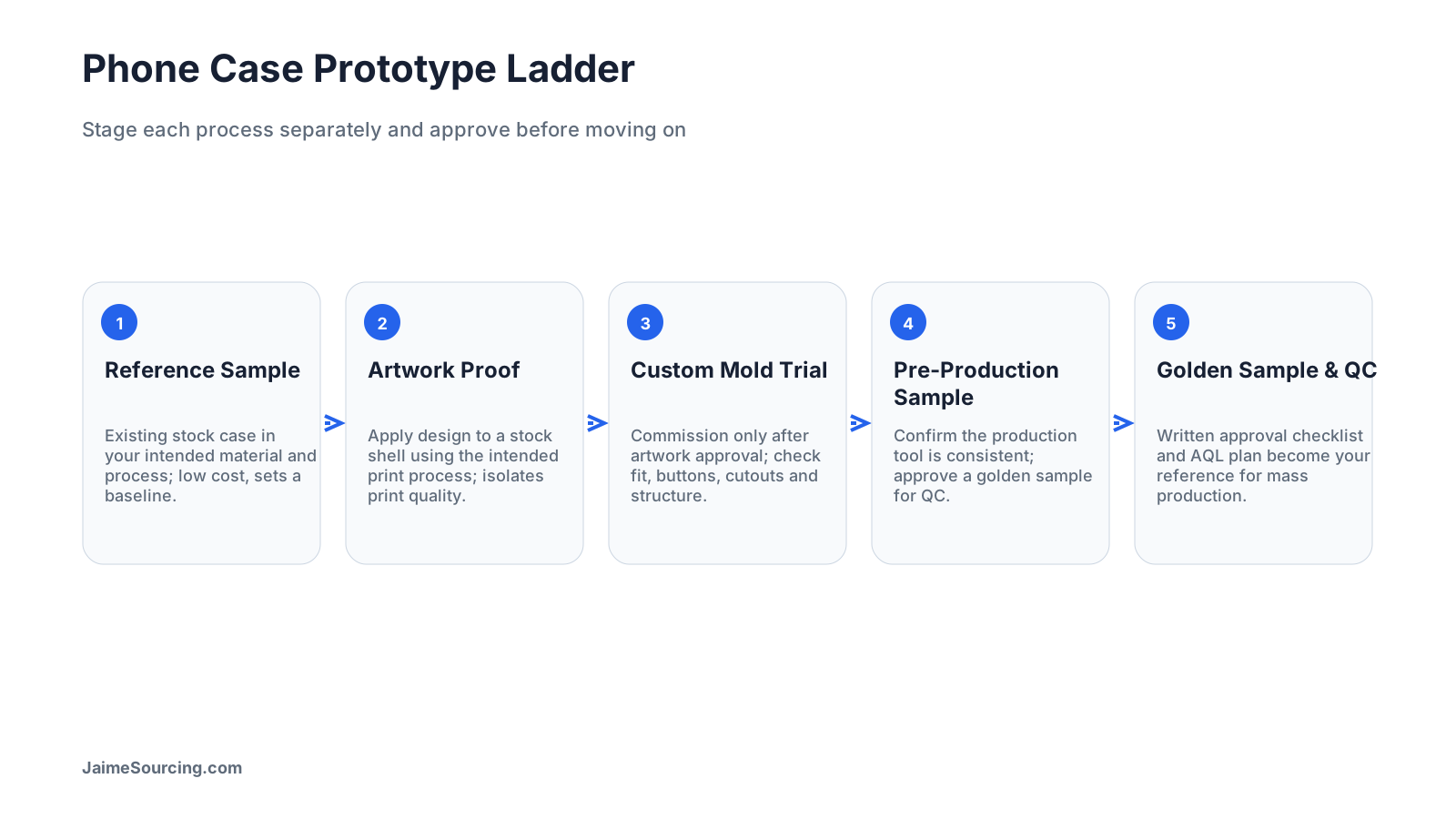
Do not jump from a design file to a production mold. Use a staged prototype ladder so each round tests one variable.
Stage 1 — Reference sample (off-the-shelf). Ask the supplier to send an existing stock case in the same material and process family you intend to use. This costs little and tells you whether their baseline molding, fit and finish are acceptable. It also gives you a physical benchmark for later rounds.
Stage 2 — Artwork proof on a stock shell. Apply your design to an existing shell using the intended print process. This isolates print quality — color accuracy, edge sharpness, adhesion, wrap-around coverage — from mold quality. Not every supplier prints on the sides of a case; many print only the back, so confirm coverage before design approval.
Stage 3 — Custom mold or fixture trial. Only after artwork and baseline quality are approved should you commission the custom tool. Sample from the trial shot and check fit on a real device, button responsiveness, camera and port alignment, and drop-relevant structural weak points.
Stage 4 — Pre-production sample from the production tool. Confirm the tool produces consistent parts, then approve a golden sample that becomes your QC reference.
Industry guidance on phone case sampling describes it as a full chain — material selection, process matching, testing and verification — where difficulty, lead time and cost differ sharply by process route. Treat each stage as a paid, documented milestone with written approval before the next begins.
Tooling cost drivers and how to structure the quote
Ask for a quote broken into these lines, per SKU:
| Cost line | What it covers | Ownership question to ask |
|---|---|---|
| Shell mold (injection) | Steel tool for the case body | Who owns the tool? Can it be transferred? |
| Print fixture / jig | UV, heat-transfer or pad-print setup | Is it reusable across designs on the same shell? |
| Artwork setup | File prep, color separation, proofing | Is re-setup charged per repeat order? |
| Packaging die / plate | Custom box, sleeve or insert | One-time or per-run? |
| Sample charges | Materials, labor, courier | Credited against the bulk order? |
| Tooling maintenance | Wear parts, re-polishing | Included or billed separately? |
Two negotiation points matter more than the headline number. First, tool ownership and transferability — if you switch suppliers, can the mold leave with you? Get this in writing. Second, amortization — some suppliers reduce or waive tooling on a committed volume; confirm whether that is a discount or a conditional credit with clawback terms.
Be skeptical of a single all-in “mold fee” that is very low. It usually means the supplier is amortizing hidden costs into unit price, or that the “mold” is a soft tool with a short production life.
Fast iteration: how to compress the loop without cutting corners
Speed in phone case sourcing comes from parallel work and pre-agreed standards, not from skipping samples.
Lock your device-model list first. Because each model needs its own geometry, decide which models you will support before tooling. A tight launch list of high-volume models beats a broad, thin catalogue.
Approve artwork digitally, then physically. Use a 300 dpi file standard and preview the design on a case mockup before committing to a physical proof — standard practice in print-on-demand workflows that applies equally to bulk custom production. Digital approval removes one courier round.
Run design variants on one shell. If your print fixture is reusable, you can iterate artwork across multiple designs on the same molded shell without new tooling. This is the single biggest lever for fast iteration: separate shell tooling from design iteration.
Set a written approval checklist. Fit, print color against a physical reference (not a screen), adhesion after a simple rub/tape test, cutout alignment, and packaging condition. Approve against the same checklist every round so “approved” means the same thing each time.
Batch your sample shipments. Consolidating samples from multiple suppliers or SKUs into one courier shipment reduces cost and time — plan this into your calendar.
Low barriers to entry mean intense competition, so speed to a good-enough, well-documented product often beats speed to a perfect one.
Verifying the supplier behind the mold
Before you pay tooling, verify the legal entity, not just the sales contact. Use the Chinese National Enterprise Credit Information Publicity System (the official registry) as your primary check, and Tianyancha or Qichacha as secondary commercial databases for cross-reference.
Check these fields and understand what each means:
- Unified Social Credit Code — the 18-character identifier. Confirm it matches the name on the proforma invoice and the bank account.
- Establishment date — a very recently registered company may be a trading intermediary rather than a factory. That is not automatically disqualifying, but you should know which you are dealing with.
- Registered capital vs. subscribed vs. paid-in capital — registered capital is a declared figure; subscribed is what shareholders committed; paid-in is what has actually been contributed. A high registered capital with low paid-in capital tells you the balance sheet is thinner than the headline suggests.
- Business scope — confirm it covers the relevant manufacturing or trading activity.
- Abnormal operations / legal proceedings — check for listings that suggest instability.
Also ask for a live video walkthrough of the production line and confirm the actual factory name that will make your goods. If the entity on the credit report differs from the factory name, ask for the relationship in writing.
Quality control: AQL, defect classes and the golden sample
For pre-shipment inspection, the common framework is ISO 2859-1 / ANSI/ASQ Z1.4, sampling at General Inspection Level II. Define defect classes explicitly:
- Critical — safety or legal issues (e.g., a case that obstructs a camera in a way that creates a privacy or legal problem; note that covert camera cases have attracted regulatory and media scrutiny ). Critical defects are typically zero tolerance.
- Major — functional or customer-visible failures: wrong model fit, print misalignment, peeling, cracked shell, wrong colorway.
- Minor — cosmetic issues unlikely to trigger a return: faint surface marks, slight shade variation within tolerance.
A common starting point is Critical 0 / Major 2.5 / Minor 4.0, but this is an example, not a universal rule — set your AQL based on price point, channel and return tolerance, and write it into the PO. Pair the AQL plan with the approved golden sample so the inspector has a physical reference, and specify the inspection stage (during production vs. pre-shipment).
Landed cost, Incoterms and paying a Chinese supplier
Distinguish the Incoterms clearly:
- EXW — you take responsibility from the factory door; you arrange export clearance and main freight. Cheapest on paper, most work for you.
- FOB — supplier handles export clearance and delivery to the named port; you pay origin charges beyond that and main freight. Origin charges (THC, documentation, handling) are frequently underestimated.
- DDP — supplier delivers duty-paid to your door. Convenient, but be careful: some “tax-inclusive DDP” arrangements under-declare value or use non-compliant routing. As the importer of record in your jurisdiction, you carry the compliance risk. Check the current official customs rules for your country (US CBP, HMRC, EU customs authorities, CBSA, or Australian Border Force) rather than relying on the supplier’s assurance.
On payment: overseas buyers typically pay Chinese suppliers by T/T. Expect bank charges on both ends — clarify who absorbs them. Watch FX exposure if you are quoted in USD but the supplier’s costs are in RMB. If you use a platform’s Trade Assurance, understand the fee and the dispute process. Pay the company account matching the verified entity, not a personal account, unless you have documented the reason. For samples, agree in advance whether sample and courier fees are credited against the bulk order.
What to Verify Before You Proceed
- Entity match: Unified Social Credit Code on the credit report matches the invoice, contract and bank account.
- Factory identity: the actual production site name is confirmed, ideally by live video.
- Tool ownership: written confirmation of who owns each mold and fixture, and whether it is transferable.
- Quote breakdown: tooling, setup, samples and packaging are itemized separately, with amortization terms stated.
- Golden sample: a signed, physically approved reference exists before mass production.
- AQL plan: defect classes and sampling level are written into the PO.
- Incoterm and duty: the term is explicit and DDP compliance is checked against your jurisdiction’s official rules.
- Payment terms: T/T schedule, bank fee allocation and sample-fee credit are documented.
FAQ
How much does a phone case mold cost in China?
Tooling cost varies too widely by process, material and supplier to quote a reliable figure here. Request itemized quotes for shell mold, print fixture, artwork setup and packaging die separately, then compare like for like. Treat any single all-in “mold fee” as a prompt to ask what is included and who owns the tool.
How long does phone case prototyping take?
Timelines depend on process route and how fast you approve artwork and dimensions. Digital artwork approval and reusable print fixtures compress the loop; new shell molds and physical courier rounds add time. Ask each supplier for a stage-by-stage schedule and hold them to written milestones rather than a single delivery date.
Can I iterate designs without paying for a new mold each time?
Often yes, if your print fixture is reusable across designs on the same molded shell. Separate shell tooling from design iteration in your contract so artwork changes do not trigger new mold charges. Confirm this in writing before you commit to tooling.
Do I need a different mold for every phone model?
Generally yes for the shell body, because each device has its own dimensions and cutout geometry. This is why a tight launch list of high-volume models is more capital-efficient than a broad catalogue. Plan tooling per model as part of your roadmap budget.
What should I check before paying a tooling deposit?
Verify the legal entity via the National Enterprise Credit Information Publicity System and cross-check on Tianyancha or Qichacha, confirm the factory name, and get tool ownership and amortization terms in writing. Also confirm the bank account matches the verified company. Paying a deposit to an unverified entity is the most common avoidable loss.
Manage the distance, not just the order
Tooling and prototypes are where quality drift starts: a mold wears, a print fixture shifts, a substitute material appears on reorder — and you are thousands of miles and several time zones away from the line. The real risk in sourcing phone cases from China is not the first sample; it is the fifth reorder.
Jaime Sourcing acts as your ground team in China, covering supplier research and verification, inspection and quality control, consolidation, packing and shipment coordination. If you are planning a phone case line or want a second opinion on a tooling quote, talk to Jaime Sourcing for a supplier check or a workflow review before you commit a deposit.
Turn your product and order requirements into a controlled sourcing brief.
Share the product, supplier link, quantity, destination and current order stage. We will identify the practical verification, quality-control, packing and shipping steps.