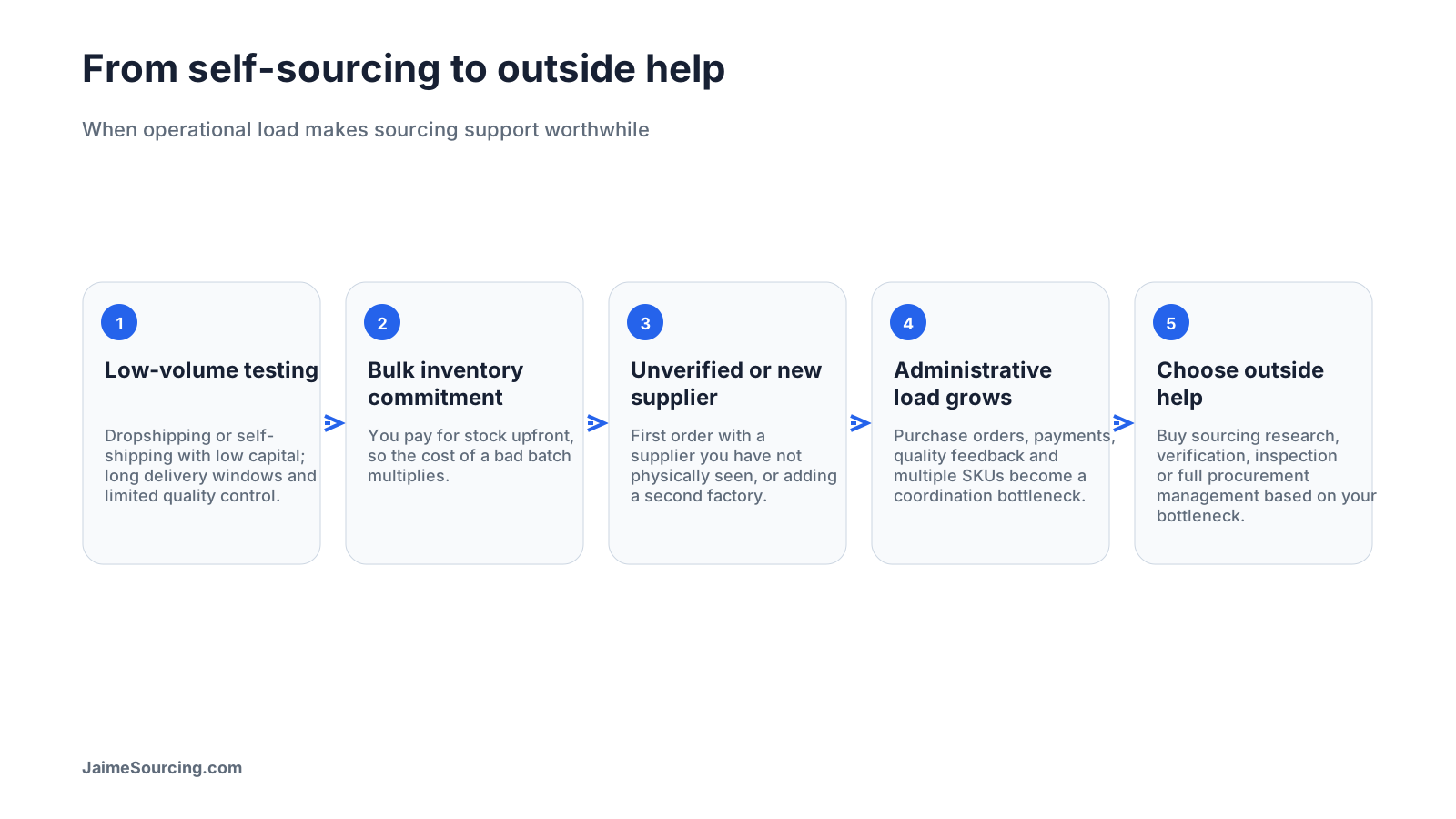
Outside sourcing help pays for itself when a mistake in China costs more than the help does. That threshold arrives at four moments: you move from dropshipping to stocked inventory, you place a first bulk order with a supplier you have never physically seen, you add a second product or factory, or your order volume outgrows the hours you can spend chasing suppliers across time zones. Below the threshold, self-sourcing is usually fine. Above it, supplier verification, pre-shipment inspection or full procurement management becomes the cheapest insurance in your cost stack.
This guide is written for overseas buyers and Shopify resellers, not for mainland exporters. It covers the operational tradeoffs, the verification steps that catch problems, and how to decide between hiring a sourcing agent, booking inspections only, or handing over end-to-end procurement management.
The Four Trigger Points for Outside Sourcing Help
Most sellers do not need a sourcing partner on day one. Dropshipping and low-volume self-shipping from China are low-capital testing modes, with the tradeoff being long delivery windows (roughly 15–40 days for dropshipping) and limited quality control. That is a rational way to validate demand. The question is when the model stops fitting.
Trigger 1: You commit to bulk inventory. Once you move to a virtual overseas warehouse or a true overseas warehouse, you pay for stock upfront, and the cost of a bad batch multiplies. The Shopify fulfillment guidance frames this as a stage-based progression: test with dropshipping or self-shipping at 0–5 orders/day, then transition as volume grows. The moment you wire a deposit for hundreds or thousands of units, a factory visit or third-party inspection costs a fraction of one defective container.
Trigger 2: First order with an unverified supplier. Cross-border supply chains are longer, involve export and import clearance, and carry compliance obligations in two or more jurisdictions. A supplier who looks credible on a marketplace profile may be a trading company, a shell, or a factory with capacity problems. Verification is cheapest before money moves.
Trigger 3: Product or supplier diversification. Sourcing guidance is consistent that relying on a single supplier is a structural risk: if that supplier runs short on capacity, raises material prices, delays delivery, or ships a batch with serious quality problems, the whole chain is affected. Adding a second supplier is the standard mitigation, but each new supplier is a new unknown that needs checking.
Trigger 4: Administrative load exceeds your capacity. Purchase orders, payment terms, supplier currency, and quality feedback all need to be tracked and documented. With several suppliers, multiple SKUs and seasonal peaks, the coordination work itself becomes a bottleneck — before time-zone friction is even counted.
Sourcing Agent vs. Verification-Only vs. Full Procurement Management
These are not competing products; they are different depths of involvement. Choose based on what you can reliably do yourself.
| Service depth | What it typically covers | Best fit when | Main tradeoff |
|---|---|---|---|
| Sourcing / supplier research | Finding and shortlisting factories, comparing quotes and terms | You have a product idea but no supplier pipeline | You still own negotiation and order management |
| Supplier verification | Checking the legal entity, ownership, capital and operating status | You have a shortlist and need to eliminate fakes or shells | Verification confirms the entity, not the quality of a specific batch |
| Pre-shipment inspection | Physical QC against your spec before balance payment and shipping | You have a PO in production and need evidence before release | Sampling finds defects probabilistically, not with certainty |
| Full procurement management | Supplier research, verification, follow-up, inspection, consolidation, packing and shipment coordination | You are scaling SKUs and cannot manage factories remotely | Higher service cost; you delegate day-to-day control |
A useful rule: if your bottleneck is finding suppliers, buy sourcing research. If it is trust, buy verification. If it is proof, buy inspection. If it is time, buy procurement management.
How to Verify a Chinese Supplier Before You Pay a Deposit
Supplier verification has two layers: the legal entity and the physical operation. Do both, in that order.
Layer 1 — the legal entity. Chinese companies can be checked through the National Enterprise Credit Information Publicity System, and commercially through Tianyancha or Qichacha. Look at:
- Unified Social Credit Code — the 18-character identifier. Confirm it matches the code on the supplier’s business license and invoices. A mismatch between the quoted company name and the code is a red flag.
- Establishment date — a company registered a few months ago may be a trading intermediary or a newly spun-up entity. Age alone is not disqualifying, but it changes how much you verify.
- Registered capital vs. subscribed vs. paid-in capital — registered capital is an authorized figure, subscribed capital is what shareholders committed to contribute, and paid-in capital is what has actually been paid in. A high registered capital with minimal paid-in capital tells you far less about financial strength than the headline number suggests. Treat registered capital as a disclosure item, not a credit score.
- Business scope and status — check that the scope covers manufacturing or trading of your product category, and that the company is in normal operating status rather than abnormal or revoked.
- Shareholders and legal representative — cross-check names against the person you are emailing. If your “factory contact” is not connected to the registered entity, ask why.
Layer 2 — the physical operation. Entity checks cannot tell you whether the factory can make your product to spec. Ask for a live video walkthrough, request photos of the production line and existing orders, and — for meaningful order values — commission a physical factory audit or at minimum a third-party verification visit. If a supplier refuses any form of physical verification, that refusal is itself information.
When to Book Inspection, and How AQL Actually Works
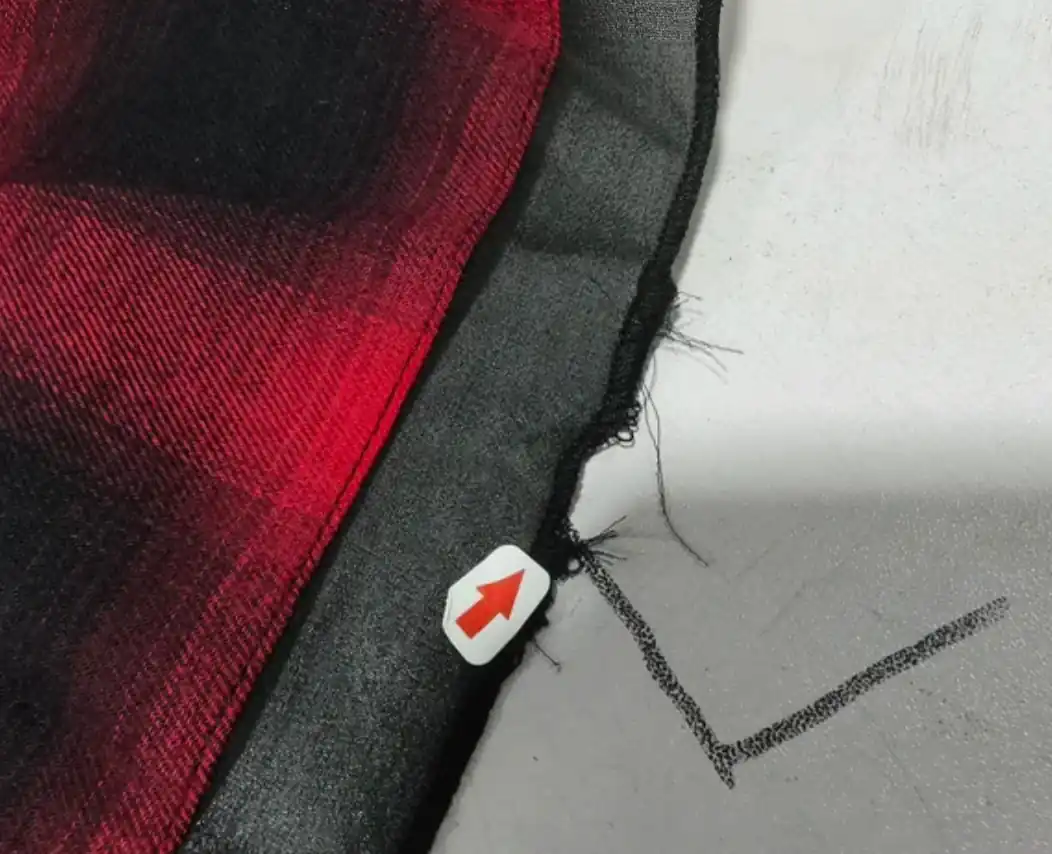
Book a pre-shipment inspection when the order value justifies it and the goods are finished but not yet packed, or packed but not yet shipped — early enough that defects can still be reworked or the balance payment withheld.
Most inspections use AQL sampling under ISO 2859-1 / ANSI/ASQ Z1.4, commonly at General Inspection Level II. The inspector draws a random sample sized by your lot size, then classifies defects:
- Critical — safety or legal issues (e.g., a hazard, prohibited substance, or a defect that could injure a user). Buyers commonly set Critical at 0.
- Major — defects that make the product unsellable or functionally defective.
- Minor — cosmetic or tolerance deviations that do not affect function or safety.
A widely used starting point is Critical 0 / Major 2.5 / Minor 4.0. This is a common example, not a universal rule — tighten or loosen it based on your product, price point and brand risk. A $5 accessory and a $200 electrical appliance should not share the same defect thresholds.
Two practical cautions. First, AQL is statistical: passing a sample does not guarantee zero defects in the lot. Second, the inspection is only as good as your spec. If you have not written down dimensions, materials, colors, packaging and labeling requirements, the inspector has nothing objective to measure against. Build a simple spec sheet and a golden sample before the first production run.
Landed Cost, Incoterms and Payment Mechanics You Must Control
Sourcing decisions are cost decisions, and the cost that matters is landed cost — not unit price.
Incoterms. Under EXW, the supplier’s obligation ends at their premises; you carry origin pickup, export clearance and everything after. Under FOB, the supplier delivers to the named port and handles export clearance, while you pay main freight, insurance and destination charges. Under DDP, the seller quotes a delivered, duty-paid price — convenient, but the party arranging import is responsible for compliant declaration and duty payment. Be cautious with “tax-inclusive” DDP quotes that do not clearly state who is the importer of record and how duty and VAT are declared; non-compliant arrangements can surface later as customs issues. For EU-bound sales, tax and customs obligations vary by region and may require registrations such as IOSS depending on your setup — confirm the current official rule for your destination.
Payments. Overseas buyers paying Chinese suppliers typically use T/T, often a deposit plus balance before shipment. Budget for bank fees on both ends (they are frequently deducted from the received amount, so the supplier receives less than you sent), and for FX exposure between quote and payment. If you pay through a platform’s Trade Assurance-style protection, understand the fee and what it actually covers. Pay the corporate account named on the business license, not a personal account, unless you have documented why — personal-account payments weaken your evidence trail if a dispute arises. For samples, agree in advance who absorbs the sample cost and the courier fee, and whether the sample fee is credited against the bulk order.
Consolidation. If you buy from several suppliers, consolidating at a China warehouse before international shipping can reduce freight and simplify tracking, but it adds handling time and requires clear labeling so cartons are not mixed up.
What to Verify Before You Proceed
Run this checklist before any deposit leaves your account:
- Entity match — Unified Social Credit Code on the license matches the quotation, invoice and bank account name.
- Capital reality — you have read registered, subscribed and paid-in capital and understand what each does and does not tell you.
- Operating status — company is active, business scope covers your category, and the contact is traceable to the entity.
- Physical evidence — live video walkthrough or third-party visit completed; refusal documented.
- Written spec and golden sample — signed off before production, with tolerances stated.
- Inspection plan — AQL levels, defect definitions and inspection timing agreed in writing.
- Incoterm and importer of record — named explicitly, with duty/VAT responsibility clear.
- Payment terms — deposit percentage, balance trigger, bank fees and FX responsibility agreed.
- Compliance check — destination-market requirements for your product confirmed against current official rules for the specific jurisdiction.
FAQ
Do I need a sourcing agent if I only order a few hundred units?
Usually not for the first small order, provided you verify the supplier entity and book at least one inspection. At low volume, a verification check plus a pre-shipment inspection often delivers most of the risk reduction for far less than full procurement management.
Is supplier verification the same as a factory audit?
No. Verification confirms the legal entity, ownership, capital and operating status; a factory audit assesses physical capability, processes and quality systems. Entity checks are cheap and fast, but they cannot tell you whether the factory can actually build your product to specification.
How do I decide between FOB and DDP?
Choose FOB when you want control over freight, insurance and customs and have a forwarder you trust. Choose DDP for simplicity, but insist on written clarity about who is the importer of record and how duty and VAT are declared, because vague “tax-inclusive” quotes can create compliance exposure later.
Can an inspection guarantee my order has no defects?
No. AQL sampling under ISO 2859-1 / ANSI/ASQ Z1.4 estimates defect rates probabilistically; a passing result reduces risk but does not eliminate it. The inspection is only as reliable as the written specification and golden sample you give the inspector to measure against.
When does full procurement management make sense?
When coordination, not product knowledge, is your bottleneck: multiple suppliers, several SKUs, seasonal peaks and repeated factory follow-ups across time zones. At that point, delegating supplier research, verification, inspection, consolidation and shipment coordination usually costs less than the margin lost to delays and quality drift.
The Real Risk Is Drift, Not the First Order
Most sourcing failures are not dramatic. They are gradual: the second batch uses slightly thinner material, the third shipment slips two weeks, the packaging label changes without notice, and nobody on your side is close enough to notice until customers complain. Cross-border chains are long, involve multiple clearance stages, and are exposed to transport disruption and policy shifts that are hard to predict. Distance and time zones make every follow-up slower, and quality drift is exactly the kind of problem that hides between inspections.
That is the gap a ground team closes. Jaime Sourcing supports overseas buyers with supplier research, supplier verification, inspection, quality control, consolidation, packing and shipment coordination in China — the physical, on-the-ground work that is difficult to run from another continent. If you are unsure whether you need verification only, inspection only, or a fuller procurement workflow, talk to Jaime Sourcing for a supplier check or a workflow review before your next deposit.
Turn your product and order requirements into a controlled sourcing brief.
Share the product, supplier link, quantity, destination and current order stage. We will identify the practical verification, quality-control, packing and shipping steps.